"THE" patch kit for decades now. Hard to write a review on such a well-known classic. So I'll just add to the admittedly meager instructions. 1) find the puncture in your tube, usually by inflating and either feeling for escaping air, or listening, or dunking under water (the tube - not you). 2) examine the inside of the tire to be sure whatever punctured your tube isn't still there. Remove anything pointy sticking through the tire. 3) scuff the tube in an area around the puncture slightly larger than the patch you'll be using with the included abrasive square (or a spare piece of sandpaper). This is to get rid of the molding release stuff and any talcum on the surface of the tube. 4) apply a thin layer of cement around the puncture, again, slightly larger than the patch you'll be using 5) Wait - but you don't have to wait too long, just until the cement is no longer shiny. Once the cement is dry and dull you can... 6) Peel the foil backing off the patch and apply. 7) Push down quite FIRMLY all over the patch - I use the rounded end of my pump with the tube lying on a hard flat surface. This is important. It's called stitching and failure to do this step results in patch separation. 8) Optional: remove the clear plastic backing film. If you try to pull it from the outside edges, you're likely to pull up the feathered edges of the patch. Not good. Fortunately, although Rema doesn't document it very well, if at all, the film has an almost invisible slit in the middle. Stretch the patch very slightly and you should see that slit. Peel from the center of the slit toward the outside edge of the patch. Or leave the plastic film on - it doesn't seem to hurt anything. 9) Install, inflate and ride. I've never had one fail, and, like I said, I've been using these for decades.
I can confidently say this is the only bike patch you should be using on your tubes. Easy to use. 1. Buff where your puncture is with provided sand paper 2. Blow/wipe off debris from area “you can use some rubbing alcohol if you have it” 3. Apply rubber cement on the surface around and over the puncture “let dry if you used alcohol to clean area off” 4. Let rubber cement dry 5. Once dried peel off foil back and apply patch orange side down over puncture. 6. Firmly apply pressure evenly to patch for 30 seconds. 7. Peel off the clear film from the black side of patch carefully. If you are too rough you might begin to pull the edge of the patch up. 8. Enjoy your patch tube and money $$$ saved by not buying a new one. Some people have rules on how many times they will patch a tire, I have heard many say 8 patches and then get a new tube.. you could do more or less.. the two main rules I follow is no patches by your valve stem, or if the new puncture is within one inch of an existing patch. If I was on the road I would patch the tube to get home/car and then replace the tube before my next ride.. however these patches are so awesome you might be able to just keep using the tube even if a puncture happens on one of these two points
These are the best patches I've used so far. I wish I could find the patches and glue in bulk for a better price (maybe I can, I haven't looked). The patches separate from the foil backing easily. It's a little harder to remove the plastic backing, but only if you, like me, are too impatient to let the patch adhere completely. After applying the patch and reinstalling my 700x25 road tire and waiting a day, the patch had completely integrated with the original tube's rubber (in this case, a Slime tube). No seams anywhere. In comparison, I've used: The park tool patch kit - Almost as good but I give the edge to these, though the park patches are cheaper Cheap bulk chinese patches - They work okay but are hard to remove from the foil backing, don't integrate with the tube, come in too large a size and come with really bad rubber cement that tends to squirt out everywhere The Zefal patch kit - the levers in the kit are fine but the rubber cement is so-so and the patches are the worst of the worst. They don't come off the foil (the orange part tears sticks, tears and becomes useless) and they don't integrate with the rubber. Heck, I've only managed to get one patch from the whole set to apply at all, and it came loose after a couple of rides.
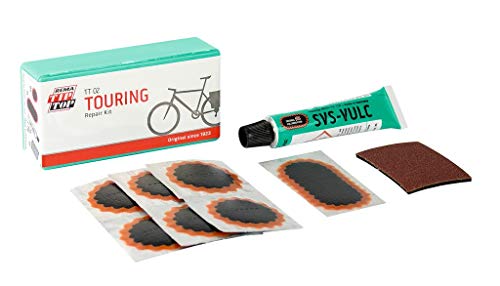
This is pretty much the gold standard of bicycle tube patching. I picked up 8 boxes to minimize the shipping charge per box (8 boxes had the same charge as 1 box). I like the smaller tubes of glue so that you can sit down and patch 7 tubes all at once and not have to worry about the freshness of the glue. If you have been frustrated in the past with patches that get funky over time in your bike bag, or if your patches do not always hold, you will probably like these patches. The box is rigid plastic that holds up well in a bike bag. The patches themselves are thick enough for most of the area to keep the bond with the tire and they taper down to a very thin scalloped edge that fuzed very nicely with the tube and is unlikely to get pulled up by anything (except maybe your own effort to remove the thin clear plastic backing. I have started to just leave that on the patch. It does not seem to do any harm doing so. But if you must remove it, first try one corner carefully, and if it looks like it is pulling on the patch, just try a different corner) I have found that thicker edges tend to catch and break loose from the tire. They stretch nicely with the tire. Much more so than my old method of using a piece cut out of an old inner tube. You can see this in action when you pump up a tire with a patch looking for another hole. A word about "vulcanizing" fluid. I found a lot of discussion out there (without much support) as to how much Rema's $10 formula differs from Elmer's $2 Rubber Cement I had been using all these years. Then I read, "If you use Elmer's, you will find that, one month later, you can pull the patch off, but with the TipTop vulcanizing fluid, you cannot". However it was stated in a fashion that led me to believe that he did not actually test that theory. So I decided to try. Result? After 80 miles, the patch certainly looked chemically fuzed to the tube and it took a lot of effort to get an edge up (more effort than my patches of the past), however I WAS able to separate it from the tire as if there never was a patch, so it did not truly become one with the rubber of the tube. However the entire patch and especially the all important edges DID look like no air would ever escape. In the end however, I like the small sealed tubes and I just feel more confident in my patch using the fluid provided by Rema as there is a good possibility that the formula they use bonds better to the chemicals on their patches. The real proof however is in this statement: This are the only patches I have tried that have never, not once, leaked again. My tubes have an average of 4 of these per tube and I feel secure continuing to use these tubes, which has never been true before I switched to these patches. I have never tried them on a long tear or a leaking stem however (obviously). When that happens, I just throw the tube away.
Perfect little kit for your saddle bag. Emphasis on little as it's slightly bigger than a few stacked wooden match books. Shortly after purchasing, I got a pinch flat after hitting a nasty bump on my road bike. Without any tubes, I busted out this little gem and was able to successfully patch my tube. I rode the remaining 10 miles with no incident. For those who say these don't work, then they are doing it wrong (scuff area and wait for the cement to dry before applying patch). The instructions included are basic on how to use it and for that, id recommended watching a you tube video on how to properly patch a tube. This is cheap, and saves you from walking the miles home/bike store so just get one!
Other than tire irons and a pump, this is all you need to get you back to your starting point when you get a flat. I have never had one of these patches leak on me - I was surprised to find that the last patch I had to apply showed me that the inner tube had been repaired once already. Can't recall how long its been there. Although Park is not bad, I prefer these. Small, easy to carry case is much smaller and lighter than carrying a spare inner tube. Wish they sold small tubes of Vulcanizing Fluid as once opened their storage life seems short.
I was bike touring on the Erie Canal Trail when I discovered a flat rear tire. Pulled out the tube, pumped it up, and found. Tiny pinhole causing the leak. The Rema kit saved the day. Important note: make sure the adhesive is spread wide enough for the patch to contact it edge-to-edge. I made the mistake with the first patch of spreading on a small area, and the patch’s edges didn’t stick, causing the patch to start pulling loose. Second try was a charm. Rode another 110 miles before coming home. Tire is still firm.
These are the first bike patches I have ever purchased and used. So far I have needed to use them once and they work very well. After putting on the patch it held for the final 7 miles of my ride. They also held for about a week while my bike was hanging in the garage. After that I replaced the tire. I just don't trust a patch enough to go on a new ride with it. In order to use these patches you need to deflate your tire, use the small piece of emery paper to flatten the area around the puncture. Next apply the cement solution. Allow it time to dry completely. You can blow on it to speed the process. Make sure you sand and glue an area that is slightly bigger than the patch. This will allow for the best adherence. I noticed that the very edge that I didn't glue or sand did not stick very well but the parts that were prepped well were solid.
I haven't repaired a bike flat since I was a kid, and this takes me right back there again. I was a bit dubious about the kits with self adhesive patches, so this old school kit was just the ticket. Seems to me the rubber cement is better than I remember from 40 years ago - dries quicker and more evenly. Or maybe I just have more patience now?
I have to admit that I had a fling with the self-adhesive patches. After a number of failures, I am back with the glue on patches like this. At least now when I get a flat tire (and I have been getting altogether too many), the hole is new and not the result of a patch failure. These patches have never failed for me. One note: It is important to put the glue on the tire, and to let it dry for five minutes (or until it is completely dry). Also, patches have a metal base on the sticky side that must be removed before applying the patch. On the other side of the patch is a clear plastic wrap. That wrap may be left on the patch on the tire, since removing the plastic may pull of the patch.


Tosin Johnson
Old reliable
"THE" patch kit for decades now. Hard to write a review on such a well-known classic. So I'll just add to the admittedly meager instructions. 1) find the puncture in your tube, usually by inflating and either feeling for escaping air, or listening, or dunking under water (the tube - not you). 2) examine the inside of the tire to be sure whatever punctured your tube isn't still there. Remove anything pointy sticking through the tire. 3) scuff the tube in an area around the puncture slightly larger than the patch you'll be using with the included abrasive square (or a spare piece of sandpaper). This is to get rid of the molding release stuff and any talcum on the surface of the tube. 4) apply a thin layer of cement around the puncture, again, slightly larger than the patch you'll be using 5) Wait - but you don't have to wait too long, just until the cement is no longer shiny. Once the cement is dry and dull you can... 6) Peel the foil backing off the patch and apply. 7) Push down quite FIRMLY all over the patch - I use the rounded end of my pump with the tube lying on a hard flat surface. This is important. It's called stitching and failure to do this step results in patch separation. 8) Optional: remove the clear plastic backing film. If you try to pull it from the outside edges, you're likely to pull up the feathered edges of the patch. Not good. Fortunately, although Rema doesn't document it very well, if at all, the film has an almost invisible slit in the middle. Stretch the patch very slightly and you should see that slit. Peel from the center of the slit toward the outside edge of the patch. Or leave the plastic film on - it doesn't seem to hurt anything. 9) Install, inflate and ride. I've never had one fail, and, like I said, I've been using these for decades.
Chrissie Phillips
Best patches period!!
I can confidently say this is the only bike patch you should be using on your tubes. Easy to use. 1. Buff where your puncture is with provided sand paper 2. Blow/wipe off debris from area “you can use some rubbing alcohol if you have it” 3. Apply rubber cement on the surface around and over the puncture “let dry if you used alcohol to clean area off” 4. Let rubber cement dry 5. Once dried peel off foil back and apply patch orange side down over puncture. 6. Firmly apply pressure evenly to patch for 30 seconds. 7. Peel off the clear film from the black side of patch carefully. If you are too rough you might begin to pull the edge of the patch up. 8. Enjoy your patch tube and money $$$ saved by not buying a new one. Some people have rules on how many times they will patch a tire, I have heard many say 8 patches and then get a new tube.. you could do more or less.. the two main rules I follow is no patches by your valve stem, or if the new puncture is within one inch of an existing patch. If I was on the road I would patch the tube to get home/car and then replace the tube before my next ride.. however these patches are so awesome you might be able to just keep using the tube even if a puncture happens on one of these two points
Patricia Pena
Like having no patch at all
These are the best patches I've used so far. I wish I could find the patches and glue in bulk for a better price (maybe I can, I haven't looked). The patches separate from the foil backing easily. It's a little harder to remove the plastic backing, but only if you, like me, are too impatient to let the patch adhere completely. After applying the patch and reinstalling my 700x25 road tire and waiting a day, the patch had completely integrated with the original tube's rubber (in this case, a Slime tube). No seams anywhere. In comparison, I've used: The park tool patch kit - Almost as good but I give the edge to these, though the park patches are cheaper Cheap bulk chinese patches - They work okay but are hard to remove from the foil backing, don't integrate with the tube, come in too large a size and come with really bad rubber cement that tends to squirt out everywhere The Zefal patch kit - the levers in the kit are fine but the rubber cement is so-so and the patches are the worst of the worst. They don't come off the foil (the orange part tears sticks, tears and becomes useless) and they don't integrate with the rubber. Heck, I've only managed to get one patch from the whole set to apply at all, and it came loose after a couple of rides.
Helena Loffelmanova
The best method to patch your tubes
This is pretty much the gold standard of bicycle tube patching. I picked up 8 boxes to minimize the shipping charge per box (8 boxes had the same charge as 1 box). I like the smaller tubes of glue so that you can sit down and patch 7 tubes all at once and not have to worry about the freshness of the glue. If you have been frustrated in the past with patches that get funky over time in your bike bag, or if your patches do not always hold, you will probably like these patches. The box is rigid plastic that holds up well in a bike bag. The patches themselves are thick enough for most of the area to keep the bond with the tire and they taper down to a very thin scalloped edge that fuzed very nicely with the tube and is unlikely to get pulled up by anything (except maybe your own effort to remove the thin clear plastic backing. I have started to just leave that on the patch. It does not seem to do any harm doing so. But if you must remove it, first try one corner carefully, and if it looks like it is pulling on the patch, just try a different corner) I have found that thicker edges tend to catch and break loose from the tire. They stretch nicely with the tire. Much more so than my old method of using a piece cut out of an old inner tube. You can see this in action when you pump up a tire with a patch looking for another hole. A word about "vulcanizing" fluid. I found a lot of discussion out there (without much support) as to how much Rema's $10 formula differs from Elmer's $2 Rubber Cement I had been using all these years. Then I read, "If you use Elmer's, you will find that, one month later, you can pull the patch off, but with the TipTop vulcanizing fluid, you cannot". However it was stated in a fashion that led me to believe that he did not actually test that theory. So I decided to try. Result? After 80 miles, the patch certainly looked chemically fuzed to the tube and it took a lot of effort to get an edge up (more effort than my patches of the past), however I WAS able to separate it from the tire as if there never was a patch, so it did not truly become one with the rubber of the tube. However the entire patch and especially the all important edges DID look like no air would ever escape. In the end however, I like the small sealed tubes and I just feel more confident in my patch using the fluid provided by Rema as there is a good possibility that the formula they use bonds better to the chemicals on their patches. The real proof however is in this statement: This are the only patches I have tried that have never, not once, leaked again. My tubes have an average of 4 of these per tube and I feel secure continuing to use these tubes, which has never been true before I switched to these patches. I have never tried them on a long tear or a leaking stem however (obviously). When that happens, I just throw the tube away.
Chris Anglin
Must have little kit
Perfect little kit for your saddle bag. Emphasis on little as it's slightly bigger than a few stacked wooden match books. Shortly after purchasing, I got a pinch flat after hitting a nasty bump on my road bike. Without any tubes, I busted out this little gem and was able to successfully patch my tube. I rode the remaining 10 miles with no incident. For those who say these don't work, then they are doing it wrong (scuff area and wait for the cement to dry before applying patch). The instructions included are basic on how to use it and for that, id recommended watching a you tube video on how to properly patch a tube. This is cheap, and saves you from walking the miles home/bike store so just get one!
Amber Hawkins
Excellent
Other than tire irons and a pump, this is all you need to get you back to your starting point when you get a flat. I have never had one of these patches leak on me - I was surprised to find that the last patch I had to apply showed me that the inner tube had been repaired once already. Can't recall how long its been there. Although Park is not bad, I prefer these. Small, easy to carry case is much smaller and lighter than carrying a spare inner tube. Wish they sold small tubes of Vulcanizing Fluid as once opened their storage life seems short.
Merlys Francis
Saved my bike trip
I was bike touring on the Erie Canal Trail when I discovered a flat rear tire. Pulled out the tube, pumped it up, and found. Tiny pinhole causing the leak. The Rema kit saved the day. Important note: make sure the adhesive is spread wide enough for the patch to contact it edge-to-edge. I made the mistake with the first patch of spreading on a small area, and the patch’s edges didn’t stick, causing the patch to start pulling loose. Second try was a charm. Rode another 110 miles before coming home. Tire is still firm.
Deborah Ann Calliou
Works well and will let you finish your ride
These are the first bike patches I have ever purchased and used. So far I have needed to use them once and they work very well. After putting on the patch it held for the final 7 miles of my ride. They also held for about a week while my bike was hanging in the garage. After that I replaced the tire. I just don't trust a patch enough to go on a new ride with it. In order to use these patches you need to deflate your tire, use the small piece of emery paper to flatten the area around the puncture. Next apply the cement solution. Allow it time to dry completely. You can blow on it to speed the process. Make sure you sand and glue an area that is slightly bigger than the patch. This will allow for the best adherence. I noticed that the very edge that I didn't glue or sand did not stick very well but the parts that were prepped well were solid.
Pinky Quiban
Old school methodology that still works today.
I haven't repaired a bike flat since I was a kid, and this takes me right back there again. I was a bit dubious about the kits with self adhesive patches, so this old school kit was just the ticket. Seems to me the rubber cement is better than I remember from 40 years ago - dries quicker and more evenly. Or maybe I just have more patience now?
Johannes M. Koch
Great Patches
I have to admit that I had a fling with the self-adhesive patches. After a number of failures, I am back with the glue on patches like this. At least now when I get a flat tire (and I have been getting altogether too many), the hole is new and not the result of a patch failure. These patches have never failed for me. One note: It is important to put the glue on the tire, and to let it dry for five minutes (or until it is completely dry). Also, patches have a metal base on the sticky side that must be removed before applying the patch. On the other side of the patch is a clear plastic wrap. That wrap may be left on the patch on the tire, since removing the plastic may pull of the patch.