
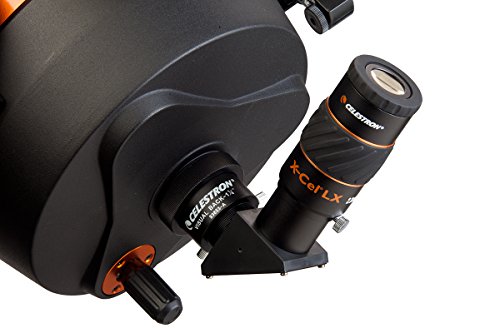

- X-Cel LX eyepieces, optimized for planetary viewing, offer a 60° field of view through a six-element fully multi-coated lens system
- Pop-up rubber eyeguards provide comfort and increase contrast. Raise and lower with a simple twist
- A treaded rubber grip offers a no-slip grip, even with gloves on
- 1.25” barrels are threaded to accept filters
-
Information
-
Twitter
-
Pinterest
-
Youtube
-
Facebook
Nicole D Friedley
Solid buy for a 114mm 500FL reflector
I got the 4mm eyepiece to use with a 114mm reflector with a FL of 500. At first I was skeptical, I read reviews and had many "experts" tell me it would provide too much magnification. I assume they saw 114mm and assumed the worst. This thing provides excellent magnification and produces a detailed image! Full Review: For people looking at this eyepiece there are 2 factors more important than the size of the primary mirror. The first is quality, I'm using an Orion telescope but there are other good brands out there. Is you are using a cheap barska or some other department store brand you are sadly wasting your time. The second most important thing is focal length. Based on my research the best a ground based telescope can do in magnification is about 300x simply due to the atmosphere. There are exceptions like remote locations and unusually calm atmospheric conditions but those will be rare occurrences. In my experience there will be times when atmospheric conditions won't let you see much detail at 100x, that's just the way it goes. Additionally if you want to get the best view of planets you want to wait until they are as directly above you as possible to minimize how much of the atmosphere you are looking through. So that said, to figure out a eyepieces magnification simply take your focal length and divide it by the size of the eyepiece. So (500/4 = 125x)... That is well below the scopes limit of 228x. You can figure out a reflectors limit by multiplying its size by 2 so (114 x 2 = 228). So the greater your FL the more magnification this will apply. This eyepiece will certainly give you more bang for your buck with a FL of 700 but it's still great on the lower ends and I recommend it. Knowing what I know now the only way to potentially do better is get a 5mm and a Barlow 2x, I have the latter.
Mick Omerta Chinchio
Baby's first plossl
I know that this isn't the best plossl eyepiece on the planet (i bought the 12mm) but it is LEAPS AND BOUNDS better than the stock eyepieces that came with my scope (Celestron Astromaster 130eq). I plan to slowly upgrade all of my eyepieces but dang, I love this one! The Omni line feels nice, like the build quality is good (i also have the 2x barlow). Overall, i'm quite pleased with my purchase. I took the attached photo by using a phone mount to the eyepiece (i have an iPhone XS), taking a short video and then using software to stack the images and remove noise. :)
Elizabeth Hocog
Good product but please read before buying
So I have the Powerseeker 114 EQ. It comes with the Standard 20mm and 4mm lens. Both are okay yet I wanted a mode sharper image of Jupiter and Venus. I live in the American South West. At 3,000 ft of elevation. Before I got this I consulted customer support from Celestron about my telescope and he recommended this lens and the X-Cel LX 5mm lens. I got this one now and it works really well. Quick tip get the 20 mm lens to help you find the object the swan it out with this lens to save your self time. Once that’s done you can do the minor adjustments needed to focus and see these distant objects like I have. Things to note my telescope is a Newtonian scope and has a focal length point of 900mm. Please consult celestron customer support before making a decision this will help you with the type of telescope you have
Neena KN
Buy buy
I've purchased a cheaper model with the same 4mm now I can really see the difference. I was able to see Saturn and the moons, also took great pictures of the moon. Dont buy a cheap $10 spend a little more and get something that's worth it.
John Clark
A Must-have eyepiece
Longer focal length eyepieces often get overlooked, especially by those just getting started in amateur astronomy. Most beginner astronomy kits (Optical Tube Assembly w/finderscope, mount, eyepieces) usually include two focal lengths to get you started: a 25mm and a 10mm. My own experience tells me that anyone who wants to start a successful observing run needs to have a 40mm eyepiece to perform field narrowing from finderscope to eyepiece. a 40mm may not exactly be an "observer's eyepiece" except for the most extended objects, but it is an absolute must-have to narrow the field around a target. In fact, since I typically run several rigs at once at my college's star parties, I found that I needed to have at least two of these eyepieces. I already had a Sirius Plossl 40mm from Orion, and the Celestron Omni is an equivalent (nay, nearly identical) optical stack to work with a second 'scope, so I wouldn't have to keep hunting for a 40 when acquiring a target in the eyepiece. This is a great, yet often overlooked, workhorse eyepiece.
Sky Moe Sky Moe Ei
Wow what a difference !!
I guess you would consider the X-cel eye piece the 3rd tier offering from Celestron (2 up from the eye piece that comes with scope) and let me tell you what a diiference!! To start off with the build quality is vastly superior than that of the standard eye piece and there is a significant weight difference (X-cel the heavier). There is also a noticable size difference that Im sure has to do with whats held inside. The adjustablity is also a huge plus and it comes in its own sturdy container for storage. But what really matters is the perfromance and all I can say here is Wow! The field of view is significantly better. The images are crisper any clearer. Color seems more vibrant and light artifact at the edges of the eye piece seemed markedly reduced. All this for what I feel is a fairly reasonable price ($59.95 sale-%79.95 normal); especially when compairing them to Televue ($200+). Give this brand a shot you wont be disappointed.
Veronica Changed Brown
High quality eyepiece that comes with a quality "bolt case" for storage
Note that this is not a performance review, that will come later. I recently purchased a Celestron 9mm and 5mm X-Cel LX eyepiece . I was quite pleased to find that each eyepiece came with its own Bolt case which are two semi clear plastic halves that slide together and lock to provide protection for your delicate eyepiece. Not many eyepiece companies offer this benefit which is too bad, because bolt cases are relatively inexpensive (the size required for these eyepieces would cost 4-5 dollars each)...However, they are only available thru a couple of companies i.e. Agena and High point Scientific and a few others. My eyepieces also came with dust covers on both ends of the eyepiece... I also really liked the twist up eyecups which were easy to operate and seem to stay put. All of the internal surfaces were blackened and this eyepiece looks and feels very welll made including the rubber grip band that is mid body on the eyepice. Kudos to Celestron (who ought to mention the bolt case in their specs) for such a high quality eyepiece for such an affordable price.
Sharon Harripersadh
Great eyepiece for the money.
If you have a decent telescope and are using the stock eyepieces, this is a great upgrade. I have a Celestron NexStar 130SLT and the stock eyepieces are ok, and you can see the stars and planets, but I was missing out on so much. The moon is one of my favorites so I bought the 7mm eyepiece and it's perfect. I didn't understand the difference it would make until I tried it. This is money well spent. I updated this with some comparison photos. Last night was the first night in a while to get a decent photo with the new eyepiece. In the picture I attached you can see the stock 9mm lens on the left and the X-Cel 7mm lens on the right. The X-Cel eyepiece is so much brighter and more clear. The harsh color distortion around the moon is gone and the larger glass and field of view means less eye strain.
Ginger Bugielski
More Magnification is Not Always Better
At 25mm, this eye piece is ideally suited for those wanting to view large chunks of the night sky at one time. Why is this important? If you are looking to just explore, feel like your floating in space with the stars, and see what you can find in space, that is the type of eyepiece you want. If you already know what you want to look at, say for example, Jupiter, then you want more power so you can see the storm clouds, and the moons. This may not be the eye piece you want. I use a 7 to 12mm to see details of Jupiter, Mars, Saturn. I use 15 and 25mm to get lost in the night sky. What's the benefit of just getting lost in night sky with a 25mm eyepiece? The sudden surprise you get when you catch a satellite streaking across your view. The lump in your throat you will get when you are looking at the sky and you accidentally 'run into' the Andromeda galaxy for the first time. So 7mm to 12mm when you know your destination and exactly what you want. 12mm to 25mm+ when you want to just enjoy the journey of exploring.
Heather Eaton Biggs
Well made, clear and bright
I own a Celestron- Trail Seeker Spotting Scope with the 20X - 60X eyepiece. It is their new moderately priced scope that in my opinion beats everything bellow the $700. price point. Every photographer knows that as a rule "fixed lenses beat zoom lenses" in photographic quality. In my opinion my 20X-60X provides fine viewing up to about 45mm. However the 32mm eyepiece with a 50 degree field of view is a vast improvement in brightness and clarity. Truthfully I cannot see much of a difference between much higher priced scopes than mine when using this eyepiece. I am extremely pleased with this eyepiece.