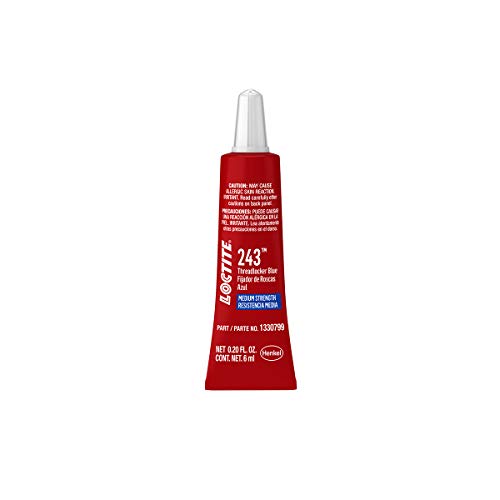
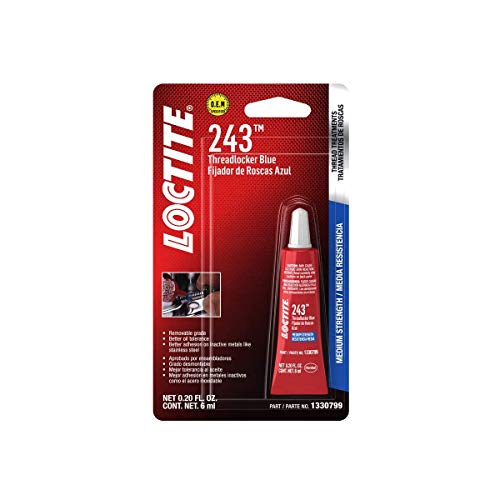
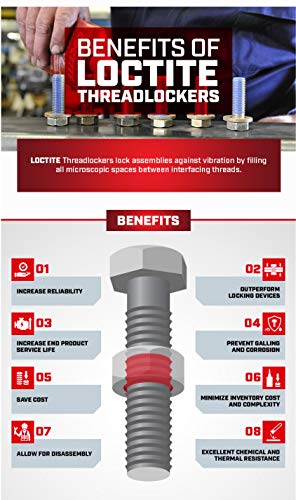

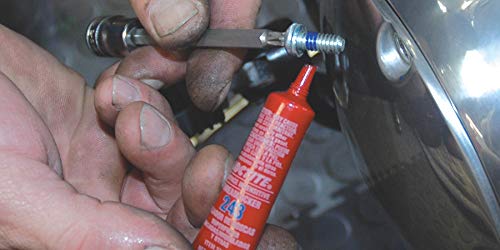


- DESIGN. Ideal for fasteners between 1/4-Inch to 3/4-Inch (6 mm to 20 mm).
- SECURE. Locks and seals while preventing parts from loosening due to vibration.
- RESULTS. Secure, one-piece assembly that will not loosen under stress.
- EASY TO USE. Parts can be separated using hand tools.
- APPLICATION. Rocker studs, rocker adjustment bolts, bolts on valve and cam covers, oil pans, disc brake calipers, intakes and alternators, pulley assemblies and much more.
-
Information
-
Twitter
-
Pinterest
-
Youtube
-
Facebook
Fre Man
Great product for a firearm
I bought this to use on a firearm and I must say I am very impressed. I used loctite 242 and it produced some great success but using it in conjunction with oily areas of the rifle, it seems to cause issues. It appears either I had to carefully apply oil or just never oil the area. Then came this product after reading around. The maximum temperature threshold for loctite 242 is about 200 degrees. With Loctite 243 it's almost twice that nearing 360 degrees. On top of that, it is indeed surface insensitive when you apply it. Before going all crazy with this product, I decided to give it a garage science test. My favorites are Loctite 242, and Rocksett and finally the newcomer, 243. I got a scope mount that had set screws to torque it down. What I did was for each screw I would wipe it completely clean with rubbing alcohol, and simply apply each product. Each product worked as advertised and to unscrew I had to apply above average torque to break loose. Then I cleaned it all again and got the stuff off the screw. I then applied a light oil on the surface and wiped it down with a towel the best I could to get it somewhat dry but still have oil on it that you can't see. The loctite 242, and Rocksett both failed. I could unscrew it by hand after waiting 1 week and it even seemed like it was loose before even trying to unscrew it. With loctite 243, it had the same amount of torque required to unscrew it and it was on really tight. It seems like it is working as advertised. My guess is if loctite 243 fail, it will fail due to high temperature but that is expected on a firearm. It's impossible to really say how hot a firearm can get as it depends on how much you shoot and all that. From reading online military manuals, it appears that the expected temperature range depends on location of the barrel. On a rifle, it appears the average temperature for near the muzzle is about 400-600 degrees and this is shooting approximately 1 round per second until 60 rounds are fired. Of course that is on the surface of the barrel and the question is transferring that heat off the barrel to where the set screws are different questions. It's only a matter of time before this is figured out and I believe so long as whatever it is torqued correctly I shouldn't see any issues. Overall I am impressed with this product. It does work very well and I highly recommend it for firearm folks who are looking for something that can still oil over. You don't have to go all crazy with taking off the oil on the screw when you install whatever it is you're installing. However, I still recommend doing that just to be sure you have the best application possible. From there, you can apply oil to your heart desire without worry about it breaking loose. As a side note, another product I'm looking into is loctite 246. This is the same stuff as 243 where it is surface insensitive, BUT it has a higher temperature threshold. I also notice loctite 246 has a expiration date but the loctite 243 doesn't. Not sure what the shelf life is on this but that is another thing I will monitor on my own.
Bryan Hepp
for removable bolts, 243 is best
This is the best loctite for thread locking screws or bolts, whatever is metal on metal, that you'd like removeable later on. Unlike Loctite 242, you needn't worry about cleaning off all grease on the threads, or even contaminating the surfaces with oil from your hands. 243 is harder to find, most retail stores stock 242. I wish Loctite would make these bottles all blue, not blue lettering on a red bottle to avoid confusion with #271 or #262, which is permanent threadlocker. Now if you make a mistake and use #271, it is nearly impossible to remove without a blow torch! Sometimes, #271 is sold with a BLUE band on a red bottle. The only key is that regardless of the bottle color, the number 271 is always colored red, while the number 242, or 243 are always colored blue.
Olga Dib
An Industry Standard
There's a reason why copiers are called "Xerox machines" and tissues are called "Kleenex." And it's the same reason that thread locking compounds are called "Loctite." This stuff was probably the first, it's still the best known, and it just works. The 243 compound supposedly has a greater level of resistance to grease and oil than the 242, which was the "blue Loctite" that everybody used for years. As far as I can tell, this 243 stuff works exactly the same as the 242 stuff ... you apply it, tighten your fastener, and give it at least a day to cure. The 6 ml tube is handy for a toolbox and should last pretty well as long as it is kept tightly capped.
Schuenemann Sheryl Audrey
It's Loctite...what else is there to say?
I own a single cylinder dual-sport motorcycle so I need large quantities of this stuff :) I use it on just about EVERY fastener I remove and replace on the bike whether it had threadlocker in the first place or not otherwise I may need to find a new bolt later. This formulation is supposed to better handle oily environments.
Chyna Dolly
The best thread locker in the class
I tried several thread lockers before starting using this one and there is a big difference. It is not necessary to perfectly clean off bolts before applying 243 threadlocker. The thickness of the liquid is just right. It is sufficiently liquid to easily apply to bolts but not too liquid to drip off. The strength of locking is sufficient to prevent bolts release from vibration but is not too strong to affect removing bolts with a screwdriver. I mostly use threadlocker with RC helicopter parts and had a few times bolts coming off in flight. It never happened since I switched to Loctite 243. Highly recommended. The only possible "complaint" is that the container is red color, even though formula is blue (medium strength). I have blue (243), red (271) and green (290) strength loctites in my toolbox and have to read the label to select one. It would have been much easier to have matching strength to container's color.
Adam Escorial
this is the good stuff!
The tube is a little smaller than I had imagined it in my head, but it does the job. You only need a drop! You do have to be very careful to squeeze out a very small amount, this stuff is very fluid and you can accidentally use a lot more than you intended. I always apply it to the threads while holding the bolt I am wishing to secure over some paper towels because it is easy to drip excess.
Theresa M Bodman Barcavage
Product arrived already opened (only outer container)
This product is really expensive for the small amount of fluid in the tube. I was surprised to see the plastic packaging was already opened upon arrival. How do I know if it's already been used? Are they selling a return item? EDIT: Although outer casing was half opened, the product itself was intact. The tube tip was not cut, so I changed my rating to 5.
ツ ツ
No More Seized Bearings
I purchased Loctite formula 243 after cap screws on my longboard brake truck came loose while I was out skating. Thank the Lord that I was still testing the truck at a low cruising speed because the screws jammed up one of the bearings on one wheel and also came loose in the other rear wheel. The Loctite has prevented the screws from loosening from road vibrations. As one reviewer noted, the blue Loctite 243 comes in a red bottle. I had bought the fast-acting "Super Glue Professional" Loctite at a big box hardware store before I found out the exact formula I would need. It comes in a blue bottle that has a blue cap. It was the wrong formula because, from what I understand, I wouldn't have been able to remove the screws with hand tools. I did not use it. And, I could not find formula 243 in local stores. So, if you want a secure thread locker that will still allow you to replace screws easily, look into Loctite 243. Just be sure to shake the bottle well before use.
Claudia Soares
If you work on your motorcycle, you need this stuff
I use this on almost everything on my motorcycle including handlebar mounts, brake caliper mounts, rotor mounts, axle pinch bolts, etc. - anything that I really don't want to vibrate loose. If you're going deep into your engine, you should consider using red threadlocker - however, you need heat and some serious effort to get that stuff apart. Blue is sufficient for almost everything. Loctite makes it easier to take the bolts off eventually because the threads don't corrode and seize. Your mechanic will thank you. If you use this on aluminum, stainless steel, magnesium, titanium or some other inactive metal, you should also use primer ("Klean 'n Prime"). 243 compound is oil-resistant but otherwise very similar to 242. Unless you have a reason for using 242, use 243 (at least that's what I've been told).
Carlos Hankins
The 243 formula is not the easiest to find.
Loctite 1330799 Threadlocker 243 Surface Insensitive-Medium Strength Tube, Blue, 6-ml is the improved version, reputedly more resistant to solvents. Purchased both the blue and red through Amazon and have used and trusted Loctite for years. Permatex and others may be ok, but I have been satisfied with Locktite.