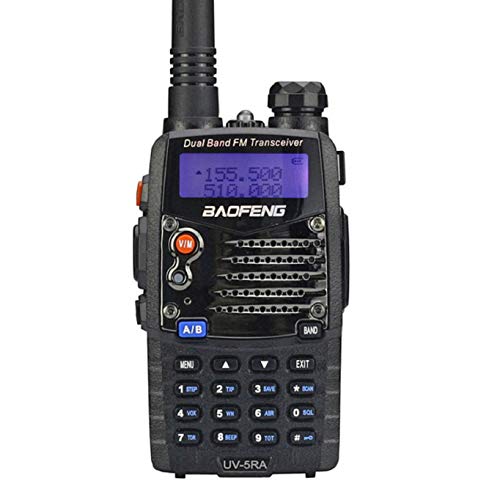
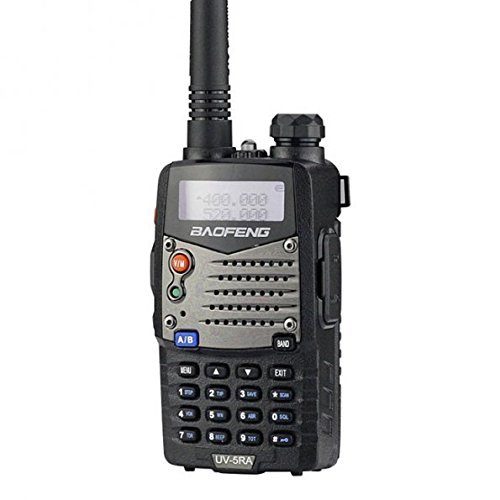
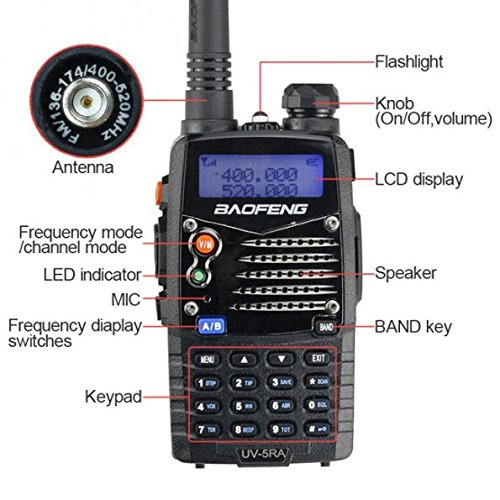


- Dual PTT keys; A/B band independent operation
- Incorporates 105 codes "DCS" and 50 privacy codes "CTCSS" programmable.Other features include: selectable wide/narrow, battery save function, VOX, DCS/CTCSS encode, key lock and built in flashlight
- CTCSS & DCS Scanning/ CTCSS & DCS Direct input
- Emergency Alarm; LED Flashlight; Built-in key lock
- Tri-color background light selectable; 0~9 grades VOX selectable
-
Information
-
Twitter
-
Pinterest
-
Youtube
-
Facebook
Mark Grisham
Im prepping for any SHTF scenario
This baofeng handheld ham radio is by far the best investment I could have made when it comes down to emergency communication. The reason why I purchased this radio is to have a means of communication to the outside world if there is ever any kind of major disaster. Our world is a scary place right now and you never know when we will lose satellites and cell phone towers. That's when you resort to Old Fashioned Ham radios. PROGRAMMING: Let's face it, I am by no means an expert when it comes down to programming or using these radios. But baofeng makes it very easy for me to figure out how to be able to communicate to others using this radio. It comes with everything you need in order to get started. You could easily program all of the NOAA frequencies and all of your local emergency frequencies as well. It's very time-consuming and tedious to hand punch all of the frequencies into your baofeng radio therefore I purchased the programming cable so that I could hook up the radio to my computer using a software program. Unfortunately you have to purchase the baofeng programming Cable in order to easily program all of your frequencies. I highly suggest purchasing the more expensive authentic cable because all of the other cables that are not authentic will not work. RANGE: The two way radio does come with an antenna but I do recommend purchasing a longer antenna if you need to have a longer range. Again, I suggest purchasing authentic items when dealing with baofeng products. It is worth the extra few dollars you need to spend if you ever do need to use this in an emergency. With all that being said I was able to communicate with my son on his radio about two and a half miles away with the original antenna. We were on flat cleared land. When we were in the woods I was able to reach him approximately one mile away. I was not able to test these radios in the city but I would assume that the range would probably be cut in half. LEGALITY: in order to communicate with others on designated radio frequencies, most frequencies require you to have a license. Check your local laws and use common sense. Some frequencies do not require you to have a license. But if the STHF, I don't think they're going to be coming into your house looking for your license. Please rate this review to give me a better idea how I can improve my reviews. Thanks.
Katelyn G Irwin
Great radio!
For the price this radio cannot be beat considering it is dual band and fully programmable. At first I was not sure what to expect, however I found this product to be of good quality, long battery life, looks good, sounds good and works as good of not better than any other name brand. It is loaded with features and options. The only con is manual programming is tricky and takes some time to get familiarized with. I would recommend using programming cable and CHIRP software instead. Otherwise perfect hand held radio, small enough to fit in your pocket.
Sanjay Duhlani
The FT-60R has great reviews but this little radio is smaller
I wish that I had purchased this radio instead of the Yaesu FT-60R. The FT-60R has great reviews but this little radio is smaller, has longer battery run time, has a charger cradle, the menu talks to you. I don't see what all the fuss is about with the menu. The Yaesu menu seems harder to work with to me. I did order the programming cable which came with no instructions. I did not need the driver CD because windows found the driver on the internet. I programmed the radio with Chirp - which took a lot of trial and error to figure out. Bear in mind that the red led need to turn off prior to doing anything or the radio will not recognize Chirp. Chirp is nice in that it imports repeaters, FRS, GMRS, MURS and others. But you do need to set the proper offsets and PL Tones. Chirp does not do this for you. But Chirp is free - so complaining is stupid. I like the size of the radio. I like the numerical keypad that was added with this model. The flashlight, strobe. alarm, and FM broadcast radio are a nice edition. The best part is the cost. Great quality for $100 plus less money. I will recommend this radio to everyone I know. Be careful with this little gem. It is easy to break the law. FRS is limited to .5 watts. You can set the FRS channels to low power of 1 watt, using the earpiece will also help you keep the output power below .5 watts. Be careful with the GMRS capabilities. Don't use GMRS without the proper licensing. The radio also uses ham frequencies that you will need a license for. Be very careful not to transmit on frequencies that can get you in major trouble such as police, fire, commercial aircraft, etc.
Serrina Randolph
Baofeng (Bo-fung) HAM radio
Well, I got this radio for $34, and what an amazing value it is. You have to put a couple hours into reading forums and watching videos to be able to know how to work it, and hopefully this review can drastically reduce that time. Now, when you get the radio, here is how to program it manually: (taken from a forum and youtube video - How to program the Baofeng UV-5R manually: [...] In all cases, you must program the UV-5R while in VFO, or "Frequency Mode". And you must program from the upper line, that is, the A line, of the display. There will be a "cursor" present on the left side of the line that is active. This is chosen with the A/B button. The programming sequence is, Menu (to enter Menu mode), then Up or Down button (or enter the menu number via keypad) to get to the Submenu you want to change. Once there, press Menu again, and use the keypad (such as setting tones) or Up or Dn buttons to make the changes you want. When you have it set the way you want, press Menu again, then press Exit. The radio will say "confirm". Also, set the Band button for the band you wish to program, VHF or UHF. Now continue with the video. BUT... at 01:26, do NOT enter tones in Submenu 11, R-CTCS. That is receive squelch tones. Not all repeaters retransmit the tone from the station talking on the repeater. If you enter a tone in Submenu 11 the radio will only un-squelch if it receives that tone. This can be handy if you live in an area halfway between two repeaters on the same frequency, but only want to listen to one or the other. Those repeaters will likely use different tones. You COULD set up, in that case, one Channel with that frequency, and the tone for repeater A, and another Channel with the same frequency, but the tone for repeater B. But for the most part, do not activate Submenu 11. With this rare exception, you should leave it Off. Likewise, set Submenu 10, R-DCS, to Off. At 01:55, Submenu 13, T-CTCS (transmit tone), this is the tone your radio must transmit, and the repeater must hear, in order to activate the repeater. This is not used on all repeaters. If you set a tone, and your repeater does not require a CTCS tone, your radio will still work the repeater. However, if your repeater requires a tone, and you do not set a tone, or set the wrong tone, the repeater will not work. Set Submenu, T-CTCS accordingly, Off for no tone, or to whatever tone required. Before you start programming there are some settings I suggest. This radio has "Dual Watch". That means you can have the upper, or A line set to one channel, and the lower, or B line to another channel, and the radio will switch back and forth to whichever is active. That is a pain in the drain. I suggest you set Submenu 7 to 0, which is Off. Next, Submenu 1, tuning step... I suggest setting to 5 khz. The UV-5R can go down to 2.5 khz steps, but that is not needed. Yes it is, for FRS and many other frequencies, set it to 2.5 khz. Submenu 2, power, set to High (appx 5 watts) or Low (appx 1 watt) as you wish. I have mine set to High, and can toggle it down or back up at any time, without going into the menu, with the # button, lower right on the keypad. There is an L (for Low) present on the screen when set to Low. Submenu 3, Battery Save, set to Off. Submenu 4, VOX. Voice Operated... this means it will transmit just from your voice, or other sounds, without using PTT button. Set this to Off. Submenu 5, WN (Wide-Narrow bandwidth). For ham use, set this to W (Wide). Submenu 6, ABR, display illumination timer. The number is the number of seconds the display stays lit. Normally set it to 5 (5 seconds). Submenu 7, we set already to Off. Submenu 8, Keypad Beep. If you want it to beep every time you press a button, set this on. If that constant beeping irritates you, as it does me, set to Off. Submenu 9, TOT, Time Out Timer. This cuts off transmission after so many seconds. This is good, and will keep from hanging the repeater open if PTT gets stuck on, jams down between the seat and console resting on the PTT, etc. I set mine to 30 seconds. Submenus 10, 11, 12, 13, discussed in the video and above. Submenu 14, voice prompt. Choices are Chinese, English, or Off. I set to English. Submenus 15, 16, 17, 18, ignore unless you have a use for these. Submenu 19, PTT-ID, set to Off. The following two Submenus determine how the A and B lines read in channel mode... Frequency, Channel Number, or Name. You can only put in an alpha-numeric name via software. With software you could name CH-003, which is the Smithtown Repeater, SMTHTN, and the Jonesville Repeater as JNSVIL. This requires software programming. Submenu 21, MDF-A (In channel mode, how Line A reads, Freq, Ch, or Name) Submenu 22, MDF-B (In channel mode, how Line B reads, Freq, Ch, or Name) Submenu 29,30,31, leave as they are. These choose color of backlight for RX, TX, etc. Submenu 32, set to 0 (Site) This setting prevents the radio from transmitting the alarm siren sound, it will only sound on the speaker, not on the air. There is no way to disable this completely. Submenu 34, set to 0 (Off) Tail tone stuff, set as follows: Submenu 35, set to 0 (Off) Submenu 36, set to 0 (Off) Submenu 37, set to 0 (Off) Submenu 39, set to 0 (Off) ("roger beep") Make all of these settings FIRST. Then proceed to programming your Channel Memories as per the video. When in Channel Mode, you may navigate to a channel via the Up and Dn buttons OR by pressing three digits for the channel number. That is, Channel 3 is entered as 003. In Frequency Mode, if you are entering numbers and it keeps screwing up when you punch in the last digit, check that you have the Band toggled correctly. That is, if entering 146.520, as you hit the 0, it won't take it, you probably have the Band set for UHF instead of VHF. You cannot easily edit a channel once it is entered into memory. The best thing to do is use Submenu 28 to delete that channel number you wish to change, then program that channel from scratch and enter it via Submenu 27 as per the video. "Setting the Wide/Narrow (Submenu 5) to Narrow will give weak audio if everyone else is Wide band. For ham use, it should be set to Wide." If you want to program in the FRS frequencies, google them first. There are 22 of them, each must be saved individually. To save you a lot of trouble programming them, first change the STEP (menu 1) to 2.5K. Again, this will save you a lot of trouble, and allows you to input channels 1-14 FRS.
Mariam Muladze
BAOFENG UV-5RA Good starter unit
First intro into this type of small radio format. Did watch videos on YouTube to try to learn about this particular product and also found a place on the Internet to download a more in-depth manual for this radio . Have to say I am just using this to scan different frequencies and not transmit because I do not have my license yet . But still fun to just listen . Although I am having trouble trying to find a better quality antenna.
Graham Brown
I'm shocked at the value, honestly.
I'm surprisingly impressed with this thing. I'm a long time ham, extra class, with a huge hatred of HTs. For the price on this, I went with the "OK, for the price, why not" approach. I received it a couple of days ago, charged it up and really played with it yesterday. It can be said that the receiver is not the quietest....it hits every St Louis repeater without a problem and using the cable (not included, but it was another 5 bucks or so), it is stupid easy to program using Chrip. I run on Mint Linux, and after charging the battery and hooking it up to the computer, it was only a few minutes before I pulled all 2 meter and 70cm repeaters in the area from the directory, loaded them into the memory on the radio and hit the airwaves. I'm not just impressed with this radio for the price...I'm actually just impressed with this radio. Here are the major points to me that make this thing a no-brainer: 1. Price. Now the kids in the area with an interest in amateur radio have a way to get in without breaking the bank. We deal with Girl Scouts (wife is a leader) and Boy Scouts (son is a Scout), and in both the barrier to radio is not interest...it is the price tag of a 2m rig, feedline and a commercial antenna. Yes, we try to explain that building antennas is easy, but after the sticker shock of a radio, that is a lost conversation. 2. Dual VFO, and super-easy to use 3. Dual band 4. Solid and easy to use dual watch 5. Voice prompts for menu entries, including voice confirmation of settings changes. I was not a fan of this at first, but I really like it after a bit 6. Super easy menus. Any HT user knows this pain, and even my high dollar mobile all-banders need an almanac just to operate sometimes. 7. Built-in flashlight. Yeah, it is a superbright LED and isn't really a great flashlight...but it is a really nice addition and sort of a no-brainer. At the price level, I am really shocked. It does lack in terms of noise floor, and 4 watts max output is a little under many HTs. The stumpy rubber ducky antenna on it has plenty of room for improvement, but as a ham these are just part of the job. My Alinco has been retired and this has taken up my HT primary spot. It is really a no-brianer.
Kamal Kumar Rajak
You get more than you pay for.
For a throw away Ham radio handy talky, its hard to beat. Repeater owners and other old guys will fuss about them but I shut one old gas bag down by telling him that my Kenwood Mobil radio, Right on the box said, Made In China.. Depending on were you are, might look at the little 8 watt Baofeng for that little extra power to make the repeater. Also, remember, any ham radio, antenna, antenna, antenna. Get the connector that will adapt the radio to your standard PL-259 and hook it up to a bigger antenna. Retired folks in assisted living or apartments, the Mag mount antenna's on a cookie sheet on a TV tray in front of the window makes a Lot of difference as well. Great little rig for the price you pay.
Tasha Trix Keyzel
Obviously not the highest quality HAM radio out there. But... probably the most bang for your buck.
Obviously not the highest quality HAM radio out there. But... probably the most bang for your buck. I have 4 of these and all of them function as they are supposed to. Some of the features are not the most intuitive, but it has a lot of features. I would suggest programming via your computer, there is free software just use google to find it and the instructions but you will need the USB programming cable Baofeng USB Programming Cable for Baofeng Two way Radio UV-5R, BF-888S,BF-F8+ With Driver CD. I also suggest a new antenna, you can double the range with a Authentic Genuine Nagoya NA-771 15.6-Inch Whip VHF/UHF (144/430Mhz) Antenna SMA-Female for AnyTone, BaoFeng, and Yaesu I am impressed with the battery life, but I would suggest buying an extra battery Original BaoFeng UV-5R Two-way Radio Battery you can charge it in the base without the radio! If you don't mind the unit being a little bigger the extended battery works well. ExpertPower® Baofeng Extended True Capacity Battery (Model: BL-5L, 3800 mAh) Mine have worked well for over a year now!
Leni Baliza
It actually WORKS great! Low cost, Minimal use scanning (not using it as its intended purpose of transmitting).
I am using this just as a scanner for 5-7 channels. It was EASY to program once I found a link on the Internet telling me what to do. I got my local Police and Fire frequencies online too. The item was just as I expected but it performs BETTER than an actual scanner that I purchased and sent back. I do recommend this for minimal scanning use, if needed. I do not use it to transmit so I cannot comment on that. Seems to be working just fine and the price was very cheap. Picks up good for me.
Rhonda Brown
Which version of the 5RA should you get?
In short: as of around mid December 2012, buy this one. Best antenna for this: The Diamond SRJ77CA. Alternately, the Nagoya NA-771 SF if you are on a budget. I was trying to figure out which version to get on here, frustrated by the reviews, so I decided to buy them all and report. I had read that the various versions are all the same radio, just the style and color vary: UV-5R, 5RA, 5RC, 5RE, 5R+, 5R Mk II, UV-E5, UV-5R Plus. This is true, so it comes down to which one is going to ship with the most recent firmware. The firmware varies, but there does not seem to be much of a difference in performance. Holding "3" while you turn the radio on gets you the firmware version. I bought this mid-December, 2012 and got firmware version BFB295. I thought BFB293 was the latest but this is even more recent. The "UV-5R Plus" that I bought from Amazon for more money was BFB293, but I don't notice any difference at all in the functionality of the two. For programming channels, don't bother trying to program directly to the radio - get the programming cable. You can buy the cheap connector, search for CHIRP software, and navigate that with some frustration. If you would rather spend a bit more and skip the frustration, look into the RT Systems connector and software which works perfectly without any frustration. This can transmit on Multi-Use Radio Service (MURS) with no license required. It also transmits on General Mobile Radio Service (GMRS) which technically requires a license. However, "bubble-pack pirates" persons who use GMRS without a license are common. It also transmits on the HAM bands and even some commercial and emergency frequencies, so be careful what frequencies you transmit on according to your licensing. Construction? Much better than you're expecting. I have a $450 Yaesu VX-8DR, and this does 99% of what I used the Yaesu for day to day. It's not submersible, so don't take it into the bath tub with you, but at $44 it's practically disposable. The accessories are dirt cheap too. The volume can get much louder on a 5R than any other HT that I've used. Update 12/28/12: I bought a second one, received on Dec-21-2012, this time it was the BFB293 firmware rather than the BFB295 that I received two weeks prior. Update 1/4/13: I bought a different, earlier UV-5R variant that came with BFB297 firmware. These radios are all the same, it seems to be a crap shoot what firmware you'll get.