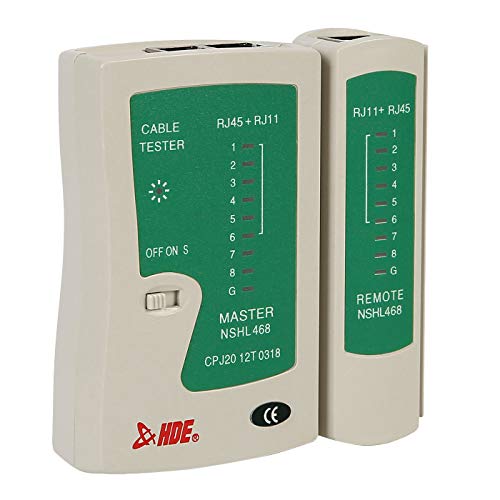

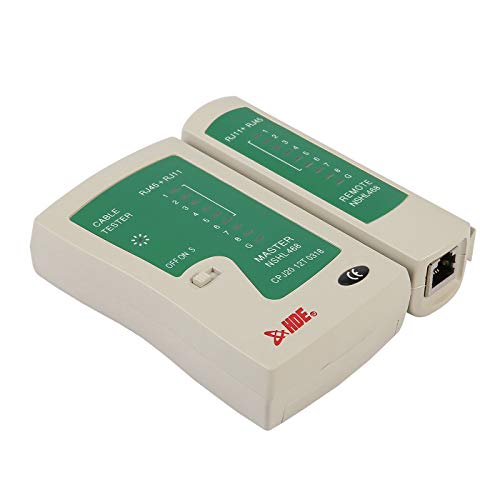


- Construct your own patch cables? Test them with this!
- Works with Twisted-Pair, Straight & Crossover Cables: RJ-45 & RJ-11
- This cable tester comes apart so you can test even when the cable's ends are in different rooms
- Requires one 9-volt battery (not included)
- Tester detects if wires are connected correctly; Includes travel case & instruction sheet
-
Information
-
Twitter
-
Pinterest
-
Youtube
-
Facebook
Connie McCord Determan
Not expensive and works well
I bought this product because I had a problem with a long Ethernet cable and I thought that I had checked the wiring multiple times. Less than 5 minutes after unpacking the product, I found out that I had reversed 2 wires. The important thing to note is that it is critical to monitor both the sender and the remote unit. In my case the problem was shown on the remote unit while the sender was showing a perfect 1-2-3-4-5-6-7-8-G sequence. It has been noted elsewhere that this is generic product that is branded differently by different vendors. As far as I can tell there is absolutely no difference between any of these products so buy the cheapest you can find!
Ena Pericas
Makes life easy, just get it . Saves you more time then anything.
I was running cable in the house and out to my shed, after in stalling "New" wip ends from the factory, they had a bad one,, After getting this, it takes the guess work out,, I would never run cat6 without it. I had one bag connector and would have never known if I didn't have this. This is simple to use, even I didn't have to read the institutions after watching on youtube, But I did anyway.
Pretty Swag
and it works great. I have not tried the tester on phone ...
This has helped me to add ethernet to every room in my house. The instructions don't really help much. It seems to be a fairly standard type of tester, since I found many YouTube videos showing how to use it. When I plugged both ends of a store-bought cable into the testers, both ran through the numbers 1 through 8 in synchronized order. I used two kinds of outlets - one that is built in to a faceplate, and makes you connect the colors to different colors (orange doesn't connect to orange, for example). The other end of the cable is wired to plugs which then fit into a faceplate with squares for the plugs. These had the wire colors connect to the same colors. I plugged the master into one end, and the remote into a far away room. The master lights up in order 1 through 8. The remote lights up in a crazy pattern. The switch on the master has 3 positions: off (left), middle, right. The middle setting was too fast to see the order of the lights. I finally realized that the far right was the "slow" mode. Once I slowed things down, I could see that some lights did not go on. I went back to those plugs, found loose wires, fixed them, and all the lights went on. I am still trying to determine if the crazy order is a problem. I have installed an Apple TV on one, and it works great. I have not tried the tester on phone lines. I am using Cat6 cables, and at least I know when it is not working correctly. (So far, I am still pretty inconsistent with crimping connectors on to the cable - this tester has really helped me to know each time I mess up.)
Andres Romero
Gets it done!
Being a newbie on making up cables, I wasn't real sure of my finished product. With this HDE Network Cable Tester I can tell quickly if my cables are wired up correctly and all the connections are good. It is very simple to use and shows you immediately if there is a mix up in the wires or if there is a poor connection. If you are going to make cables or if you have old cables that you suspect may be giving you trouble, I would highly recommend this tester.
Sumaila Karim
WORKS AS EXPECTED/GREAT TROUBLESHOOTING TOOL
I have security cameras wired around the house with CAT5 and CAT6 cable connected between the cameras and a NVR (Network Video Recorder) Because one of my cameras has been intermittent, I started troubleshooting using one CAT6 cable from the suspect camera directly to the NVR bypassing the existing installed cable. With this setup, the camera reported properly. I then used the same CAT6 cable to test the installed cable and during the Network Cable Tester (NCT) operation, the scan process detected dimmer than usual indications on two conductors. I then went to the camera jack and existing cable plug and found a black substance on male and corresponding female copper conductors. Without this NCT, I may have found the cause of the intermittent problems but with a lot more time expended. With the dimming of the leds on the NCT, I quickly determined that most likely the cause of the intermittent operation was due to 2 conductors trying to conduct through corrosion e.g. resistance. The cameras operated properly when I used the bypass CAT6 cable but the resistance between the male and female conductors was basically 1/2 of the existing connection enough to result in continuity and proper operation. I have at least 2 choices: 1. to physically scrape the corrosion off the two conductors or 2. to use a material that will remove the corrosion. Most likely I will choose option 2 due to my shaky hands and the size of each tiny conductor. Failing that, I'll have to replace the cable. There you have it, how my morning went with the use of the Network Cable Tester. I’m very happy I purchased this tool.
Phenphitcha Jam
This cable tester is great and a good value for testing all the lines in an ethernet or phone cable.
This comment is based on the assumption this device works properly. If not I will update the review, but I fell in love right away with the design. It comes with a great fitting zipper bag to keep the instructions with the tester. This is an asset because of how often devices and their instructions part ways. To further assure the components don't get separated the two components are stored together by sliding one onto a track on the other one. If it were to be improved though the manual should be a little larger and stapled together, so be sure to make a copy if not changed to one page. There are different ports for the RJ-11 and RJ-45 cables to make testing easier. More expensive models can test more kinds of cables, although in principle with an adapter you can at the least check full continuity on all the wires of any other kinds of cable. Testing can be done at 2 different signal speeds.
Sharon Jane Waters Moore
If you have ever put cat 5 connectors on just ...
If you have ever put cat 5 connectors on just to find out that your wiring was wrong on one end, and didn't give your self enough cable to rewire the connector,.......Well this is a must have. and paid for it self the first time I wired the first connector wrong. Saved me 120 foot of cable It lets you know immediately that you wired it wrong, The lights flash from 1-2-3-4-5-6-7-8, and if it skips one it was worth it.
Vickie Osborne
Very useful tool
Works very well for checking the continuity of the wires, and that you've actually crimped them solidly and in the correct order. Easy to use, and not expensive. If you use this first thing after crimping on the plugs, it may save you a lot of grief over why your internet is not working. I assume that a professional installer would have a more expensive tool that actually checks the quality of the line in addition to the basic connections.
Mutcasa Montealegre Resh
Nice instrument for short money!
Cannot make enough positive remarks about this inexpensive tester. I used it specifically to check on Cat5e testing. In new construction, my electricians ran five Ethernet drops. Each drop is a "home run" to a closet on the first floor. Then, a primary section of Cat5e extends from the closet to the basement, ending near the electrical drop on the outside of the house. I connected the termination points on all cables consisting of a Leviton combination wall plate at one end and a RJ45 terminal end in the closet. The remote piece of the tester is easily removed and a section of Cat5e with RJ45 ends can be inserted in the wall plate. The primary tester is then connected to the other end of the Cat5e and switched to the "on" position. If wiring is correct, a flashing light will follow a one through eight sequence. If it is incorrect, then the light deviates from the sequence. I discovered one error. Clipped off the faulty RJ45 and reconfigured.
David A. Nugent
Worked as described
I'm new to making my own patch cable, this was a long, buried outdoor run of about 150', from the basement to our camper. Being new to making RJ45 ends, this tool made it easy and saved me time and trips back and forth across the lawn. Since the first two ends didn't come well this was a useful tester to have and well worth the small cost for it.