
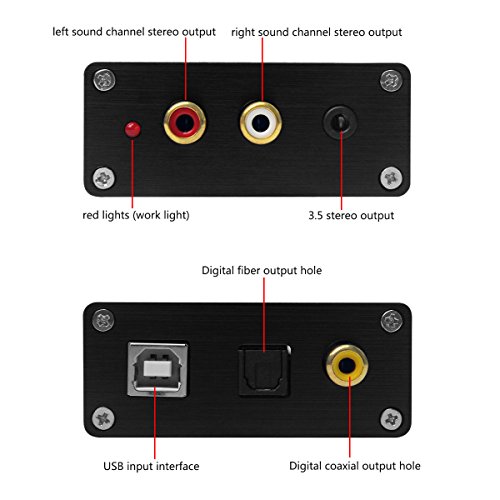

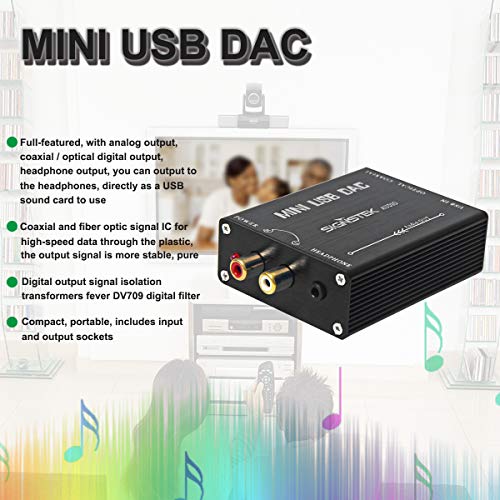
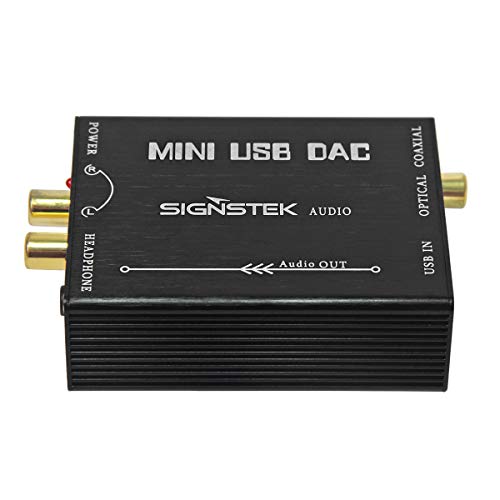

- Full-featured, with analog output, coaxial / optical digital output, headphone output, you can output to the headphones, directly as a USB sound card to use
- Coaxial and fiber optic signal IC for high-speed data through the plastic, the output signal is more stable, pure
- Digital output signal isolation transformers fever DV709 digital filter, the other a more pure sound
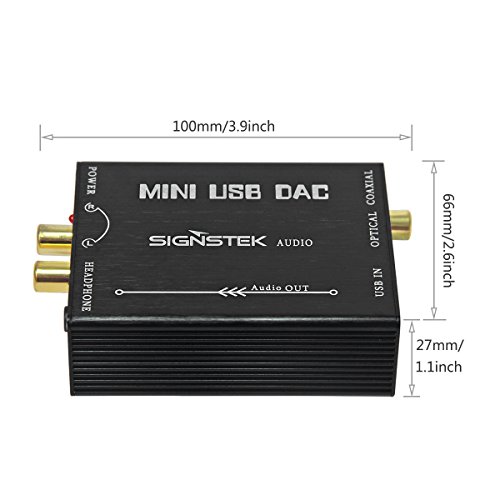
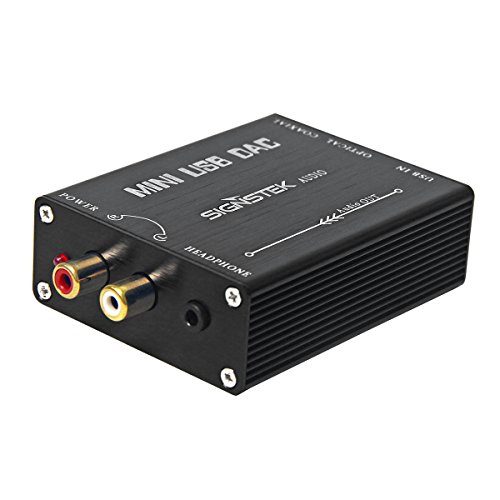
- Compact, portable, includes input and output sockets
- With fever world acclaimed USB chip PCM2704
-
Information
-
Twitter
-
Pinterest
-
Youtube
-
Facebook
Richie Embry
Great little DAC...with so much more potential!
Having purchased several of these impressive little DAC's from various sources over the past couple years, we felt it was time to chime in with a real review. Spoiler alert: While our initial impressions concur with the vast majority of other positive reviews posted here, we'll mention there is FAR more performance to be had from this device with some minor modifications. If this is potentially of interest to you, feel free to read on, otherwise rest assured even in the original configuration the 'bang-for-the-buck' here is exceptional. Considering the modest cost, we feel it's unlikely to disappoint. Note that this identical DAC can be found elsewhere online with other brand names on the casing. The original design was apparently by Muse Audio and has been widely copied by numerous overseas manufacturers and sold through many channels. In our experience the internal component quality does vary somewhat, although the general circuit design has been consistent and the TI/Burr-Brown 2704, while an older D/A chipset, is certainly of high quality. With an electronics background and an innate compulsion to tinker, we decided to see just how much performance can be squeezed out of this little beast. Part of the allure here is the small overall size, and for convenience, the lack of an outboard power source. Essentially any device with a typical 5V/1A USB port should adequately power this DAC. The build quality of the aluminum case is of surprisingly high quality at this price point. After removing the four screws retaining the end plate, the entire board can be carefully slid out. Delving a bit deeper into the circuits themselves, decoding the resistor banding, they appear to be fairly tight tolerance. Subsequent testing with a multi-meter confirm. Those we choose to leave alone. Having personally re-capped many older components over the years (amps, receivers, crossovers, etc.), we're well aware of the sometimes dramatic difference in perceived sound quality a few well-chosen capacitors, particularly those in critical locations (signal path especially) can make. This is one area that every one of these DAC's we've purchased has differed - the brand of capacitors. While outwardly identical, internally even the color of the PCB's has varied. One was blue, another white, and yet another black! Not much consistency there. Likely a matter of which parts vendor was slightly cheaper on a bulk order at the time of manufacture. We know you're thinking, 'cut to the chase here man!' No problem. Ultimately we opted to upgrade ALL of the caps on the board. Factory component values were retained. After many hours of total listening to various configurations, the final mods (see photos) included a mix of our personal favorite, silky-smooth Elna Silmic II's, Nichicon Fine Gold, and Nichicon BP's (1uf - 50V). As you can see in the photos the Elna's in particular are absolutely massive size-wise compared to the decidedly inferior originals that were removed. After some careful measurements it was determined they would just clear the case, and indeed they do. Nowadays, due to strict ROHS standards virtually everything electronic is now manufactured with lead-free solder that can be much more difficult to work with. Some also feel it has a deleterious effect on sound quality. We chose to reflow the entire board at the same time as the cap upgrade with Cardas Silver Solder. Insane overkill for this tiny, low-priced DAC? Absolutely, no question, but it was a fun project and we simply wanted to see what additional sonic potential could be unlocked from this little guy. The actual total cost of parts is very modest and they're readily available. Anyone with basic soldering skills could easily perform similar mods (and we're hoping it may inspire a few folks to try - we'd love to hear what you think). So, what is the end result you naturally ask? Amazing! Incredible! Stupendous! Ok, ok, tempering our enthusiasm with a bit of reality, it really is better than it has any right to be. Many friends have listened in wide-eared amazement to this DAC. Lots of head-shaking disbelief. After much begging, even begrudgingly sold a couple of them. Coupled to bit-perfect JRiver Media Center software (an important part of the equation in our opinion) and run through anything from a netbook, to our custom-built laptop, gaming desktop, you name it... this thing delivers the goods. On a whim, even tried it hooked to a huge pure Class-A power amp and some massive Infinity tower speakers and while it wouldn't necessarily make a high-end, mega-buck audiophile DAC nervous in an A/B test, it definitely didn't embarrass itself. There is a real, honest-to-goodness soundstage now, and it has palpable width and depth even through basic PC speakers. Never experienced that before! The background is dead quiet. The highs aren't grating or fatiguing even after lengthy listening sessions. It never gets more than slightly warm even running 12 hours a day. The RCA and headphone outputs sound identical to our ears. The optical and S/PDIF conversion... well those are just icing on the cake. If you get the impression we're pleased overall with what was ultimately a total investment of less than 50 bucks including the DAC... you're right. Thrilled would be more accurate! UPDATE: It's been more than 3 years since posting this original review. We had no idea it would generate so much interest! Thanks to all for the (mostly) positive feedback and congrats to those who successfully performed similar mods with great results. For another fun project, we recently (2019) decided to take one of these and give it the 'Full-Monty' treatment consisting of the aforementioned capacitor swap, PLUS have now replaced 100% of the cheap factory carbon-based resistors with ultra-low noise Vishay-Dale CMF series metal film versions, once again retaining all of the originally spec'd values. The only original components now remaining on the board are pretty much the DAC chip, I/O sockets, and a few diodes. Everything else is upgraded. See the last photo for a nearly completed board with one of the stock resistors still visible. This would be an easy project if the original lead-free solder weren't such a pain to deal with. Here's the real question: Is it really worth expending this much time/effort/$$ into a bargain-basement DAC? Only you can answer that question for yourself, but it our ears this little guy has now taken on a fitting new name: 'Giant Killer'. It really is remarkable! P.S. For those who'd like to give it a whirl, the list of original values I believe are as follows: (5) 22-ohm, (3) 100-ohm, (1) 220-ohm, (1) 300-ohm, (4) 1.5K-ohm, (1) 5K-ohm, and (1) 1M (meg-ohm). Should be a total of 16 in all, but please check your particular board with a meter and verify due to the possibility of running production changes. Any questions, feel free to ask. Love to hear from some folks feeling froggy enough to take the leap and give this additional mod a try!
Chantelle Reid
Great Value, Lovely Sound Quality
I wanted to test this product carefully before I wrote this review. I got this DAC for ONE and only ONE reason, to get better sound than the build in sound on my Dell XPS computer. The build in sound was provided by a VERY nice Realtek HD chip and I was fine with it (lots of connections). That is until I got a nice set of bookshelf Speakers to go with my sub-woofer attached to my computer. The speakers were a huge upgrade but I felt it also gave me room for improvement on the sound card area. Enter the Signstek HIFI USB. So I tested this Dac (Signstek HIFI USB ) vs the Realtek HD and also against an old USB Sound card based on the C Media- Multimedia Chipset (CM119 chip) (under $10.00, with headphone and mic jacks, many names at Amazon) Using headphones I tested all three sound cards using classical music. After I was done I tested again but this time letting my daughter pick and she came to the same conclusions I did. Test Results: Realtek HD: Not bad but it was dead last. Both me and my daughter felt that the sound was the least defined. USB C-Media: Marked improvement than the Realtek and for the money it would have been a good upgrade (under $10). Signstek HIFI USB: It was the best but the improvement from the USB C-Media was not huge but it was there. Note that this was strictly a sound quality test. The Signstek HIFI USB also has many useful connections that I don't ignore and also add value but this was a sound quality test. So what exactly do I mean when I say it sounds better? I know this may seem academic but the way it sounds better is not the same as when we change speakers or headphones. The improvement is in "CLARITY" or some would call it sound separation. Especially on the Realtek HD there is a distortion that makes the sound seem muted, almost distorted, it's nothing that can be fixed with an equalizer. Is not that I can hear sounds I could not hear before, that experience usually comes from changing speakers, it is more like being able to tell the exact note that was played on a guitar or a drum. That "clarity" lets you distinguish instruments better and appreciate music better. Problem is that once you hear it with that clarity the old way sounds much worst than it really is. You don't want to go back, period. So, are there better dacs? I'm sure there are and most are more expensive too. Don't forget the law of diminishing returns. I'm fairly positive this dac will meet the needs of most people who also have a nice set of speakers or headphones not to mention provide digital outputs if needed. PS: Have been listening to the Signstek HIFI USB while writing this review, the sound is so good! Very happy with my purchase. Update: There is something I want to mention on Windows computers (don't know about Macs). Windows will install default audio drivers. This is great and all but you will most likely miss one very special feature that many build in sound cards have, an equalizer. I was able to solve this problem with two programs. The first is called "Equalizer APO" and it is free, worked OK but not all features worked as expected. I think most people will be happy with it regardless. The next option was paid, "EqualizerPro", it had less features but had no issues at all. Being able to add equalization in Windows for the Signstek HIFI was huge as I can customize it to my speakers. I was using some external treble and base controls but a digital equalizer was a much better option. For those who find the sound of the Signstek HIFI USB a little flat or just want to customize it to your particular needs I'm sure one of these two programs will help (at least in Windows).
Precious Sufiah
Works well as an audio pass-through device.
As my headline says, I'm using this bad boy as a digital audio pass-through device (Chromebook->USB cable->Signstek DAC->coaxial cable->receiver), so that I can properly enjoy my digital music collection on my home stereo. Works like a charm. Sounds fantastic Unfortunately, I can't comment on this units ability as an actual DAC (the majority of reviewers seem to think it sounds great), but as a bridge, it does the job without any hiccups.
Fagbohun Kazeem Olawale
The Ayes Have It
I listen to classical music and have recently been astonished how many fine recordings are on Amazon Music. I have a respectable desktop computer, dvd player, dac, and headphone amplifier in my office. But sometimes I linger at the dining table downstairs with my ancient laptop (IBM Thinkpad!). I wondered whether there was a way to get reasonably good sound without breaking the bank. I looked at one excellent option of a separate dac and amplifier but then hesitated over the $300 combined price. It is clearly a good value -- just for people with a bit more money than I want to spend. I continued searching and came across this. I could hardly believe it would be any good at such a low price. But it is, and, without external power, it can even drive my vintage Sennheiser HD 530 headphones (300 Ohms). It is quite good enough to shut your eyes, stop multi-tasking, and listen to the piano quartet. PS: I had an extra, if old, headphone amplifier lying around, and for pure curiosity, I connected it using the RCA outlets, instead of connecting my headphone directly to the Muse's headphone outlet. It is no improvement, and I have gone back to plugging my headphones directly into the headphone outlet of the Muse. Really, the quality is astonishing, much less at this price.
Petrena Jones
DANG! Who Knew?!?
Why didn't I get this years ago? What was I waiting for? Oh, I know... audiophile quality DACs are EXPENSIVE, overpriced, not worth it, etc., etc.. Well, you can forget everything you "thought" you knew about DAC. A little history on my system... I have a bunch of 40-year-old vintage audio gear. I wanted to set up a little stereo in my office. At first, I thought the receiver was shot. So I bought this little $20 Lepy LP2020A amp. They've taken the old Tripath amplifier and upgraded it with the much improved Texas Instruments chip. Next, I found it really wasn't the receiver, it was the old speakers. Based on the THOUSANDS of GLOWING reviews on the Micca MB42, I bought a pair. Then I decided to "refurbish" the old receiver. Bad idea. The little Lepy blows away the old receiver! It really IS that amazing! Now I needed something to feed this crazy little stereo. An old laptop that was too old, slow, and underpowered for daily use should fit the bill. I loaded Linux Mint xfce. Perfect! I have Pandora, Spotify, Slacker, and every other Internet music/radio service in the world. It sounded awesome! Unbelievable actually. So I was on the fence about this little DAC. Would it "really" make much difference? After about a week of extensive listening, I was noticing some distortion. It wasn't bad, but it was there. I upgraded my audio cables, but that made no difference. So with all the glowing reviews on this, what have I to lose? Plugged it in, selected a couple different genres of music, and CRANKED it up. There is no sign of the distortion. Between selecting music services and genres I had dead air. And I mean DEAD. No hiss, no whine or squeal from the PC. Not that it was bad before, but it was there. Those problems are completely cured. But what really blew me away was how much deeper and punchy the bass is. The highs are absolutely incredible. These little speakers are easily the best sounding I've EVER had. The stereo separation is dramatically improved. The soundstage is very wide, much wider than the speakers themselves. I'm hearing nuances in the music I've never heard before. If you read my review of the amp and speakers, you'll see I said this before. I was beyond impressed with the system... amazed is a better word. Now I'm feeding it with the quality signal it deserves. If you have an accurate amp and/or quality speakers/headphones/earbuds they will reproduce everything sent to them, good, bad, or indifferent. If the data is not there, you're missing it whether you realize it or not. This little DAC gives your system everything that should be there, and nothing that shouldn't. The sound is more accurate, much cleaner, and I honestly can't imagine it getting any better than this. The whole thing cost $100. A complete audiophile quality system for $100? I must be on drugs. If so, I feel great and I'm in audiophile bliss. Just leave me alone and let me enjoy this for many years to come. The DAC completes my system. I have quality from the source to my ears. Are there better sounding DACs out there? I'm sure those from Cambridge Audio are pretty amazing. There are more esoteric models charging $700 and up just for the DAC. I suppose if you have unlimited funds to burn and you want to say you have the biggest, badest, most expensive sound system in the world, they'll help get you there. Personally, I wish I knew some of these people. I just wanted something that sounded good for a little Office music. I never imagined I'd end up with something that sounds this good for so little. I sit in awe, disbelief, and amazement at this incredible "little" system. Forty years ago I paid hundreds for a system that sounded great at the time. But that vintage gear just can't hold a candle to what I have now. To sum it up, if you've ripped all your CDs, subscribe to online music services, listen to Internet radio, or otherwise listen to music from a computer, this DAC is an absolute must-have. I can't recommend this whole system enough. Thank you, Amazon! I'd have never known about any of these components if it were not from reviews from people like you. *** UPDATE *** With this outstanding little DAC in place, I gave the restored vintage receiver one more shot. I'm glad I did. I was ready to recycle the old receiver. The problem was not the receiver. It faithfully amplified the flaws in the audio and sent them to the Micca speakers, which faithfully reproduced them. With a pristine source, my little stereo really shines. I am so impressed with this, I purchased a similar Syba Headphone Amp for my other laptop in the living room. I even put little rubber feet on the bottom of this so I can set it on top of my receiver and display it with pride. Sure, it's pretty small. You can easily hide it if you want. If you're on the fence about this, think your headphone jack sounds fine, not sure you can justify it, whatever... do yourself a favor. It's less than $30. If you're not satisfied Amazon will take it back. Don't worry Amazon, it won't be coming back.
Axad AR
Works like a dream with the Raspberry Pi 3
Bought this to connect my Raspberry Pi 3 with 7" touchscreen to the sound system in my workshop. The receiver / amp is an older Onkyo and doesn't have HDMI in but does have S/PDIF and Coax digital in. After connecting the USB to the Pi I was able to select the output type, connect to the receiver/amp via Optical and play music immediately. Sound quality is outstanding when processing MP3, FLAC or even SACD. Only one con. I left it running all night because I hadn't set up the remote app for the Pi. When I powered up the amp the next day there was a slight hissing / buzzing in the sound output. I thought maybe it was a grounding issue so I connected the HiFi USB to the amp with a small wire. No help. I disconnected the USB, waited 10 seconds and reconnected. Hissing was gone. If it happens again I will connect the Pi, HiFi USB and Receiver grounds to see if that helps. Otherwise very happy with this product.
Phea Roun
Insane dac. Much beyond this is diminishing returns.
I have been using a PeachTree Audio DacIT for several years now (not the new model, DacITx). I've become very accustomed to it's sound, and have really grown to love it. When I bought it, my entire family was in awe of how much of a difference a dac made in my music system. I've wanted to update peoples music systems for Christmas gifts over the years, they are cost prohibitive (A PeachTree Dac runs right around 300$, so for many, not exactly a purchase you can just do on a whim.). I did purchase my sister a NAD Electronics DAC 1 Wireless USB Digital-to-Analogue Converter for 150$ here on Amazon. Horrible purchase. The dac didn't sound nearly as good as my Dac, and it wrecked her wifi. She could only either use her internet, or her dac. Not both. No streaming music. Wow, what a let down. - So, that was the end of me considering buying dacs as gifts.. til now. I was about to buy a Benchmark Dac2 (2000$ ish dac), and give my mother my old Peachtree, But then I stumbled upon a review by PCgamer website, of his new acquistion - Benchmark Dac2. He compared it to a 20$ dac, a 50$ dac, and a 200$ (I think?) dac. He came to the conclusion that it is BEYOND diminishing returns. The only thing you are paying for with more expensive dacs, is the extra features. So, I decided to buy this dac as a Christmas present this year. When it arrived, I immediately opened it up to compare it to my Dac. I was very surprised. They sound identical as far as I can tell. The system I used to test it: Mac Mini using iTunes/Fidelia (for flac) Onkyo Txnr-809 Receiver Emotiva XPR-5 Amp Energy Veritas 6.2 rear speakers Cerwin Vega XLS 215 fronts. I just ordered some Tekton Double Impact speakers to replace the Cerwin Vegas. If that makes a difference in how I hear the sound between the two dacs, I will update. Also, I am writing this review the same day I received the product.. I have no idea as far as longevity.
Tera Lindsey
Fabulous
This little machine is well worth its modest price tag. Definitely a noticeable improvement over my Asus desktop internal soundcard. I have it connected to pc via UBS (automatically superseded the realtek) , via dual RCAs to my Dayton T amp. The speakers (Pioneer SP-BS22) are run through the high input of my 8" Dayton powered sub which is in turn hooked up to the amp via speaker wires. Me of little faith also ordered the SMSL q5 pro dac/amp w/ sub out ($ 80.- from China)- not trusting that the Signstek would live up to its reviews, and worrying that wiring everything through the sub might hurt the sound. We will see when the q5 gets here, but for now the described set up sounds terrific as my desktop system. Update: I now have the SMSL Q5 hooked up to the same speaker configuration, and cannot detect a significant improvement over the Signstek DAC + Dayton Audio Amp. So, my verdict stands: if you already have a digital or traditional amp without DAC to play music files from your computer, the Signstek DAC is a fabulous small investment.
Saymalyn Aradji Sabdaini-jimenez
Unique product that allows you to adapt a USB signal to digital audio coaxial or Tosslink
Digital Audio Converters (DAC's) in computers are not noted for quality, while the DAC in my receiver/amplifier is supposed to be very good. Thus, I wanted to bypass the DAC in my computer and use the DAC in my amplifier/receiver by using the output of a USB port on the computer, rather than the analog output that is standard on sound cards. Since my receiver/amplifier does not have USB input, but does have Tosslink or Coaxial Audio digital inputs, I needed a USB to Tosslink or Coaxial Audio adapter. After many, many hours of searching the internet and using the chat lines of audio equipment stores and manufacturers, the Signstek DAC on Amazon was the only product I was able to find that had such an adapter. It has the capacity to bypass its DAC and simply convert USB signal to Tosslink and Coaxial Digital Audio. I switched to coaxial digital audio because the distance between my computer and the amplifier was 25 feet. The difference in sound quality was night and day. Manufacturers describe the components of my audio system as entry-level audiophile or above. I have never made a change in the system that resulted in such a dramatic improvement in sound. I could not have done it without this adapter. Qualifications: I have only had the product for a few weeks. Thus, my ratings of material quality and durability represent hopes and first impressions, rather than experience. I hope to update the review in a year or more. In addition, I have not tested the DAC in this product.
Zack Ael
Fantastic for what I need
I have had this unit running since Dec 14th 2017 without any issues. It is Velcro to the back of my entertainment cabinet and I completely forgot it is there or I would have reviewed it earlier. I guess that kind of sums up why I gave it 5 stars. It does it's job so well you forget it exists. The one caveat I will add to this review is I chose this unit to do one task and only one task. I don't have experience with all of its features. I use this to convert USB audio from the nVidia shield 2017 model over to Optical/Toslink. The latest model of the nVidia Shield dropped the optical port in favor or 2 hdmi. My Panasonic "smart" TV in it's great and wondrous intellect drops HDMI audio on the ARC channel whenever it power cycles. Meaning when you turn on the TV you would have to run its HDMI audio discovery routine to pick up the soundbar again. This was EVERY TIME you turned the TV back on. So that's the background on the problem I needed to solve. I introduced this little unit about 2 days after the smart TV turned out to be not so smart and haven't looked back. I mounted this little hommie right next to the shield on the back of the entertainment cabinet and they have been best buds ever since. I then ran the toslink to the soundbar that is mounted directly under the smartish TV and that's how i've rolled for over a year now. No problems and no complaints. I haven't been able to test its output or distortion levels at very high volume. I have a 300 watt soundbar so I've never had a need to go past 80% volume. The few times i took it that high was just for testing and this thing sounded great to me. Do i think this unit is "audiophile" worthy...no...but i have a soundbar so that would be a dumb question to ask. Will this solve all the world's audio issues for AV equipment...again no...but it costs $20 bucks so we're back at dumb question again. Will it solve niche problems in your AV setup...in my experience it absolutely will. Hope my ramblings helped out. Have a good day.