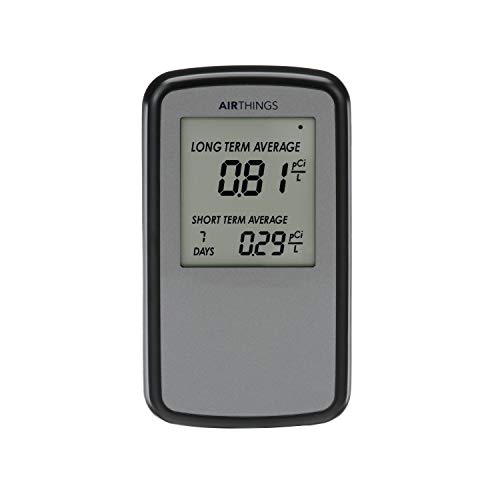
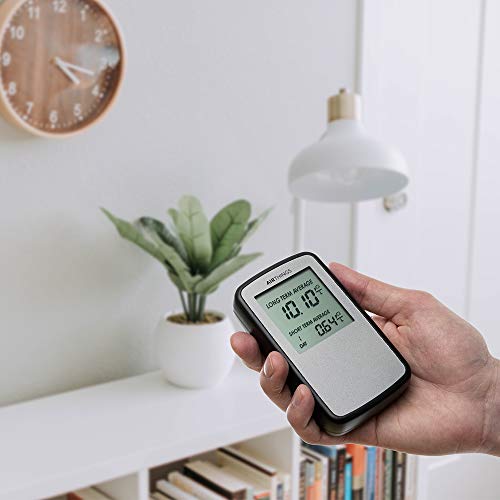
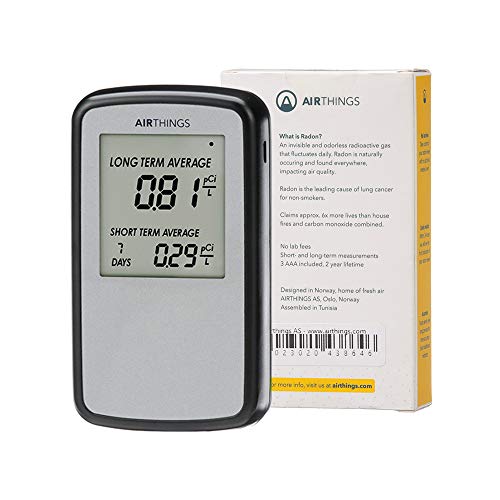

- Continuous monitoring of radon, a radioactive gas that is found in all buildings.
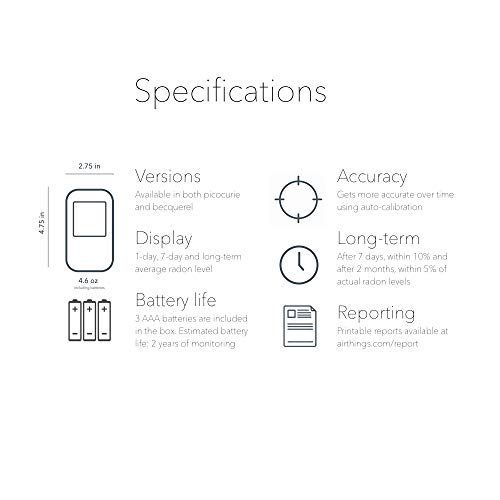
- LCD Display shows daily, weekly and long term radon levels
- Portable, Lightweight with 2 years of battery life and peace of mind
- Unlike charcoal tests, receive your first indication of radon levels within 24 hours with no lab fees, ever!
- Designed by scientists, this easy to use device allows you to protect your home from radon gas.
-
Information
-
Twitter
-
Pinterest
-
Youtube
-
Facebook
Donnie Omar
Switched from Saftey Siren Pro to Corentium
Had previously used the Safety Siren Pro Series3 Radon Gas Detector for many years. Old unit was very accurate at first as I tested against an expensive professional test. However, the unit was getting old and they have a limited life for accuracy and so purchased a new safety siren pro which I then returned as the new one was defective and would error out when I walked by with my cell phone ( old unit did not have this issue). Reading other reviews it seems quality control for the Safety Siren is going down hill. Switched to the Corentium Detector. No problems with my cell phone, no problems with humidity, hassle free. I am extremely pleased with the unit. Note I am using the unit for post mitigation ongoing monitoring. You should do multiple tests including the low cost Charcoal units and a more expensive professional test if you are trying to test a home to determine if mitigation is needed. Also note that radon levels can change over several weeks. First pre mitigation tests were at 16. Second tests three weeks later were at 27. Should be 4 or less. This was done using a professional home inspector's unit as well as my original meter and both meters agreed for both sets of tests.
Art Crum
Good overall, seems reliable when compared with charcoal tests
[Update 2: August 2016] In Feb 2016 I ran another side by side comparison of the Corentium 223 vs the SS (Safety Siren), and this time using two charcoal tests as "controls." All four were placed around the same spot (pictures do not show the charcoal tests but they were right next to the Corentium and SS). The Corentium and the SS were turned on at the same time and allowed to run until the SS started to show a result (due to the SS not showing an initial reading until a couple days after turning it on or resetting it, whereas the Corentium starts showing a reading almost immediately). Once the Corentium and SS were on for a few days I opened both charcoal tests and left them open for 4 days (the longest time allowed by the lab to get legitimate/accurate results). Then I sealed up the charcoal tests and mailed them in and checked the readings of the Corentium and the SS which had now been on for 7-days (the reason for 7 days is that the devices both provide readings at 7 days but other readings are at different time parameters and so not comparable). The results are shown in my pics (3rd-6th pics). Charcoal Test #1: <0.5 pCi/L Charcoal Test #2: <0.6 pCi/L Corentium 223: 0.97 pCi/L ("7 days" reading) Safety Siren: 1.2 pCi/L ("S"=7 days reading) Please note that I bought both the Corentium and the SS in March 2014 and so both were almost 2 years old at this point. I'm not sure the charcoal test results and those of the Corentium and the SS can be compared directly since their readings are over different times (approximate 4 days for the charcoal test vs 7 days for the two devices; I had to do this since the charcoal tests cannot be tested for more then 4 days and the two devices do not show readings at shorter times (e.g. 3 days, etc.). Interpreting the results is not exactly easy or maybe even valid, but it does at least seem to show that the devices are not wildly different than the charcoal readings and more importantly, they seem to read higher rather than lower than the charcoal readings (i.e. they do not give falsely low readings). It also shows that the charcoal tests are very close to each other and therefore probably a reliable test (i.e. repeated testing yields values close in value to each other) and are assumed to be the most accurate way to test radon levels. Another finding is that the SS, which needs re-calibration annually, had higher values compared with the Corentium (which is not supposed to need retitration over the life of the device which is stated as about 10 years). However, when I left the two devices on for a few more days (see the 6th pic) I found that the values became much closer to each other: 0.9 for the SS and 0.94 for the Corentium. Conclusions? I would say that based on my amateur and non-expert tests and interpretation of the results, that both devices are probably reliable and accurate enough to get a decent approximation of the radon levels in your home. The SS, though cheaper than the Corentium, is uglier and needs a wall power adapter whereas the Corentium is smaller, better looking, lasts a long time on batteries, and can be hung on the wall. It also reportedly does not need re-calibration for the 10 year lifespan and so I consider the Corentium to be a superior device and would recommend it over the Safety Siren. [Update 1: March 2015] Sorry to the folks who were waiting to see the results of my side by side comparisons between this device, the Safety Siren, and the charcoal mail in tests. I've attached a photo of both detectors (along with the charcoal test, only did one of those) side by side after both had been sitting there for over a week. As you can see, the Safety Siren is set to short term reading, which I believe is the past 7 days reading, and shows at 1.6 while the Corentium shows 1.64 and is for the past 7 days also. So, based on this test (and I've done this several other times with the same, comparable results) both detectors seem to give similar readings. Of course, the gold standard seems to still be the charcoal, mail in kits and so I've attached a photo of that reading too. Basically, the kit shown in the pick was set out for the required time (48 hours) and mailed in promptly. The reading I got back from the company was 1.7 pCi/L, so pretty close to both detectors. The Safety Siren only goes to one decimal place and so is a bit more limited than the Corentium which goes out to 2 decimal places, but in reality 2 decimal places is probably not very valuable or helpful. So, to summarize, my test did show that the device is pretty accurate compared to a charcoal test and also that the Safety Siren was comparable -- although that device does not run on batteries and apparently needs to be recalibrated on an annual basis or so. The Corentium supposedly does not ever need to be recalibrated which just seems really odd to me. I will repeat these tests periodically and update this review on an annual basis (or until a better detector comes out than either of these!) to see how well the Corentium stands up over the years with regards to calibration need. I have also upgraded my rating to 4-stars. --- [Original Review: April 2014] Just want to point out that this radon detector does not wait for a couple days to give an initial radon reading, like some detectors do (like the Safety Siren Pro Series3 Radon Gas Detector - HS71512 by Family Safety Products, Inc. does), so basically within a minute or so of turning this device on for the first time (or after resetting), you will start to get initial readings that are predictably around 0.00 pCi/L. Obviously, getting a reading after 10 seconds isn't helpful, and I don't understand why it would give a worthless reading instead of making you wait for the necessary time (typically 2 days with the Safety Siren Pro detector) before giving you a reading. Over the next days/weeks, the reading will often steadily increase for the same reason, making you really question how useful this device is unless you wait at least a week or so. Even then, you're not sure if the 7-day reading is a weighted average -- meaning that those early really low readings would bring the average rating lower than it actually is. When I placed the Safety Siren Pro and the Corentium side by side for about 2 days in my basement near my sump pit, the readings were dramatically different: the Safety Siren gave a 1.7 and the Corentium around 0.56. Over the next couple days (again, the initial readings were after 2 days already), the Corentium reading starting to creep upwards, going from mid-0.5s to around 1.0 and then above, while the Safety Siren Pro stayed fairly steady around 1.7 Another couple days may bring the Corentium to around the reading of the Safety Siren Pro, which would make me feel better that they're both reliable if given enough time. I have ordered some charcoal testing kits (which get sent and read by a lab) to use as a kind of reference testing (supposed to be the best way to test apparently) to see which, if either or both, is accurate in detecting radon levels. I will update this review when it does come back, but preliminary testing with the Corentium leaves me unimpressed, especially for the hefty price tag.
Helen Hutchinson
A great tool to have. I highly recommend it.
I recently moved into a "new" (existing 10-years-old). I immediately did a radon test using a mail-in "First Alert" test kit that I purchased through Amazon. My first test resulted in a reading of 17.8 pCi/L. My first attempt at remediation was to seal everything in the basement (and there were lots of places that needed sealing). A few weeks after sealing all the leaks, I purchased another First Alert test kit and repeated the test - same spot, same length of time. The result was 3.1 pCi/L. I decided to wait a few months and repeat the test during the winter. The result of the third test was 7.8 pCi/L. I was glad that I did the tests, but now found myself about $70 into one-use test kits, not to mention three trips to the post office. So I purchased the Corentium detector. The first couple of days revealed that my radon level was fluctuating from 4.5 to 7.8 pCi/L, with the higher readings occurring during the times when the heat pump was running for longer periods of time. My next move was to (quickly) order a radon fan, from Amazon, install it ASAP. I made a new, heavy duty plywood cover for the existing sump pump and installed the suction pipe to the new radon fan in the new plywood cover (to support the weight of the pipe and fan). Now, after 48 hours, the radon reading in my basement is staying steady at 0.43 pCi/L. My lesson learned: Unless your test kit reading is very low, it's a good idea to get a constant monitor, as readings can fluctuate. If I had been okay with the 3.1 pCi/L result from the second test kit, I would not have known that the radon levels in my house were going as high as 7.8 pCi/L - and possibly even higher. I'm now a big fan of constant monitoring!
Gail Conley
Radon Detective
Detector arrived in a timely manner, well package, and in working condition. This Radon detector works very well. Purchased to test my basement. First results took between 24-48 hours. The detector has a USB port where you can download the data and do some other stuff. I haven't hooked into it to use any of these features. I merely put it in an out of the way central location in the basement and left it alone, checking it every now an then to see the 24 hour average level and the long-term average. Predictably, as indicated by the home inspector, the detector showed radon.. The more the house was shut up and the AC on, the higher the numbers got. open the windows at night and let the cool air in and use fans, the number went down. The levels never got to what is considered dangerous but I decided to put in a ERV in the basement anyway. 48 hours after the ERV install this meter showed a 75%+ reduction in the 24 hour average radon level. It seems to work very well and use it very easy.
Prabhu Kumar
Outstanding Customer Service & Support
I purchased this detector in January 2017, so I could monitor the radon in the lower level of my house. I live in an area with high radon levels. Set-up was super easy - just pull the plastic tab sticking out of the battery compartment to turn it on. It immediately goes to calibration mode, then it goes into detection mode. You will not get any readings until after the first 24 hours. This is not an "instant read" device, like a digital thermometer. It is meant to remain in an area of your house, where it will continuously monitor. The lower digital display toggles between the 1-day and 7-day averages, while the upper display gives the radon average since first activating. I placed my detector on a shelf in the amusement room. The first few weeks, I checked the readings every day. They seemed consistant from day-to-day. Then I only checked it a few times a month. I did notice that radon levels would increase after a heavy rain; perhaps the water in the soil would "push" the radon to an area of less resistance? In August 2018, I checked the detector for the first time in many months. (With my readings being fairly consistent, I had stopped checking it all the time.) I was surprised to see the lower display reading "0.00", because I knew it was impossible to have zero radon in my house. I moved the detector to the kitchen, where I could keep an eye on it. After a week of 0.00 readings, I finally pushed the reset button on the back. It went into calibration, then displayed "Err 4". I tried new batteries, recalibrating again, etc. but still stuck with "Err 4". I emailed Airthings customer service, explained my situation and asked if there was any way to get my detector working again. They replied with several tests for me to perform, and asked me to report back. Everything I did didn't change it from the "Err 4" display. To my surprise, they said they would be sending me a brand-new unit! Being seven months past the warranty end, I certainly wasn't expecting this! All I had to do was email photos of the front and back of my detector, along with my original Amazon receipt. I was asked to dispose or recycle my old detector. What fantastic customer service! A company that stands behind it's products and makes customer satisfaction a priority! Thank you Airthings!
Mian Sohail Farooqi
A small price to pay, for reducing health risks.
When I was searching to purchase a home, I generally avoided homes with a Radon mitigation system already installed. I was not well read, informed, or concerned about Radon. I thought that a home with a Radon problem would be devalued in some way. I purchased my home in 2012. The home inspector placed a charcoal radon test kit in the basement. Results returned at 3.8 pCi/L, just under the EPA recommendation of 4.0 pCi/L. I thought great! Remediation is not necessary according to the real estate closing papers. Fast forward a few years, I did some minor basement renovations to remove batt insulation between the exterior rim joists and install a DIY spray foam seal, and replaced my window well windows with dual pane vinyl inserts. I became a little more concerned about Radon now that i "sealed" the basement from drafts. I did a little more reasearch and found that the charcoal kits are statistically very inaccurate. I bought the Corentium unit, because of the great reviews and easy continuous monitoring. The Corentium unit reported long term exposure levels of 8.3 pCi/L. I was surprised the Corentium reported high levels even in the upper floors of my house. That's all the information I needed to contact a Radon mitigation specialist to install a sub-slab depressurization fan to vent the radon outdoors. The mitigation system cost me $1300. The long term levels dropped significantly to below 0.7 pCi/L. The Corentium calibrates itself...just read the instructions, set it down, and check as often as you like. The Corentium is a small investment to buy piece of mind. I highly recommend it. I have loaned the unit to friends, family, and neighbors to help them make informed decisions.
David Silver
Accuracy ... if you’re concerned about it read this.
I am a retired chemist so I’m concerned about radon emissions. I had absolutely no knowledge of this product or company until I found out that have a lot of radon in my new home. So, I purchased a model 223 a couple weeks ago and am using it to help me understand the situation while I wait for remediation. It’s doing a wonderful job of informing me of ‘hot spots’ and the average level throughout the house while I hold my breath. Now to its accuracy. The Corentium 223 specification is perhaps the most honest approach to accuracy I have ever seen in a consumer product. It’s based on: ‘sigma = less than [a percentage and the length of test]. It is statistical probability specification of accuracy and it is rich in accuracy information. However, you need to do the math, understand what ‘sigma’ means in variance statistics, understand probability distribution curves, and then the use the spec to calculate the worst case accuracy of the device associated with your own radon situation). So, please do that before you criticize the device. If you studied the specification and did the math, as I have, you would see that it is quite accurate for an inexpensive radon continuous monitoring device.... and way more than suitable for home use. Let me repeat that again. If you use the device as instructed by the manufacturer and are willing to trust the specification as determined by some very smart people who spent a lot of time, money and brainpower to prepare it, then you will be measuring Radon and its variability in your home in a way that is vastly superior to doing periodic mail away tests. The radon in your home varies from day to day, month to month, hour to hour. The anecdotal ‘evidence of accuracy’ presented in virtually all of these reviews is absolutely without merit. Why, because determining the accuracy of the device against a standard source is extremely complicated. As a chemist I know that for a fact. We, as customers, do not have the time, money, equipment, or knowledge to do it - period. If you are somehow guessing that you need better accuracy in a shorter period of testing then please consider buying the Corentium pro for $1200 or perhaps some other professional device. You may not get better accuracy but you will likely get equivalent accuracy in a shorter period of time.... that’s how the statistics work. Please read the last two sentences again. Consider this too. The manufacturer, Air Things, is based in Europe and it appears to be a spin off of CERN in Geneva, Switzerland. Look up CERN in Wiki. You will be impressed. They are the world’s leading experts on making and measuring radiation. I am impressed because their ‘no calibration necessary’ technology for this device (and their more expensive professional models) seems to be the result of a micro miniaturized, more precise spectroscopic technology for measuring radioactive decay of radon daughters alpha particle emissions. Finally, I’ve read literally hundreds of these Amazon reviews where accuracy is mentioned... and actually is somehow mysteriously determined in the basement of their home. However, I’ve not seen one review that references the manufacturer’s specification. Everyone here that’s comparing ‘this to that’ or ‘that to this’ and making claims about ‘accuracy’ doesn’t have a clue what they are talking about. However, a number of thoughtful reviewers seem to have run side by side tests with other devices or mail away canisters. Assuming those tests were done properly, then they can be considered slightly helpful but otherwise of no use in determining the device’s accuracy. I’m going by the specification. I’m confident in my device and am very relieved that I own one.
Charles Massey
Comparison with the Safety Siren Pro Series3
Update 8/2018: Still going strong, long battery life. Love it! I like this radon detector better than my Safety Siren Pro Series3, although this one does cost more. When that unit failed and couldn't be fixed, I gave this one a try. The Corentium is battery operated, so is very portable instead of having to be near a wall outlet. It can also be used to test a home without power. I like that it takes less time to get an initial reading (about 8-12 hours for me), it runs for two years on batteries so you can put it anywhere, and being a techie I like that it also shows a short-term reading from the last day at the bottom so you can see how the readings fluctuate day to day. I was surprised by how much it would change - 3.75 one day and the next 1.47 without doing anything different (although a cold front did come through overnight but I don't think that should affect it that much). It is small and can be wall mounted or put on a table. This version is for the US and shows readings in pCi/l. It gives readings more consistent with the carbon tests I've done than the Safety Siren so I have more confidence in this one.
Hamza Khan
To ensure proper radon control, you need continual monitoring
This is one of the most important $200 purchases I've made. Having this in my basement was extremely eye opening, showing me that: -The radon mitigation fan that was installed in my house, which is working in the green (according to its vacuum indicator), does essentially nothing to reduce radon levels. On or off, same averages. *See update below, I don't believe this to be completely accurate anymore. Just don't RELY on your radon fan as your only means of protection. -The radon levels can swing WILDLY when air-moving appliances are in use. My basement averaged around 1 pCi/L for months, then shot up to over 5 when we began running the heater. I believe the heater was lowering the relative pressure in the basement (exhausting air via flue), causing far more gas to be sucked in through the cracks in the concrete slab and foundation walls. I'm currently in the process of remedying that, and this tool gives me the info I need to know if my changes (patching cracks, ventilation, etc) are making a difference. We're seeing our radon drop to the lowest levels yet due to our improvements, thanks to the help of this tool letting us know what is working and what is not. You simply CANNOT rely on some "professional" coming into your house and testing your radon level, even if tested over a long period of time. The average radon level in your house over a week or month is meaningless when it can change so drastically month to month. If you live in a place where radon is known to be problematic (I'm in CO), then you need continual monitoring. *Update: After a lot more testing, I've come to appreciate my 80 watt radon mitigation fan that pulls air from beneath my basement slabs. With it on, a few windows cracked, and the central air intake in the basement sealed to increase relative pressure, I've managed to get radon averages from 5 pCi/L (dangerous) to 0.50 pCi/L (safe) regardless of the heater occasionally running.
Katie Jo Moore
Same readings as professional test
Bought this to test radon levels in a property we were thinking of buying. Also paid a home inspector to test with a top-of-the-line, tamper-proof, calibrated unit. Results came back pretty close, which gave me confidence in this little battery-powered device. The advantage of the Corentium device is that we can now use it for ongoing monitoring. It displays recent radon levels as well as longer-term averages, which is very helpful for monitoring. Nifty device for ongoing monitoring or for taking readings at multiple properties. Costs as much as 2-3 professionally administered tests, so pays for itself if you need multiple tests. Also, displays results instantly as soon as it has been running long enough, vs. having to send self-administered test kits back to the lab and wait for results.