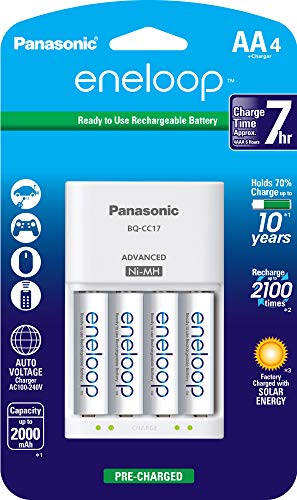


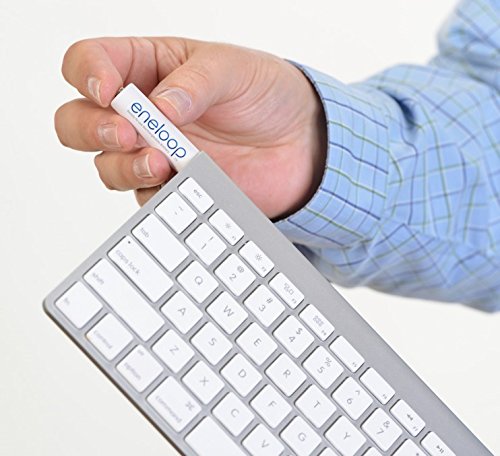

- Recharge up to 2100 times
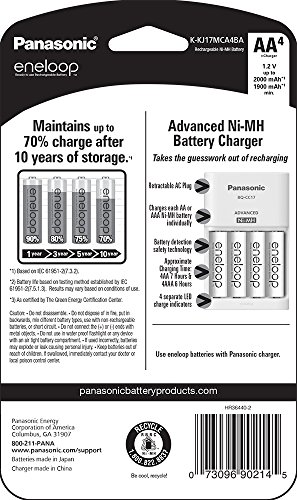
- Maintain up to 70% of their charge after 10 years (when not it use)
- 2000mAh type, 1900mAh min, Ni-MH pre-charged rechargeable battery
- 4 position charger with advanced, individual battery charging, AA and AAA cells
- Battery detection technology - automatically shuts off when charging is complete
-
Information
-
Twitter
-
Pinterest
-
Youtube
-
Facebook
Balsem Mosbah
Decipher Codes!
Lot's of confusion about "codes" so I put a chart up explaining the difference. Standard Eneloop models: 1st Generation Eneloop model numbers and specs AAA: HR-4UTG 1000cycles Rated 800mAh. Min. 750mAh ....AA: HR-3UTG 1000cycles Rated 2,000mAh. Min. 1,900mAh .......C: HR-2UTG 1000cycles Rated 3,200mAh. Min. 3,000mAh .......D: HR-1UTG 1000cycles Rated 6,000mAh. Min. 5,700mAh 2nd Generation Eneloop model numbers and specs AAA: HR-4UTGA 1500cycles Rated 800mAh. Min. 750mAh ...AA: HR-3UTGA 1500cycles Rated 2,000mAh. Min. 1,900mAh 3rd Generation Eneloop model numbers and specs AAA: HR-4UTGB 1800cycles Rated 800mAh. Min 750mAh ...AA: HR-3UTGB 1800cycles Rated 2,000mAh. Min 1,900mAh 4th Generation Eneloop model numbers and specs AAA: BK-4MCC 2100cycels Min. 750mAh ...AA: BK-3MCC 2100cycels Min.1900mAh ......C: BK-2MGC 1000cycles Min.3000mAh ......D: BK-1MGC 1000cycles Min.5700mAh 1=D 2=C 3=AA 4=AAA I just ordered these and got the 4th gen!!!!
Channea Rebecca
Probably the best Ni–MH AA battery on the market
I've been using a variety of Ni–MH batteries for a while now but for sheer reliability and longevity the Eneloop ones are hard to fault. This is the 4th generation of the Eneloop range the first coming to the market in around 2005, over time the number of charges has increased from the original 1000 cycles up to a claimed 2100 as well as extending the charge they retain in storage for longer. Since Panasonic took over Sanyo in 2013 the they retain the Eneloop branding, this model is BK-3MCCE the prior generation is HR-3UTGB the cycles up from 1800 on that model. It's easy to spot the newest model purely because they are Panasonic branded The cells are quoted as retaining up to 70% of their capacity for 5 years and are ready to use out of the box I tested the pack I got and the capacities ranged from 2020-2078 mAh this can vary a bit but you're guaranteed a minimum of 1900 mAh. Unlike some other makers you can be sure you'll get the quoted capacity Despite the higher cost per battery the longevity of the Eneloop batteries has been very good I've had sets for a good while now (over 5 years) and they're still going strong where as some budget offerings have lost their capacity or worn out after a few years. I've also never had a problem with the Eneloop cells fitting, in the past a few makers have played around the standard AA size and some are a bit longer or larger in diameter this can cause problems on some devices fitting wise. On the packaging Panasonic recommend using their own chargers, but I've never had a problem with a good quality third party smart/intelligent charger with any make of battery it's well worth investing in one of these as it can extend the life of cells and avoid overcharging problems that some timer/manual chargers have. **A few chargers worth looking at** Maha MH-C9000 (very advanced high end charger) Powerex MH-C9000 Technoline BL-700 or BC1000 Foxnovo F-4S The official Panasonic charger is: BQ CC16 this is an intelligent charger with individual monitoring and charging of cells, I don't recommend the basic BQ CC18 it works fine but it is timer control only. A decent budget 8 cell intelligent charger is the KooPower 8 Bay smart charger (this seems to be available in a few brand names same design though) Some of the top end chargers have multiple charging speeds and testing capabilities as well as discharge/re-fresh cycles. If you don't need these features then just go for a normal smart charger it's worth the small additional cost. There are some cheaper batteries out there, and some decent budget offerings too. But despite the higher cost this seems to be levelled out with the lifespan of the batteries. Hard to fault really a very reliable and solid offering and suitable for use in a wide variety of appliances even heavy drain items like flashes and digital cameras. For super high capacity users take a look at the Eneloop Pro range
Bryan Soon
Is this your best option?
When I first heard about Sanyo's new type of rechargeable batteries in 2005 I bought a set of them immediately together with the original charger. I still use those batteries on an everyday basis and though their ability to hold a charge has diminished a bit, they still work acceptably. At that time you had to charge all four batteries (and you couldn't mix AA with AAA) and the charge time was roughly 3-4 hours. Since then Eneloop has undergone lots of changes as has the product itself. Specifically what those changes are depends on where in the world you live. If you live in the USA the product you buy that's intended for the U.S. market is sold by Panasonic (one of the two owners now of the Eneloop trademark ... Sanyo is out of the picture) and the batteries are, or should be, made in Japan with the chargers being made in China. This particular set makes a big point that recharging time for a full set of four is 7 hours; charging time used to be underplayed previously. The reason may be that there is another, harder to find and more expensive "advanced" charger that quotes a 3 hour recharge time. What they don't make obvious is that if you are only charging 1 or 2 AA batteries the charge time for both chargers is identical ... 3 hours. You benefit from the faster charger time with the new premium charger only if you are charging 4 batteries at the same time. As long-time Eneloop customers are probably aware, there are literally pages of batteries with the Eneloop brand name being sold. Some have been reported to be counterfeit. Some are made in Chinese factories and intended to be sold outside of the USA. Some may have the Fujitsu brand on them and some may be ancient (pre-2009) Sanyo batteries. Do NOT buy those ... they are obsolete. This product checks out as legit and they were close to 100% pre-charged. As I discovered after getting 11+ years use out of my original set, the estimate of how many times they can be recharged is just that, only an estimate. Your useful life will vary depending on temperature and humidity conditions, what device you're using them in, how far you deplete them before recharging them, which if the several models of chargers you recharge them in, etc. If you have never before owned Eneloop batteries, I recommend starting with this kit of four AA cells with charger. I consider it a 5-star product.
Michael Catuiza
Definitely The Best Charger and Batteries in the market
The batteries that come with this great charger states a minimum of 1900mA. After they are fully charged I took 2 out and install it on a cheap Philips electric shaver, turn it on, started a stopwatch and watched a 2hr movie. When the movie ending credits started rolling, the shaver was still going on, strong. Started another movie. By the time shaver stopped running, time clocked is 3 hrs 27mins. Also confirmed that it can charge a single battery anywhere on the 4 available slots. Put 2 in positions 1,3 or 2,4 still works. Screw those models that allow charging only in pairs - the designers think with the head w/o the brain. The green leds are "embedded" inside and only light up in green when charging. When charging is completed they really did turn off. So overnight charging is cool, no worries about overcharging and slow-kill the expensive batteries. No charging cable. At the rear you flip out a 2-pin plug that connects straight to the wall socket.(see my pix) I got another set of four AA's and a pack of eight AAA's. This is a must have kit when the gizmos you have run on batteries, esp radio controlled toys since they eat batteries for breakfast. I don't have radio controlled toys, though..
Hamid Zahir
SIMPLY THE BEST RECHARGEABLE BATTERIES - ANYWHERE!
Eneloop batteries, regardless of size as I use several different sizes, are just amazing. While they do cost a little more than other rechargeable batteries they are worth every penny. They provide solid consistent power through their entire charge and hold their charge in storage amazingly well. I discovered Eneloop Batteries when I was researching AA batteries for my digital camera several years ago and found that among people who really understood rechargeable batteries they all pointed to them for the ultimate in battery power. I had trouble finding them locally so I ordered them from Amazon and started using them. I was just amazed at the difference between Eneloop and every other rechargeable battery I had tried previously. They hold more power which translates to better, longer performance in the device. It's important to note it makes sense to choose which Eneloop battery is best suited for your needs. The white (standard) Eneloop battery is perfect for most uses - TV remotes, flashlights or small electronics while the Eneloop Pro (black) is designed for, and perfectly suited to deliver the power for heavy drain items such as - remote controlled vehicles, digital cameras or DSLR external flash systems. No matter what I've used my Eneloop batteries in they have never let me down. I keep them numbered and rotate them to keep in use to keep them charged and in top working condition.
Avis Evans
Panasonic K-KJ17MCA4BA Advanced Individual Battery Charger + 4 AA Batteries
My review is for the Panasonic K-KJ17MCA4BA Advanced Individual Battery Charger + 4 AA Batteries. I purchased this product as a better alternative to the Sony CycleEnergy charger I purchased last Christmas at a B&M store in Germany for €29.99 (about $37 USD). The biggest disadvantage I had with the Sony CycleEnergy charger is that it required me to always charge batteries in pairs, which ended up becoming problematic after noticing that the batteries don't always charge equally. I would charge the batteries until the LED light would notify me that they are ready to use, yet after inserting them into my high-power devices the batteries would already read one to two bars lower instead of indicating all the bars for a full charge. At the time I also only owned two rechargable AAA batteries, one which was used for my wireless laptop mouse and the other for a Bluetooth stereo remote. This also turned out to be a problem since the wireless mouse would drain the battery very quickly whereas the battery in the remote would barely lose its charge, which in turn would force me to charge a near dead battery with an almost full battery. It was at this point that I started looking into a better alternative for charging my rechargable batteries, and after a bit of research I came across the Panasonic BQ-CC17 "Advanced Individual Battery Charger". The reason I chose to go with this specific brand and charger was because it has excellent ratings, the great price, and most importantly allowed for individual cell charging. I cannot express how pleased I am with this product, and I highly recommend this product without any hesitation to anyone in need of an excellent battery charger! The convenience factor alone of not having to charge batteries in pairs makes this product a well worth investment in my opinion. I am also shocked at how affordable this battery charger is compared to the Sony CycleEnergy I purchased, as I only paid ~$20 which included 4 AA batteries that sell for ~$14 if bought without the charger. I practically could have purchased two of these Panasonic chargers for the price that I paid for a single Sony CycleEnergy charger! As far as my experience with the battery indicators on my high power devices, they finally indicate a full charge when inserting the batteries into the device! Which tells me the reason as to why it showed one to two bars less on my previous charger is because the charger was set on a timer and one of the two batteries must not have been getting fully charged during the process. The BQ-CC17 has also bee compatible with all my other NiMH rechargable batteries, which so far include my Sony CycleEnergy AA and AAA, Duracell AAA and AA StayCharged, and Energizer Recharge Plus AA. Another plus for folks such as myself is that this charger works outside the U.S., as the packaging indicates 100-240V 50/60Hz making it world wide compatible as long as you buy a plug converter (can be found as cheap as $1, though I would recommend paying a few extra bucks for a better quality and safer product). The only con I found with this product initially was in regards to the LED lights, not that there is any performance issue with the lights themselves, it was just impossible to even know they existed until you plug the charger in and charge a battery. When the item first arrived I was under the impression that I had received the wrong charger as I couldn't see any LED lights on the charger nor did I find any mention of them on the packaging. I had to go back to the product page on Amazon to ensure that I had purchased the right product and properly read the description to include LED indicators. It wasn't until I used the charger for the first time that I was able to spot the LED indicators, as they are hidden behind the white plastic case and near impossible to see without charging a battery. Overall I think it actually makes the charger look more aesthetically pleasing with the LED lights hidden behind the case, I just found that initially it created some confusion since some of the pictures on the product page show the little green lights which makes it seem like the lights are featured externally on the charger. Perhaps it was just me, but I figured I'd mention this just in case anyone else is a bit confused when they can't find the LED indicators as the thought of them being hidden behind the casing never even crossed my mind. Another thing I want to mention in regards to these Chargers is that it appears the only difference between the BQ-CC17 and BQ-CC17 "Pro" is the color. According to the product information from each charger, everything else appears to be exactly the same. So unless you prefer a black charger over a white one I recommend that you don't get hung up on the extra wording of "Pro" and instead purchase the BQ-CC17 charger that comes with the 4 AA batteries as that's the best bargain. My purchase was shipped by and sold from Amazon.com, which arrived in the retail packaging displayed in the picture of the product page and was fairly easy to open. The 4 AA batteries including in this pack came pre-charged and were ready to be used upon arrival. In my opinion this charger is the best in it's price class, I'll even go as far as saying better than all of the more expensive models I've bought in the past. Short Summary: -Charges batteries individually which results in proper battery charge, unlike those chargers set on timers or requires charging in pairs. -Great price, especially if you purchase the model that comes with 4 pre-charged AA batteries. -Works worldwide (100-240V 50/60Hz) with additional purchase of plug adapter/converter -LED lights are hidden underneath white casing, will only turn on when battery is being charged In conclusion, this is the best rechargable battery charger I have ever used, I cannot recommend this product enough!
Ross Ariffin
What's in a name? (That which we call an eneloop by any other name would work as well)
I have done extensive study on low-self-discharge (or 'pre-charged') rechargeable batteries, starting from early 2007 when the original Sanyo eneloop cells were introduced to the US market. Subsequently I have tested Sanyo 2nd-gen eneloop, followed by Sanyo 3rd-gen eneloop and finally these Panasonic 4th-gen eneloop. Every single eneloop cell I have purchased in the past 8 years, including the original ones, are still in good working conditions. That says a lot about the quality of eneloop batteries. But the question is: are there any REAL improvements in later generations of eneloop batteries? [Capacity] The advertised capacity ratings for all eneloop (1st to 4th-gen) batteries are identical: - AA cells are rated "Typ. 2,000mAh, Min. 1,900mAh" - AAA cells are rated "Typ. 800mAh, Min. 750mAh" Actual capacity measurement, using my old La Crosse BC-900 Battery Charger, also showed that capacity numbers are consistent from 1st to 4th-gen. In fact, my measured results are consistently about 4-5% higher than the advertised values. [Charge Retention Rate] With each new generation, eneloop's long-term charge retention rate gets a little more ambitious: - 1st-gen claims "85% after 1 year" - 2nd-gen claims "85% after 1 year; 75% after 3 years" - 3rd-gen claims "90% after 1 year; 80% after 3 years; 70% after 5 years" - 4th-gen claims "90% after 1 year; 70% after 5 years" Notice that those numbers are essential the same, just extending over longer period of time. In fact, I have tested a set of first-gen eneloop cells after 3.5 years in storage, and they still contain around 75% of rated capacity. To me, this shows that there are no real changes in the charge retention rate among different generations. [Cycle Life] The main difference between different generations is in the advertised lifespan: - 1st-gen: '1000 cyles' - 2nd-gen: '1500 cycles' - 3rd-gen: '1800 cycles' - 4th-gen: '2100 cycles' Let's consider how long it takes to actually test a rechargeable battery through 2100 deep discharge/recharge cycles: The standard test procedure calls for charging at 0.2C (~5 hours) and discharging at 0.2C (~5 hours), plus cooling period of one hour each between charge and discharge phases. So a complete cycle takes about 12 hours. To exercise a battery through 2100 cycles would therefore take nearly three years! However, 3rd and 4th-gen eneloop cells are both released less than 2 years from their previous generations. [Bottom Line] My theory is that all eneloop 2nd/3rd/4th gen batteries are in fact made with the same battery technology. It takes many years to collect the actual cycle life and charge-retention rate data. Therefore only later generations are able to advertise higher number of cycles and longer storage life. If my theory is true, then it follows that there's no reason to pay higher price to get the latest 4th-gen eneloop. Any earlier generation of eneloop would perform just as well. Finally, if you are extremely 'value conscious' like me, consider the following rebranded eneloop batteries and get the same quality for even less: - AmazonBasics Pre-Charged Rechargeable Batteries (in white wrappers) are rebranded Sanyo eneloop. - AmazonBasics High-Capacity Pre-Charged Rechargeable Batteries (in black wrappers) are rebranded SANYO eneloop XX batteries - Duracell Ion Core AA Rechargeable Batteries are rebranded Sanyo XX, while Duracell Ion Core AAA cells are rebranded eneloop AAA batteries [Update on Dec 22, 2015] For additional information on eneloop batteries in general, please refer to my newly updated "Panasonic/Sanyo eneloop FAQ": http://www.amazon.com/review/R3L93DRAE29PCG/
You Seong Lew
Functionally speaking, the rechargeable equivalent of alkalines
Where It Wins Stars (+) Low self-discharge variety (+) Individual cell charger (+) Packaged charger accepts AC 100-240V input voltages (+) Functionally similar to alkaline batteries Where It (Almost) Loses Them (-) *Just slightly* thicker than alkaline batteries (-) Can take up to 7-8 hours to charge a drained eneloop to full capacity Caveats for International Customers (/) Although the charger can accept a wide range of input voltages, the integrated electrical plug on the unit I received is of the US-style 2-pin configuration. A physical pin adapter may be needed for overseas use Overall: Five stars. For all intents and purposes, the eneloops are the rechargeable equivalents of alkaline batteries. Note: This review is based on AA/AAA eneloops used in conjunction with the BQ-CC17 NiMH charger I'm no electrical or chemical engineer, so I cannot provide a detailed analysis on the characteristics of a battery. This review will just be from the lens of an average consumer that uses AA/AAA batteries in his electronic devices. I'm new to rechargeable batteries. However, for a long time, it was a given fact that not only rechargeable batteries lose their maximum storage capacities rapidly after a few recharges, they are also unable to hold the electrical energy stored inside them for prolonged periods. These two facts alone are enough for me to hold off investing in rechargeable batteries in the past. Now, however, these Panasonic Eneloops seem to have overcome the technological challenges, hence making it viable for myself to try out rechargeable batteries on a daily basis for the first time. For reasons unknown to me, every electronic device I've owned that requires AA/AAA batteries officially states that they only accept 1.5V alkalines; the eneloops, on the other hand, are specified at 1.2V NiMH. However, I have yet to encounter a device of mine that refuses to accept the eneloops; game controllers, computer mice, calculators, flashlights et al all work as per normal with similar battery lifespans observed. Naturally, this may not hold true for all electronic devices out there. The eneloops also provide more information to the end-user, printing their min/typical electrical capacities on the wrapper. Whereas, alkaline batteries I've used reported only their expiry dates. That being said, being an average user, details of their electrical capacities are not immediately useful to me without further interpretation. However, the biggest advantage of rechargeables over alkalines is the removal of uncertainty in the remaining charge left. With the eneloops, I no longer have to second guess whether the batteries would last in later use; simply charge them to remove all traces of doubt. The eneloops' low self-discharge capability and its ability to retain its maximum electrical storage capacity certainly help in this regard though I have really no means of verifying this fact objectively, though my everyday experience with the batteries has not suggested otherwise. The BQ-CC17 charger is able to charge 4 NiMH cells, AA or AAA, individually. This is without doubt, the best feature of the charger as most other models I've seen require pair charging minimum. However, there are two aspects about this charger that are less than ideal. First, the 4 individual LEDs are not aligned with the cell slot. Coupled with the fact that the LEDs are hidden until the slot is occupied and charging, it can be confusing to identify which cell has completed its charge cycle. Furthermore, I find it takes a tad too long to fully charge a drained eneloop, about 7-8 hours. Granted, I understand that this is just a basic charger without all the advanced functions expected in a dedicated unit. Still, I would have preferred it if the charging duration was shortened to 4-5 hours instead of taking almost all daylight. Finally, as an average user, I found the eneloops are a hair thicker than alkalines. Devices with extremely tight-fitting battery compartments may face an issue in this regard, but I have yet to encounter a device which cannot accept the dimensions of the eneloops. Other rechargeable battery brands I've come across in complimentary gifts also exhibit this behavior, so this issue is definitely not specific to the eneloops. For all intents and purposes, the Panasonic Eneloops are functionally similar to alkaline batteries in my everyday use despite different voltage specifications and battery chemistry. Having used the eneloops for a few months, it has thus far lived up to its claims of low self-discharge and high maximum capacity retention. Your mileage may vary, but I find the eneloops an economically viable alternative to alkaline batteries in high-drain electronic devices.
Ben Myers
Worth the money if you use lots of AA batteries.
i was introduced to these batteries back in 2011 and I have been using them since. I decided to purchase these new gen 16 pack eneloops and I am not disappointed. Long lasting batteries come charged a little over half out the box ready to use. I use them for flashlights and Roku because they are my high drain devicec. I added a photo to my batteries with the box I use to store them. Great way to keep track of old and new batteries. Also the upside down means that they are not charged and right side up means that they are fully charged. Worth the buy
Mim Blank Nonnemaker
Big improvement over previous generations of eneloop battery chargers
During the past 9 years, I have tested probably every model of eneloop battery chargers available in the US. This latest Panasonic Advanced eneloop Individual Battery 3 Hour Quick Charger (BQ-CC55) is definitely the best. [Individual Charging] The BQ-CC55 handles 1-4 AA or AAA cells independently. This is the only way to ensure each cell is fully charged but without overcharging. In contrast, the old charger MQN06 can only charge in pairs. [Faster Charge Time] The BQ-CC55 is advertised as a ‘3-hour charger’. On the back of the unit it claims output current is 750mAx4 for AA, 275mAx4 for AAA. But my actual observation shows that it is a bit complicated. The unit uses pulsed current for charging: - When charging 1-2 AA cells, the current pulses from 0 to 3A at 46%, for an average of 1400mA - When charging 3-4 AA cells, the current pulses from 0 to 3A at 23%, for an average of 700mA - When charging AAA cells, the current pulsed from 0 to 1.25A at 46%, for an average of 575mA. For example, suppose you are charging some 2000mAh AA cells. The charge time will be around 1.5 hours for 1-2 cells (because 2000mAh / 1400mA = ~1.5h), or 3 hours for 3-4 cells. This is significantly faster than the previous model Panasonic BQ-CC17, which takes around 7 hours since its average charging current is only 300mA. [Battery Status Indicator] The BQ-CC55 has four battery status indicators. Each indicator changes color according to the fullness of each cell: Red = nearly empty Yellow = half full Green = Full Blinking Red = Bad cell. Note that the description says Yellow = 20-80% and Green = 80-100%. This is not entirely accurate based on my observation. The moment an indicator turns Green, charging for that channel stops. That means the cell is already 100% charged and safe to be removed. Once all four channels have finished charging, the unit enters low-power standby mode and all LEDs are turned off. [Power Consumption] I measured the input power of the BQ-CC55, using my EUM-A1 Power Usage Meter: - In standby mode the unit consumes just 0.2W - When charging 1 AA cell: ~4W. This is consistent with an output of ~2.5V at 1.4A. - When charging 2-4 AA cells: ~8W [Bottom Line] The Panasonic BQ-CC55 is a big improvement over previous eneloop chargers, including MQN05 and BQ-CC17. If you don't already have an Advanced charger at home, I definitely recommend getting this unit. [Minor Issues] - Charger makes a faint buzzing sound while charging with pulsed current. - Due to higher current, this charger is more likely to reject batteries with marginally high impedance. Some explanation on impedance check: Many smart chargers (including the Panasonic BQ-CC17, BQ-CC55, Maha MH-C9000, etc) perform an impedance check before the start of charging. This is done by sending a high current pulse briefly through the cell, and measure its voltage drop. This gives an estimate on the internal resistance of the cell. The reasons for doing this are: 1. If the user accidentally put an alkaline cell in the charger, it will be rejected due to its higher resistance. Otherwise if you recharge an ordinary alkaline cell in a NiMH charger, it may leak or rupture. 2. If the cell is the correct NiMH type but suffers from higher resistance, it will also be rejected. Otherwise the cell will generate excess heat when charged at high current. Heat will shorten the cell's lifespan, or even cause the cell to leak or rupture.