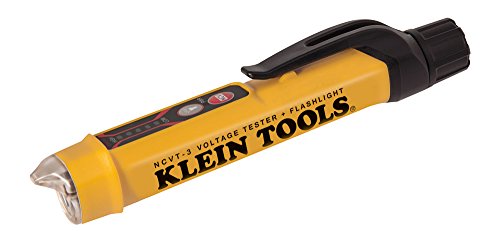

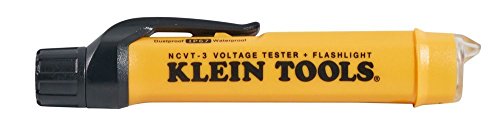

- Provides non-contact detection of AC voltage
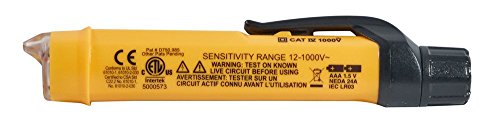
- Detects 12 to 1000V AC with simultaneous visual and audible voltage indicators
- Bright flashlight illuminates work area and may be used independent of voltage detection function
- Visual LED bar graph indicates the presence of voltage - the higher the voltage sensed, or the closer to the voltage source, the more LEDs light up
- Bar graph visual voltage indicator utilizes up to five vibrant LEDs for easy interpretation/viewing
- Audible voltage indicator beeps at a greater frequency the higher the voltage that is sensed, or the closer to the voltage source
- Auto Power-Off conserves and extends battery life
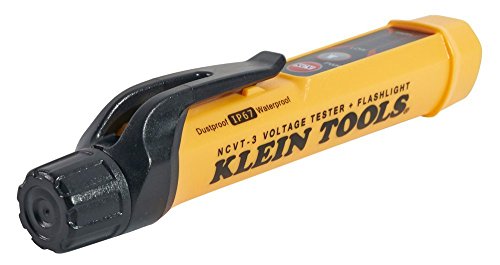
- Screw-thread battery cap with O-ring ensures protection against dust and water ingress
- Lightweight, compact tool with pocket clip provides convenient storage and quick access
- IP67: Dustproof and waterproof
-
Information
-
Twitter
-
Pinterest
-
Youtube
-
Facebook
Xyza Yoradyl De Vera
Great light
Love the meter on this, which is why I bought it over the Milwaukee. But it's the flashlight on this thing that I really like, it's not really bright but it's a perfect circle with NO hot spots
Stephanie Holton
Great troubleshooting tool
Saved me hours when I clumsily forgot to unplug a garage door opener while swapping a circuit board and shorted a line that had tentacles running everywhere. Circuit breaker did not trip but this jewel helped me track the lines to the two electrical outlets that fried and allowed a simple repair. Not much help for the opener, which was toast. Only drawback was sensitivity while testing lines at the circuit breaker panel, but for the price I did not expect miracles. Oh, and I dropped it from a ladder 8' to the concrete floor...no damage, even the dandy flashlight still worked.
Phil Will
The best features of two previous models
Being a homeowner DIY’er I thought I knew enough about tools to own most of the essential basic ones. I literally just found out about the existence of this type of device by reading an especially well-written setup guide for a wall switch. For years I’ve used one of those little plug-in polarity/GFI testers when I wire an electrical outlet to make sure it’s right. The same tester also gives me assurance that I didn’t forget to turn the circuit breaker off. But for wall switches and other wiring (especially in an older house that has wiring shortcuts) I’m never 100% sure that there isn’t a hot wire in that box or which one of those two identical black wires is the lead. Finding this tool isn’t just nice, it’s mandatory. As I shopped for the right tester the biggest selling model was a fraction of the price of this one from Klein Tools and I’m sure it would have worked just fine. But working with electricity isn’t the time nor the place to go low budget. I was attracted to this one primarily by the five LED’s that not only show you the presence of voltage but gives you an idea of proximity and strength, that plus it has a warning beeper for good measure. It is a non-contact type, which seems to be what the majority of them are. I wasn’t sure why that was important until I realized that it will work through wiring insulation, cable caps and with those switches where the wire is pushed into a hole in the back of the switch rather than attached to an exposed terminal. It makes a lot of sense you need a tester that doesn’t actually have to touch a bare wire to warn you of the presence of voltage. This model includes a built-in LED flashlight, partially contributing to its higher cost. The very last thing I need in my house is another flashlight and that almost turned me off to paying extra for it. Then I got to thinking about those real-life scenarios in which I’m working deep inside a terminal box and guess what, I had to turn the circuit breaker off which means none of the room lights around me work. Of course I need a flashlight and I only have two hands, so having the flashlight built into the end of the same tool I’m using to check for voltage isn’t just a convenience, it’s an important design feature. I’ve never owned anything from Klein Tools but I’ve always heard that they are one of the best brands. Did you know they were founded in 1857? That’s 22 years before Edison invented the light bulb. I'm surprise and disappointed that a company with such a highly regarded reputation is so lacking in a how-to-use owner’s manual. They show an illustration of the switch locations and how to replace the batteries but that's about it. I guess they assume someone buying this knows all about using it but they're wrong. They need to include a detailed tutorial on the proper use of what to do and what not to do in typical DYI use of a non-contact voltage detector. The tester, which combines the best features of the Klein NCVT-1 and NCVT-2 and adds more is surprisingly rugged feeling, it may be the first one I’ve owned but I’ve got a feeling it’s going to be the last one as well.
Sudath de Silva
The Swiss Army Knife of Voltage Testers
Simple testers at half the price are much less confusing for basic live wire identification and trouble shooting. This sophisticated and flexible tester is much more sensitive than the basic testers, and it is also capable of confusing the inexperienced user. But, for an advanced user, it can trace and find breaks in every kind of wire path - from a USB power source, to a doorbell system, to an LED light fixture, all the way up to the wires coming into and leaving the circuit breaker panel. And, if you need to find broken or failed connections in existing wiring without tearing the walls apart, this could be just the ticket. Useful also if you need to add new outlets or switches in existing homes. Why? Because it is quite capable of tracing the paths of live wires behind walls. With it you can practically see through the wall by scanning along the surface with the tester held about an inch from the surface. To make sense of what the tester is indicating, you must have a basic notion of how electric wires are installed and routed inside the walls in a typical home. Also, to keep your sanity in the face of false voltage indications, you’ll need to develop the trick of “desensitizing” the tester by holding the tester with your finger resting near its tip to eliminate most false positive indications. Where you have LED lamps and dimmer switches, the tester can easily be fooled by the kind of electrical noise generated by these devices, but the finger method has worked well for me. Lucky for me to have discovered this trick, because I have many dimmable LED lamps in my house. All in all, for my advanced projects and puzzling electrical faults, this tester now holds a place of honor next to my venerable and reliable two dollar neon lamp tester.
Reahannon Carr Toon
Useful practical device
This tool has been working very well for me, consistently detecting current carrying wires in almost all cases. There have been a few times when a junction box was stuffed full and it was confused by nearby wires, but then that's what a multi-meter is for. If you're not 100% sure, check again, it's not worth getting burned or worse just to save a little time. The flashlight is quite useful. I like that the switch is not easily turned on accidentally, and that the device turns itself off automatically if you forget.
Robin Guillory Franks
Handy tool. Use almost Daily
Pros: light/compact, cheap, fairly accurate once you know how best to use it. Cons: Flashlight is almost worthless(but who really is buying this for the flashlight?) Use at work to trace wires, spot check for voltage(yes i double check with a meter), and to differentiate quickly between different voltages in large runs of wire all ran together. This tool can be very effective at "sniffing out" different voltages if you learn how to use it correctly. It is very sensitive so sometimes covering the end with your finger will help you get more accurate results. Also isolating the wires your testing best you can helps a lot. I use this to troubleshoot lighting/ballast problems at work and it saves me quite a bit of time. The wire terminations for the ballasts and the lights are very hard to get to in some cases and being able to locate/differentiate voltages in wires going from the ballast to the light cuts a lot of troubleshooting time out. When i say differentiate between voltages i mean in a general sense. For instance 1bar= 24v-48v, 2bars= 120v, 3-4bars= 220v-277v, 5bars= anything above 300v. This is scale is an average indication based on how i use the tool and is not indicative of what you should expect. You should always verify with a multi meter and isolate power before performing work.
Paula N Moore
Works great, prevents me from getting zapped
Works great, prevents me from getting zapped. I've used it three times and it has been great. I did notice it is sensitive to other devices nearby. My tv was 1 foot away from an outlet I was testing and it triggered it. This caused me to be a bit confused over whether my house was wired wrong or if I hadn't properly turned off the breaker. I turned the tv off and then it worked reliably. I assume that's the drawback of non-contact. I also noticed that if you tap it against something it will read a current which confused me at first.
Dunja Gagulić
The Difference Between The Emergency Room and a Successful Electrical Project
DISCLAIMER: Electricity can KILL you. I am the furthest thing from a licensed electrician. Please do not apply anything posted below to your expertise as I am not a professional. If you have questions about a project consult your local licensed electrician. I am a weekend handy man, and not a very good one at that. I don’t know much about electricity. I do know that there are things around the house that I could fix myself if I was comfortable with absolutely knowing that the power was off and I would NOT wake up in the emergency room. Ceiling fans for example, I’ve held off of new ceiling fans because I’m paranoid want to be SURE that there is no juice coming into the area I’m working on. Enter the Klein Tools NCVT-3 Non-Contact Voltage Tester with Flashlight. It was made for paranoid newbies like myself. Point to the desired area, if you get no beeps, you turned off the right breaker. While I’ll still turn everything off at the main, it’s comforting to be able to test the exact area that you are about to work on. There is no ambiguity here, the circuit is hot or not. And the Klein will let you know which that is. The build quality on this thing is fantastic. Being a Klein product I shouldn’t be surprised but this thing is well built. Has a little heft to it. It’s freaking waterproof and dust proof. It’s something that will be in your toolkit and working for a long time. An absolute steal price wise for a top of the line product. Shipping: for the first time ever a product I ordered from Amazon was lost in delivery. But once again Amazon steps in and overnights me a replacement and we’re all happy. For any retailers in the audience, that is how you retain loyal customers.
Imane Ait El
Works Fine
I like the progressive LED display of low to high AC voltage and the audible alert is handy when you can't get a clear view of the LED display. The built in flashlight is a plus and the unit seems sturdy. I already dropped it about 5 ft on concrete with no damage. While it can discriminate between the hot and neutral side of an outlet, it is not a substitute for a plug in outlet tester to show reversed wiring, missing ground, etc. It was useful to me identifying live and abandoned knob and tube wiring. It is sensitive enough for work on 12V landscape lighting. These testers can only detect voltage on alternating current circuits, so this tool won't work for direct current systems such as those found in vehicles.
Eun Hee Lee
Tests Accurately!!
I needed a few electrical outlets replaced and was on the search for a good voltage tester. I was going back and forth between Klein and Fluke and finally decided on the Klein NCVT-3. Prior to turning off all power, I tested not only outlets that needed to be replaced, but all my outlets to be sure of accuracy of this tester. Then, after all power was shut off, went back around to test again to be sure it was safe to get to work. I was able to replace all my outlets with no problem and the flashlight was a major plus/help because I had no other source of light to see what I was doing. I am very pleased with this voltage tester and would highly recommend it for accuracy and the ease of knowing you can be safe using it.