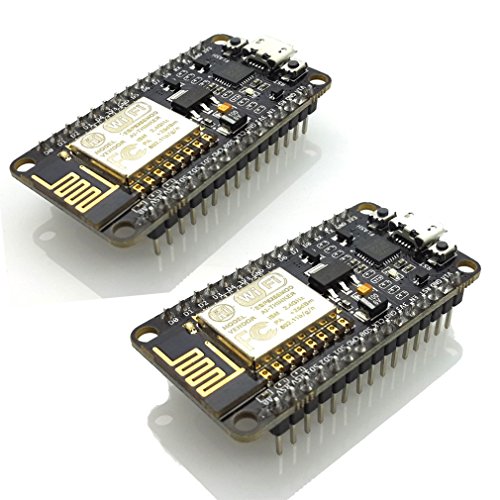
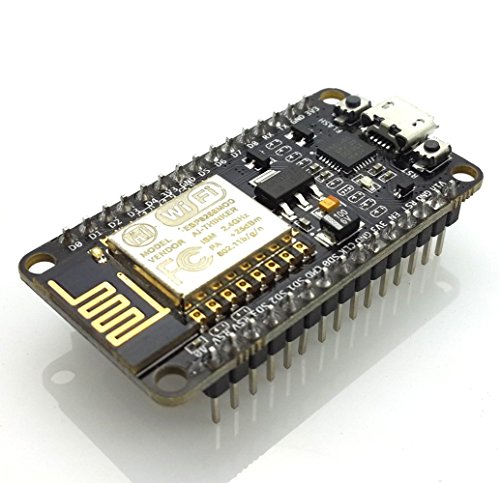


- Built-in Micro-USB, with flash and reset switches, easy to program
- Full I/O port and Wireless 802.11 supported, direct download no need to reset
- Arduino compatible, works great with the latest Arduino IDE/Mongoose IoT/Micropython
- Data download access to the website: http://www.nodemcu.com
- Firmware link: https://github.com/nodemcu/nodemcu-firmware
-
Information
-
Twitter
-
Pinterest
-
Youtube
-
Facebook
Nikki Darling
HiLetgo did an Excellent job on these -- not a 1to1 replacement for Arduino, better in some ways, less capable in others
These really are fantastic devices. I purchased 3, all arrived from HiLetgo in a couple of days, all perform flawlessly. It was a bit of a learning curve on the first but once it was setup was able to use the familiar Arduino IDE to program a temperature logger with a 20 x 4 line LCD that displays the current time, temperature, humidity and heat index from a DH22 sensor, current outside conditions along with four day forecast (from yahoo weather). PWM is software so if you want to use these to control lights for Christmas displays you might be better to look at an Arduino Mega for it's hardware PWM. For most things I do involving IoT these ESP8266 devices are great. These are much easier to work with than the cheaper 8 pin models.
Stephanie Muschamp
I'm using the NodeMCU as a web server and it works great. It was a struggle to find example code ...
Complete project description follows. I'm using the NodeMCU as a web server and it works great. It was a struggle to find example code that actually connects outside my local area network but I found some. Also had to learn the rudiments of HTML. Only issue is it seems to need to be restarted every 4 or 5 days. Since I'm going to leave it in a remote location I'll put some code in the MEGA that sits right next to it to restart the NodeMCU every couple days, by pulling the RST pin low. Green Pond Bridge Boat Clearance At ‘very low tide’ the clearance under Green Pond Bridge in Cape Cod is 6’6” or less and that is too low for the boat I use. The tide charts for Falmouth, MA are theoretical and can vary as much as 18” from what is actually happening at the bridge. This system monitors the clearance and transmits the information on the internet. All of these parts were purchased from Amazon. Transmitter An (Arduino) Elegoo UNO R3 board is connected to an Elegoo HC-SR04 Ultrasonic Distance Sensor. The UNO and the sensor calculate the distance from a fixed dock to the sea level, then transmit that data using a MakerFocus NRF24L01 Wireless Transceiver to the Receiver described below. The Transmitter sits on the end of a dock where there is no power, so the UNO, Transceiver and Distance Sensor are powered by the energyShield 2. This battery has special capabilities – it wakes everything up every 15 minutes. The system takes a couple readings of the distance to the water then transmits that data, then the battery shuts it all off. The data transmitted includes information from the battery – time, date, and voltage. I have been testing this unit at home (in Dallas) and it has been operating outside, for about 20 days. Based on battery drain it looks like it will operate for about 4-5 months before it needs a recharge. When the temperature drops below zero the system still works fine but the voltage reported in the battery seems low. All of this is housed in a plastic box printed for the purpose with a FlashForge 3d Printer Creator Pro, using eSun White ABS+ filament Picture below. Receiver An (Arduino) Elegoo MEGA 2560 R3 is connected to another NRF24 Transceiver to receive the data. The MEGA does the math to convert the distance from the dock to the water, to the bridge clearance. Then the information is displayed on an Elegoo UNO R3 Touch Screen (that also works fine on the Mega). Picture below. A small plastic frame for the Receiver was also printed on the 3d printer Web Server Finally, the information in the MEGA is transmitted over a serial bus to a Hiletgo ESP8266 NodeMCU ESP-12E Internet WIFI Development Board (Also operates using Arduino IDE programming). This board is connected to the MEGA via the XCSOURCE Logic Level Converter and powered by a UCEC MB102 Breadboard Power Supply Module. All mounted on an Elegoo Breadboard. The ESP8266 is programmed to be a web server. It connects to the internet through the modem/router provided by AT&T. Picture of my cell phone below.
Lyka Habal Belisario
WiFi Failed on first Day, but HiLetGo worked to make it right
I bought this and on the very first day, Wifi Stopped working. I played around with it for an hour. I decided to open the other package and try it. I Plugged it in, programmed it, and it connected immediately. I still have not been able to get the first one's WiFi working even following troubleshooting guides online. If you don't need something reliable, then this product will work fine, but if you care about WiFi working for more than a day or two, avoid this product. Edit: I bumped this up to four stars. After about another hour of back and forth emails, HiLetGo offered to replace or refund the device. I would have given it five stars if it hadn't been so much of a hassle to get this issue corrected. I opted for the replacement because I think this has the potential to be a great device. 2nd Edit: After some more consideration and working successfully with the second board. I realized the first one was really a fluke and HiLetgo did work hard to make it right, so I'm bumping this back up to 5 stars.
Thet Myat Noe
Very impressed!
Worked perfectly on the first try. Just follow the directions on the underside of the board and use the Arduino IDE and ESP8266 board download URL to program. It’s very easy to use and it can connect almost all electronics projects to the Web. As a test, I built a small robot that is controlled over WiFi and it worked great. One downside to this board is that it causes a pretty big voltage drop. The voltage drop can be severe enough to cause the board to reset. Easiest solution is to increase the voltage at the Vin pin (Maximum is 10V) to compensate or add a big capacitor between Vin and GND. Otherwise, it’s awesome!
Timothy Drake
Updated review. HiLetgo is making things right.
[2018-07-20] Seller has reached out to me to offer replacements for these MCU boards. This is good customer service, and I will trust that I just had an anomaly in the lot that I received. If things don't work out, I will return to give an update, but at this time all is great with HiLetgo. [Original review] Bad quality in my lot of parts. I have purchased a few of these and a large portion have manufacturing defects. I have had to touch up solder on the USB connector on one because it wasn't making contact when the cable pulled down on it. The other is unfixable because the UART chip had its legs bent under when it went through the surface mount solder process. There is no way it was QA tested fully or visually inspected with this defect. It won't boot or flash. The photo here is AFTER I removed a large glob of solder off the edge of the part. Wish they had a little bit better QA
Claudio Delgado A Luis
Pair of very nice development boards, great deal!
The ESP8266 boards are awesome! These are more powerful than the original arduino boards with built in wifi capabilities. There are numerous projects that can be quickly set up for IOT experimenting and prototyping. Using the Arduino IDE, the board profiles can be downloaded and set up in the IDE using the Boards Manager and from there the Arduino IDE is all you need to do development on these! Below is the output from the example application provided in the Arduino IDE for testing a few of the board's API calls: ESP starting. system_get_time(): 64235 system_get_rst_info() reset reason: REASON_EXT_SYS_RST system_get_free_heap_size(): 49944 system_get_os_print(): 0 system_get_os_print(): 1 system_get_chip_id(): 0x75D9F1 system_get_sdk_version(): 3.0.0-dev(c0f7b44) system_get_boot_version(): 31 system_get_userbin_addr(): 0x0 system_get_boot_mode(): SYS_BOOT_NORMAL_MODE system_get_cpu_freq(): 160 system_get_flash_size_map(): FLASH_SIZE_32M_MAP_512_512 wifi_get_opmode(): 1 - STATION_MODE wifi_get_opmode_default(): 1 - STATION_MODE wifi_get_broadcast_if(): 1 SoftAP Configuration -------------------- ssid: TestAP password: testtesttest ssid_len: 6 channel: 1 authmode: AUTH_WPA2_PSK ssid_hidden: 0 max_connection: 4 beacon_interval: 100ms --------------------
Maricel Ching Neri
Great packaging, great quality, plug and play!
Awesome boards, and for the price, you can't go wrong! They were packaged great as well, including anti-static bags, which seems to be too rare these days. I was able to get sketches uploaded without any driver installs (CP2102) and I already had the ESP8266 Library installed in the Arduino IDE, so it was literally plug and play for programming! I just used the defaults for the Node MCU and I was off and running, which was board "Node MCU 1.0 (ESP12E Module)" from the Arduino IDE. I was so used to auto-reset on other boards I spaced pushing the "flash" button during the upload process.. failed a few times before I realized what was going on, unfortunately can't blame the board for that! :)
Audrey Andersen
Awesome!
I was sooooo close to returning these because I really didn't understand them and I could not get them to be recognized by my mac or PC. I am so glad I figured it out because they are unbelievably awesome. Small, compact yet powerful and fast. Using one of these for about 4 wireless sensors and a 120/5volt relay in my garage, all hooked up thru Apple HomeKit. Totally amazing. would buy again. Great product, well manufactured. All the reading you see are from this one unit. I will be adding a few more sensors before this one is filled up. Love it.
Jacob Martinez
The best way to connect your project to the internet
This is the best dev board out there if you're looking for an inexpensive way to get real input and output on the internet. The Arduino was the best tool for electronics tinkerers until the ESP 8266 came out. It has WiFi and everything needs a connection to the 'net now. Every project has more possibilities when data is flowing. I made a remote to control Philips Hue White A19 60W Equivalent LED Smart Light Bulb Starter Kit, 4 A19 White Bulbs and 1 Bridge, Works with Alexa, Apple HomeKit and Google Assistant with an ESP8266 and 3D printed a case for it. I use it multiple times a day to turn the lights on in my bedroom and it has never failed me. Everyone that plays with electroincs should own one of these boards.
James Henry Wilkey
Great board at a great price. Get them while the price is low!
I was looking to test an MQTT-based Proof-of-concept. I needed a few more ESP-based MCUs to round out my inventory. I stumbled across HiLetGo while searching for this product. I was skeptical, at first; the prices were very low, and normally, that means that quality has been sacrified. I took a chance, and I am very pleased! The pins are clearly labeled. There were no traces, jumpers or poor soldering spots. But let's talk about what really matters: Did it work? Yes! I tested the NodeMCU with the Arduino IDE. It worked perfectly! I have some other boards that constantly needed to be reset every 3 or 4 writes. Not so with these boards. First time, every time. Had I known about HiLetGo eariler, I could have saved myself some time. Learn from me. Buy some now! I have included a screen shot of the NodeMCU using an I2C SSD1306 OLED. Helpful hint: even though the board says to set it at 9600 for the upload speed, dial it up to 115200. You will thank me later!