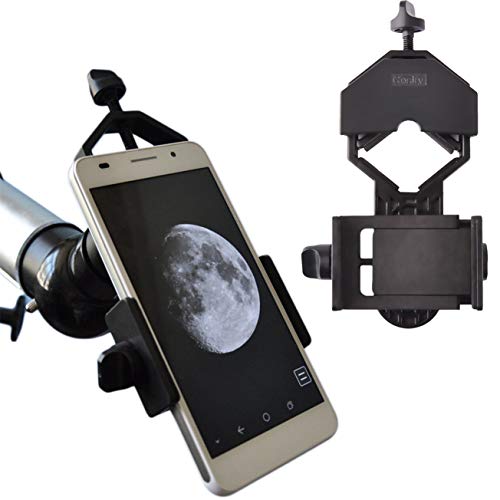


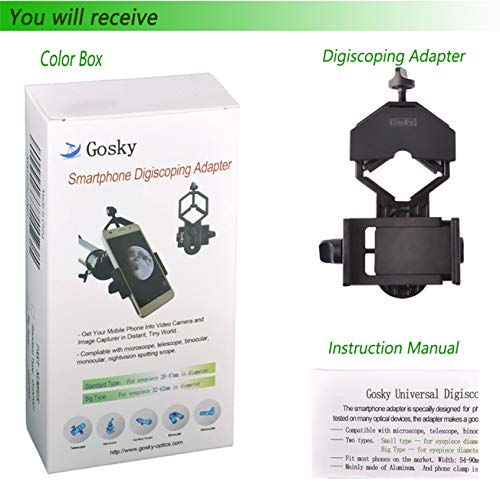

- Get Your Mobile Phone Into video Camera and capturer Image in Distant, Tiny World . Explore the nature of the world easily through your screen.
- Compliable with microscope, telescope, binoculars, monocular, night vision spotting scope. Fit eyepiece diameter 28mm-47mm.
- Universal: With super large width range: 54-90mm, Fit phone X, 10, 8p, 8, 7plus,7,6plus, 6,5s,5, Samsung Note , Sony, Sony Xperia Z and many other brands .
- Once purchase for long time use -Main Part Made of zinc alloy (More durable than Aluminum). Fully metal housing. And phone clamp made of high strength PA Plastic.
- There is also big type for eyepiece outer diameter from 32mm to 62mm(1.26"-2.44") which is compatiable with bigger spooting scopes, binoculars, small 2inch telescope eyepieces, etc (Choose "Big Type Smartphone adapter" .Search its ASIN: B01D5W0WES). 2. You can add a Gosky Camera Shutter Wire Control for Smartphones. Then you remove any chance of vibration when take photos. (Choose: Phone Camera Wire Shutter. Search its ASIN: B06Y21NKC3)
-
Information
-
Twitter
-
Pinterest
-
Youtube
-
Facebook
Jody Fick
Love this little mount!!!
Got this for my iPhone 6+ to mount to a Zeiss spotting scope. It works great and is easy to pull out of my pack, slide onto the scope and attach the phone. Plus it's lightweight. Used it all over Oregon, Idaho and Nevada this past hunting season. It works REALLY well making videos instead of pics. If I want pics I just play the video and screenshot the pics as I want them. The pics I included of the elk were a mile away on the single elk and two miles away the couple bulls on the skyline. Only regret I have is not having one all my past hunting seasons!
Karen Henderson
Very Stable
Very stable. It is simple to focus unless using a high magnification expander scope. The pictures were all taken on an iphone. Using a Celestron Nextar 6 se. One of the images is with a 5x expander scope.
Shauna P Green
Works great with iPhone6 and 12x50mm monocular.
Pho Tartee
Happy Birdwatcher Mother
Bought as a gift for birdwatching obsessed mother..... she has been sending pictures to me on the regular, of shots she never could've captured before. She attaches her cell phone to her binoculars. She says it is hard to touch the capture button without making the phone jiggle, resulting in a blurry picture. Despite this she seems to get decent pics. She has learned to use the video feature; it is far less sensitive to shuddering and blur. Then she can isolate still pictures from the video. She has snapped pics of a rare thrush, snow goose and trumpeter swan, that are not common in our area and needed proof that she actually identified them correctly. They were all too far out to make an ID without the combination of phone zoom and binoculars. It is nearly March and there isn't a week that goes by that she doesn't show me new pictures. Her skill with the unit is improving. She does not that it takes some time to set up.
Santos Ferrer Ytzehr
Worth it! You can't go wrong with this. Takes a little practice to align but it lets you easily photograph, record, and share!
Aaron Dunning
This product is awesome!! It does exactly what it is supposed ...
This product is awesome!! It does exactly what it is supposed to do and is made of very durable materials. I mounted my old phone to it and my telescope and took some pretty clear pics (see images). I recommend this to anyone thinking about getting it!!
Christine Ann Andico Arriesgado
Works Great For A Samsung Galaxy 8
First off, I’m no imager. I’m almost a pure visual observer with an un-driven Dobsonian scope, a 16-inch. I could normally car less about imaging and lost what little obsession I had in it thirty years ago. On the other hand, with the advent of decent cell phone cameras, I HAVE messed around snapping the occasional shot through the eyepiece, with mostly lousy results. The big issue is holding the camera at just the right angle in the exit cone to get a photo. With tilt and all, it’s not as easy as it sounds. Just for a goof, I decided to spring for a cheap adapter to hold the camera in place at just the right angle, so I can take my crummy shots and get a somewhat clear image. Why am I doing this? It’s mainly for a goof and also for drawing flies to paper, in a way. Whenever I post something about my visual observations to the club web site, I’m lucky to get one or two hits or comments. However, some schmuck posts a blurry photo of the moon or something, and he or she’ll get a hundred hits before the electrons are even settled. So, bait and switch. I take a crummy, unrelated image, attach it to my visual observation report, and draw flies to the paper! There’s a logic to my madness. As for how this doohickey works, I checked out the Orion and TeleVue versions, which were both around $100. No way was I going to spend that kind of money for a goof. Then, after a recommendation from a forum on the astronomical web site Cloudy Nights, I found this Gosky device. So, I read the bad reviews yet decided that even if there were some potential drawbacks, it was still worth the risk of a mere $25. I was sure I could get SOME use out of it. It was two months after Christmas before I got to take my present into the field and try it on for size. I attached it to several Explore Scientific eyepieces (and a Meade UWA), the 18mm 2-inch and the 8.8mm 1 ¼-inch and a 4.7mm 1 ¼-inch. It worked great in all cases (except see below). My main target was the moon, which that night was nothing but a sliver. As for attaching my Samsung Galaxy 8, it was no issue at all. The clamps did not come even close to interfering with the side buttons. The camera lens was able to slide right up to the perfect spot to align with the eyepiece exit cone as well. Now, the images are round and there’s plenty of viginetting, but hey, what to expect from such a cheap and easy deal, anyway? I did have one issue when I first attached it to the Meade UWA eyepiece. The thing slipped off because I didn’t set the eyepiece clamp just right. Also, you need to make sure the clamp is tight, or the whole thing will just tilt right off the eyepiece. Beware of the rubber eyecup and make sure everything is solid before you go messing around. The next thing was getting it centered in the exit pupil, or eye cone. It took a bit of adjustment. While it was still daylight it was easiest because I had surrounding scenery to use. However, after dark, it was more of a challenge, especially when I tried to focus on Uranus and it was a bit too tiny to keep in the field, even at 209X in the 8.8mm EP. I had taken the eyepiece/cell phone assembly out and when I put it back in, everything shifted a bit. I had to shine my flashlight down the tube and re-center the phone in the eye cone. However, it didn’t work all that well and I finally gave up trying to image Uranus. It was just too tiny and faint to get it to register well in the phone, though it darted through the field a couple of times. The adapter worked well. It was the cell phone camera that’s going to take some practice. With a magnification of 209X that I was mainly using, and only a sliver of moon, the phone kept trying to focus on different parts of the sliver while I was trying to focus the eyepiece. When I thought it looked sharp on the display, snapped a photo with my remote shutter release, it didn’t end up that way later. When I got home, none of the images were sharply focused. Part of that was the phone and my tweaking the focus going against each other. Part of it was probably using too high of a magnification. Overall, the adapter did what it was supposed to do, at least for a Samsung Galaxy 8 phone. It clamped the phone just fine, clamped the eyepiece just fine, once I figured out how to do it correctly, and it held it in position correctly. Oh, and it’s a very light device so there was no balance issues, at least for my Dob. The only issues I see are after dark if you change eyepieces or take it off the telescope, you may have to re-center it in the eye cone and that may require a bright light or at least a flashlight. Or, leave it attached to that eyepiece, make sure it’s very tightly secured, and be very careful handling it! Highly recommended.
Jon Lavigne
Boon to a Birder
I bought this mount after seeing a colleague using it for ornithology and taking near-DSLR quality pictures, so I decided to snag one and see how it works in my setup. I use a Nexus 5 mounted to a Bushnell Legend HD 10x Monocular. I've taken this setup into the field in cold, hot, rain, sleet, and snow, with the goal of photographing wildlife, and this is what I think: There's not much to be said for this simple tool. It just works! The scope mount is tight and versatile, the phone holder is padded for grip and protection, and the sun shield is a nice touch. It's well made- sturdy enough to be banged around outdoors without loosening and messing with your phone or scope's alignment. If it's suited for field biology, it'll handle anything you throw at it. Here are a few things of note for new owners and prospective buyers: 1. Learning Curve: If you're going to use a scope and phone for targets that might move, you'll need to learn to focus and shoot on the fly (bird pun!). That goes double for quick setup. I notched my Nexus 5's case so I could get the alignment right every time. Learning setup and figuring out how to deal with camera shake (that gets amplified the more powerful your optic is) will take practice. 2. Mileage May Vary: Your photo quality really depends on what this thing is bringing together. This mount will hold your setup steady, allowing you to work around whatever challenges your setup has. For example: my optics are great, but the Nexus 5's camera is sub-par (I miss my DSLR so much!), so I have to be picky about my focus. A phone with a better camera will clear that right up! 3. There are 2 ways to optimize your photography with a digiscoping setup. You can take the photo without zooming in on your phone, then edit. You can also zoom in so the scope outline doesn't show (not recommended for low quality cameras in most situations), then focus and take the shot Overall, I would recommend this for just about any use you could come up with for it. I've put it through the ringer and it's held up well.
John Banks
Like it!
I've only used this once (to test it) and found that it works as advertised. Just be sure to set your volume control to capture a picture -- this remote and most others rely on that setting in order to work. Using this remote avoids jiggling the smartphone when taking a picture, which is really important when using a powerful scope as a zoom lens. You could use the self-timer built in to the camera app, but this remote shutter trigger gives you a feeling of control over the timing of the shot. Obviously, this is an inexpensive gadget and it may not tolerate much abuse, but it may prove to be worth more than it cost, especially if handled with care.
Timothy Olesen
Great adapter for the price and even if it were more expensive
Don't bother spending more on other adapters, this one is very well constructed with precise controls for the phone grip and lens grip. Both are padded and hold securely without jiggling around while you are moving the telescope. It is very easy to align the phone camera and there is enough room to move the bracket up or down the lens about a quarter inch if needed for picture width. The frame is metal, so there is no worry of it flexing or breaking. Very sturdy and quality feel. Hard to believe it is so much cheaper than the other options of which many seem less elegant of a solution.