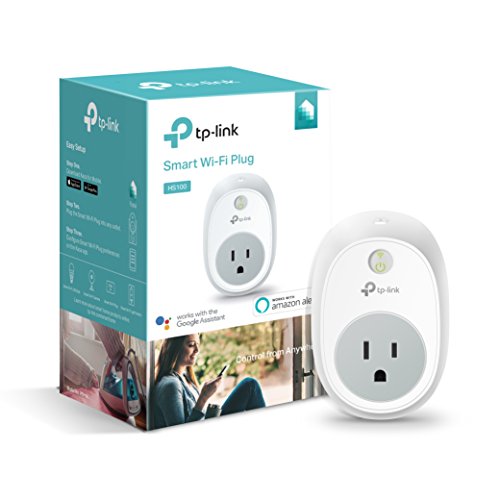
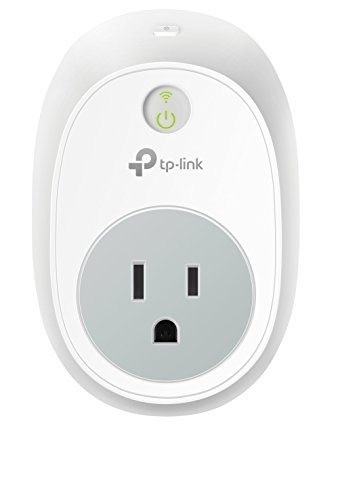
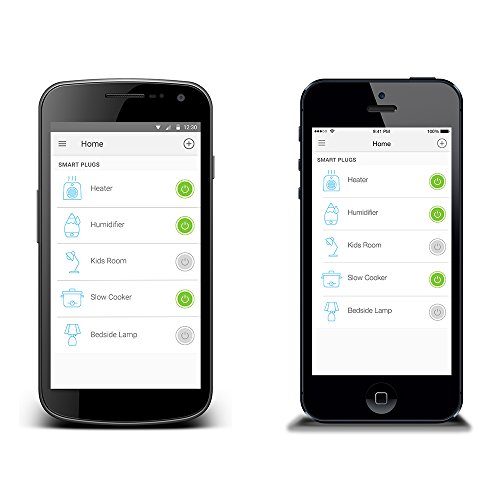
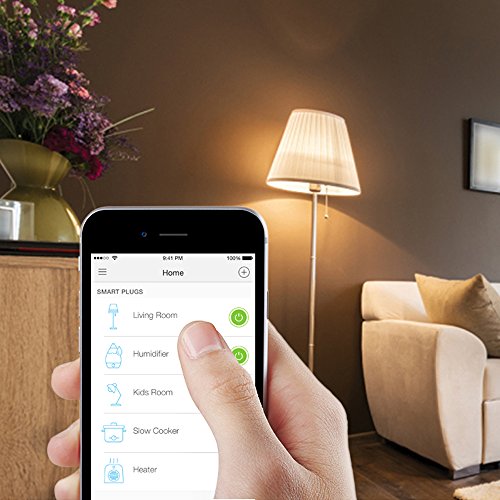
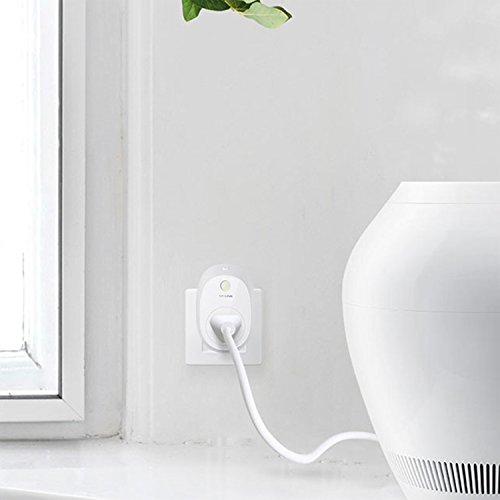

- Control from anywhere - turn electronics on or off from anywhere with your smartphone using the kasa app (compatible w/ android & ios)
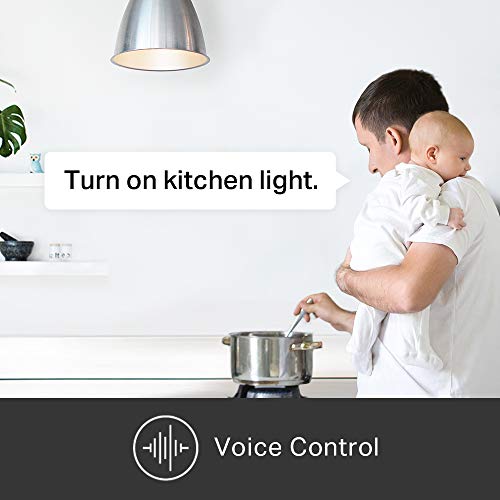
- Voice control - works with amazon alexa, google assistant and microsoft cortana supported devices for a hands-free experience
- Flexible control - ul certified to switch up to 15A, for flexible control of a wide range of plug-in devices
- Kasa scenes & schedules - schedule the smart plug to automatically switch on and off when away or set a scene for controlling many devices with a single button
- Note: requires a secured 2.4 ghz wi-fi network connection
-
Information
-
Twitter
-
Pinterest
-
Youtube
-
Facebook
Kenny Brown
Fully integrated with Alexa!! Better than more expensive Wemo outlets. **UPDATE**
**UPDATE** Sorry, I didn't know this review had gotten this much attention, but I will clear a few of my points up. I have been using the smart home devices for over 2 years now. I started with the Wemo (now have 4 outlets 3 this size and 1 insight and 2 wall switches) 3 TP-Link outlets, and 10 Philips Hue bulbs. All controlled with My Echo and 2 Dots. For the first year or so the Wemo outlets were a pain every time the power went out. Through firmware updates this is no longer the case and they work just fine now. I also was not using IFTTT at the time so it not having IFTTT support wasn't an issue for me. I have since been using IFTTT which is why I've personally gone back to using Wemos over these, but still use these on devices I don't use IFTTT triggers with. I'll also clear up the "intergrated" questions. Before February or March of 2016, when using these you had to say "Alexa, tell KASA to turn on XXXX" you still technically have to use a skill, just it only now needs to be enabled and linked and Alexa will recognize these devices individually when searching for devices like Wemo and other integrated devices. Sorry I didn't reply to questions/issues earlier, I didn't know anyone had replied to my review. Any questions my email is in my profile. **Original review** I have been using Wemo outlets and switches for over a year now and love the ability to have Alexa turn things on and off by voice. I decided to order a few more smart home devices when Amazon released the Dot since between my Echo, it's remote, and now the Dot I have voice control throughout most of my apartment. It just so happened these were on sale as a deal of the day at the right time, so I ordered 2. You will see some reviews that state these only work with Echo using a skill, that changed in February or March and they are now fully integrated with Alexa. Over the past year I've had issues with my Wemo outlets dropping connection, and anytime I lose power I'd have to set them up again. This isn't the issue with these outlets. They were very easy to setup and link to Alexa, the app walks you easily through step by step in setting them up, renaming them for Alexa and getting them online if you'd like remote access. After setting mine up I decided to move them to another room. With the Wemo outlets one I unplugged them I'd have to set them up again, not with these. One I plugged them in at their new location they reconnected with no issue. I highly recommend these over the more expensive Wemo outlets. I saw another reviewer complain these cover both plugs on an outlet, this is true of all of the smart outlets currently on the market, if this is an issue for you I recommend doing what I did in a couple locations and get a cheap pack of 1' extension cords. Most of my outlets are hidden from view anyway so using the extension cords wasn't an issue for me. Now off to bed "Alexa, turn off lights" (yeah, it's been over a year and I still giggle like a little schoolboy once in awhile over this)
Natasha Lee Aiken
Excellent, affordable option for getting into home automation - reliable, well built, and easy to set up.
UPDATE 12/11/16: I've since purchased the mini version for my Christmas tree and it works just as perfectly as its larger siblings. Setting it up and using it is exactly the same as with the larger versions, and the only difference is that this only blocks one power outlet instead of two. I imagine that eventually they will all be this small, as there's really no reason to buy the bigger one unless you're looking for the power monitoring. Anyway, it still works great, was even faster to set up than the originals since I already had Kasa ready to go, and is especially useful for Christmas tree lights instead of bending or hunching down to reach the power. Awesome value, excellent price for the convenience. I still very strongly recommend this product. **************** After finally getting my Hue lights set up and working with Alexa, the next step of my home automation process was to begin to integrate wi-fi smart plugs into the equation. I wanted smart switches for my televisions, fans, air conditioners, air purifiers, and wax burners. What I didn't want was to pay through the nose for it. I've learned over the years that you generally do get what you pay for, but some of the pricing on these "smart" gadgets is ridiculous; the Hue ecosystem is insanely overpriced, and while I like it, you're essentially paying for the guarantee that you won't have to deal with the troubles that buying non-brand cheap Chinese electronics brings. I've purchased other TP-LINK products before (wi-fi adapters), but I was hesitant to get these because all of the other, branded, smart plugs were much more expensive. I thought I'd become a victim of the cheap Chinese electronics phenomenon. I'm glad I listened to the reviews and chose to buy one, because it works perfectly and does exactly what I wanted. It's well-made and was pretty easy to set up. I'd read that before there was direct Alexa integration it was kind of a pain to set these up but now, after they've added the integration, I found it incredibly simple. Here are some abbreviated directions that I've streamlined from TP-LINK's two or three setup pages; do it in this order for the easiest setup: 1) Download the TP-LINK Kasa app from your app store of choice. 2) Install and open the Kasa app 3) Create a Kasa cloud account (requires email verification), 4) Allow Kasa to discover your plug 5) Set your plug to "remote control on" to allow Alexa to control it 6) Name the plug (i.e. Bedroom TV) 7) Exit the Kasa app and enter your Alexa app 8) Swipe down to Learn More Skills and search for "Kasa" 9) Authorize Kasa in the Alexa app by entering your email and password 10) Go back to the main Alexa screen and discover new devices 11) Once Alexa has found it, assign your plug to whatever group you want it in (Bedroom group for Bedroom TV plug) 12) Enjoy The first one I set up was for my TV in the bedroom. Keep in mind, in order for one of these smart plugs to work with Alexa to turn your TV (or other device) off AND back on, it must have an auto restart after power failure function. If it doesn't you'll only be able to turn it off, but have to use the remote to turn it on. I have various groups set up in Alexa in order to achieve various functions. I've included the TV in the the "turn everything off" group so that I can turn it off at the same time as my 5 other Hue ambient lights. I've also got it in the "Bedroom" group so that I can turn it on and off by itself. The way you do this will depend entirely on how you have your room/house setup. For me, "Turn everything off" applies only to the bedroom and leaves the rest of the house alone, because this is something I usually only use when I'm laying in bed and ready to sleep, and I've already turned the other stuff off before going to bed. You could use these switches instead of buying smart bulbs, but I find it more convenient to have all the lighting independent of the plug. The normal white light Philips hue smart bulbs, and the other brands, are already less expensive so you're not saving anything. I find this option attractive for controlling non-lighting electronics. I've since ordered and connected these to my fans, air conditioners, wax burners, and electric fireplace. Anything you want to work completely with these MUST auto restart after power failure, because that is essentially all you are doing when you turn it on and off - removing and supplying a power source. For example, I had to buy a floor fan that had a manual mechanical switch because the one I had with a remote wouldn't function except to turn off. My air conditioner automatically restarts when power returns after the (simulated) power interruption that these plugs create, so I didn't need to replace it even though it is "smart" and has a remote and no switches. It's not something that's widely discussed, but important for people who are just getting into home automation to know. Until the technology improves to allow deeper integration, you're stuck completely controlling (mostly) dumb devices. All told, this is an excellent bargain for getting into home automation. It works very well, and the build quality is excellent. The only complaint I have is that it covers more than one socket on your outlet, but as I understand it, almost all of these do simply because it is necessary to house the wi-fi components. Expect to have to also buy additional power strips for areas where you plan to use these. They are less expensive than the "brand name" smart plugs and have excellent compatibility with Alexa. I've already purchased 6 of them, and will continue to buy more as I expand my home system. Pro tip: you can use one of these to control the power to a power strip, enabling to you to simultaneously connect and control more than one device. I've successfully done this with this Amazon Basics power strip (AmazonBasics 6-Outlet Surge Protector Power Strip, 790 Joule - Black) without tripping the fuse. Or, alternatively, you can have these Smart Plugs plugged in to the power strip and still maintain individual control. You'll only be able to insert two or three, depending upon your power strip, but you can expand the outlet easily that way. Your mileage may vary, however it's something to keep in mind.
Mick Omerta Chinchio
Love it! Here is a hint for Echo owners
The new Echo compatibility works very well and allows grouping controllers under a single group name. I just set up three controllers and now I can say "Alexa, turn on the living room lights" and viola, they're on! Much easier than finding each lamp's on/off switch on a cord behind a piece of furniture. I can also schedule them to turn on and off when we're away from home. Go to the TP-LINK support site for full instructions and to the Alexa app if you're using an Echo to control the switches. The set up was mostly straight forward once I read the TP-LINK full instructions, but below is an more detailed hint for part of the instructions that weren't clear to me at first. I spent about 30 minutes puzzling this out, but the rest was fast and easy. The controllers can be configured with Kasa to be "local" or "remote" connected. To be controlled by Echo each individual controller must be set to Remote Control ON, in the Device Settings menu. That menu is accessed in Kasa with this process after the controller is initially set up: From Kasa's home page tap the device name; a screen for that device appears, with selections for Schedule, Away, Timer, an off/on button and at the top right corner an icon that looks like three little sliders. Tap that icon to open the Device Settings screen and then slide the Remote Control slider icon to the right so that it lights green. Do that for all controllers you want to be controlled through Echo.
Steve Alcorn
A Must Have with your Amazon Echo!!!
I got these to work with my Amazon Echo. Love it. The TP-Link Kasa app lets you assign names to each plug. The Amazon Echo app lets you group them. It is AWESOME. I have 4 of these plugs. 2 in my bedroom (my nightstand light and my wife's on the other) 2 in my front room (I have on 2 end table lamps. I named these lamps thing 1 and thing 2) . I made 3 groups in the Amazon echo app. Group 1 I named Bedroom (My lamp and my wife's lamp). Group 2 I named Front Room (Thing 1 and thing 2 on this one) Group 3 I called house. It has all 4 light on it. I walk in house and a I say "Alexa turn on house lights" and she turns on all 4 lights. I say turn off My light and she does and leave my wife's on. These are a must have with your Echo. Without them, it is like having a computer with out a printer. Easy to set up too.
Hareem Sania
Installing multiple switches is possible; plugs work well and are affordable
These plugs work great. They are a little bulky but more affordable than other brands. I have at least 7 smart plugs and 6 smart switches in my home. Set them all up in the Kasa app. Enable kasa in the Amazon app. Search for device. Make groups. Easy. When you want to put things on timers, open the Kasa app and use the schedule feature which is individual to each device (click the device to open the options in Kasa). I have installed 2 and 3 switches in the same gang box. You will not use the TP link plate cover. It makes for a tight squeeze to install multiple ones. You can install multiple ones and even leave some original switches. I found this information about installing switches hard to find so I'm sharing. Wiring multiple switches into your multi gang box - the green ground wires from the switches need to be wired all together into the ground. They will all be connected to each other and to your house. The white neutral wires need to do the same - all of them will feed into the neutral white bundle coming from your house. You will probably need to do like I did and buy larger twist on wire connectors/caps. The hardest part is fitting all those wires and the bulk of the switch back into your box, and then aligning the plate perfectly - without overtightening and breaking your plate. Take my advice. Buy yourself a new nylon unbreakable electrical plate (unless you plan to install a new larger gang box in your wall which is a huge PITA). If you install multiple switches at the same time, you can finish installation (I do suggest turning your breaker back on before putting on the faceplate to make sure they all work) and then use Kasa to find the new devices. Just write down the IP addresses of each device. Kasa will show all the new devices and you can set them up one at a time knowing the IP address (which is on a sticker on the front of the switch).
Gladys Faye Odom
Easy to setup
Kristen Youngblood
This MADE my hands-free Alexa wired speaker setup possible
I agree with all of the positive reviews on here, so I am writing for a more specific purpose. First, I am currently using 4 of these plugs to control Christmas lights as a group via Kasa and Alexa. It works every time. "Alexa, turn on Christmas." More importantly, I am able to use this plug to power on/off an amp, which powers external speakers. Here is the setup: Echo Dot, wired bookshelf speakers, speaker wire, 3.5mm cable, small lepai amp and this plug. I already had all of these items except the plug. I will admit that there are cheaper alternatives to my setup for bluetooth speakers or the dot's internal speaker that may work better for most people who just want a little background music in the kitchen rather than wired speakers. When the 3.5mm cable is connected to the Dot, the Dot's internal speaker does not work. You can use external speakers, but they must be powered by another source. So, I was stuck turning on and off and amp by hand. This defeats the purpose of voice command until I bought this plug. Now I always leave the amp's on/off switch to "ON" and connect the amp's power supply to this plug. I keep the amp's volume relatively low to avoid speaker popping when the amp receives power. I control the remaining volume with my voice with Alexa once I turn the amp on. Now, from anywhere on the first floor, I can say "Alexa, turn on speaker" and the plug will switch the amp on and the speakers are 10 times better than Alexa's internal speaker. "Alexa, volume 10!" A few extra notes: *Even if the speakers are off, I can still use Alexa, but I will not hear her response because the speakers are off and the Dot is still connected to the 3.5mm cable. Hence, the Dot's internal speaker is inactive. It's easy to turn the speakers on if I really need to hear Alexa, but my light commands still work very well without the need to always have the external speakers on. *I named the plug "Speaker" in the Kasa app *The plug normally covers both openings in the outlet. The outlet pictured has a little more space in between because there is a reset button in between the two openings. Fair warning if you are thinking about buying smart devices for the first time: Yes, they are awesome. They are awesome, most are very expensive and adding to your set up is addictive. I can't wait to see what other "work-arounds" people come up with....
Stella Manion
DO IT.
This thing is pretty darn sweet! My thoughts so far: It's been 4 hours since I got this gadget and already I'm impressed. The response is fantastic. I'm still using it on my local network but I verified my email and I'm hoping it can be triggered from work, etc. I installed the TP-Link into a socket inside my garage, then used it to trigger a fan on the outside of said garage, so it creates a breeze for the dogs in the backyard. The benefit of this is because I can set a schedule on the app so it goes off at certain times of the day, therefore, enabling me to cool my dogs on-time for a certain amount of time. Plus it was our dog's birthday and she wanted more fans............... 🤡 😬 The app is good, too. It's good. Buy this sh*t. *I added a picture of my dogs so you know I'm not a lunatic.
Chantal Finn
All that I had hoped. Works great.
Works great. There were a few questions and incorrect answers posted here on using it for a surge protected power bar. No problems however. One plug from a power back-up with a surge protector which is daisy chained to two power bars with surge protectors. Now a simple "Alexa, Turn my desk on" and I am ready to roll. Since my heavy duty power bar had no single on/off switch, this was a good benefit as I was stuck turning everything off one at a time. This plug I labeled "my desk" The plug has a 15 amp maximum load rating so no running your entire house off one plug. lol. However, to create what I now have with my desk using separate plugs for all my monitors, speakers, chargers, lamps would have required 8 plugs so the daisy chain was a considerable cost savings.
Gabrielle Calzada
Hey...it WORKS!
It is a sad day when our frame of reference these days is that something we buy actually works, but alas....it seems to be the world we live in now. Originally, Amazon had a special sale on another brand's Smart Plugs and we fell for it. Having already experienced the Phillips Hue smart bulb with our Amazon Echo Plus purchase and loving it so much that we bought more, we figured the Smart Plugs would be our next step. We bought the Smart Plugs Amazon had as a special, which allegedly worked with Alexa. Yeah.... The other brand's plugs arrived and setting them up was a hellish experience. That should have been the clue. After finally getting them to work, we figured that was it. A few weeks later, ALL those plugs ceased to connect with Alexa. I tried about 10 times to relink them with no success. Let this be a lesson for us all....cheap is not necessarily better (and neither is an Amazon's choice product!). We finally had enough and returned them to Amazon. After much research, I decided to a) settle for a brand that showed up in Alexa's Smart Devices drop menu and b) That thousands of people seemed to have had a good experience with. Enter the TP-Link HS Kasa Smart Plug. The plugs arrived and immediately I could tell the quality was way better. They feature two lights that let you know the plugs are on/off AND the WiFi is connected. Setting them up with Alexa was a breeze -- especially compared to the other piece of (enter expletive here) plugs we tried first. Of course, things are not simple, so you have to download the KASA app, set it up and enable the KASA Skill on Alexa before you even plug the thing in. That seems to be the norm unless you buy the Amazon plug and pay twice as much for something people keep complaining doesn't work well anyway. Once you go through the process of setting up the KASA app and its Alexa skill (you might as well do it as I did, when you buy the plugs and before you get them, so you're ready when the plugs arrive), the rest is quite simple. Plug the thing into the socket and the amber light starts blinking. Open the KASA app on your device and click 'add device.' It found the plug in no time. It then has you name the plug whatever you want, and has various icons to choose from to identify it. Immediately, it also updated the firmware. I read that you're supposed to enable 'remote' for it to work with Alexa, but I found no way of doing this nor was it necessary. Maybe they updated this? It worked. I then went into the Alexa app and selected 'find device' and the TP-Link icon was on the list of products supported by Alexa (the previous plugs we got were not). Alexa found the plug quickly and even used the name I gave it on the KASA app (that did not happen with the Smart Life app used for the other plugs we returned, which sucked). We asked Alexa to turn the plug on and it worked flawlessly. So much so I was shocked it all worked so easily. Yeah, maybe I am a pessimist, but as a friend of mine says, "A pessimist is an optimist with experience" and after experiencing many of these devices before, one is pretty much jaded.... The other three KASA plugs we got worked just as well (I was shocked with each plug I set up, believe me). It, literally, took me less than 15 minutes to set up all four plugs. The plugs go on and off quickly with the clicking sound minimal. So far, we love them and if they continue to work this well, we may even get more. KASA also lets you schedule the plug in a better way than Alexa does, so if you want to schedule your KASA plugs I suggest you use that app rather than Alexa. KASA even lets you schedule your lights to go on at sunset, which is amazing considering this changes constantly, not to mention DST would be a pain. Because you initially enable your location, KASA figures out sunset time for you. You then schedule another event to turn the same lights off whenever you want, or at sunup. I have not tired the other options, but there are several. So far, the light we scheduled using the KASA app has gone on and off perfectly. Bottom line, and to echo thousands of other reviewers here, the plugs WORK (for now...I hope I do not need to update this review in a month....) and work very well. If you had a bad experience with another brand, give these a try.