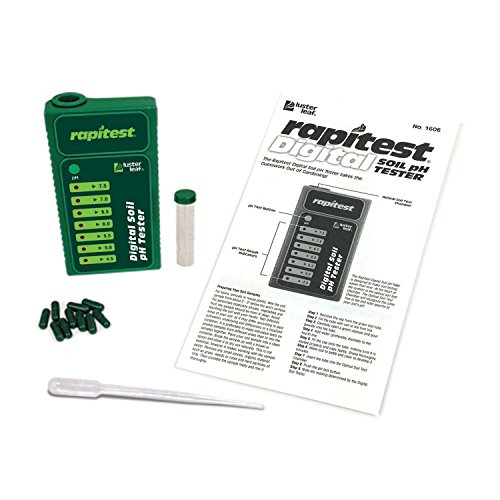
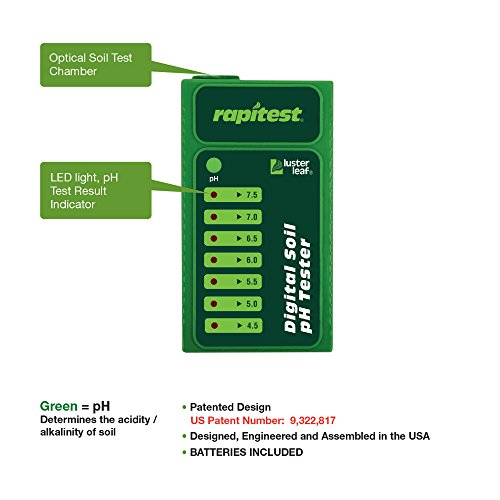
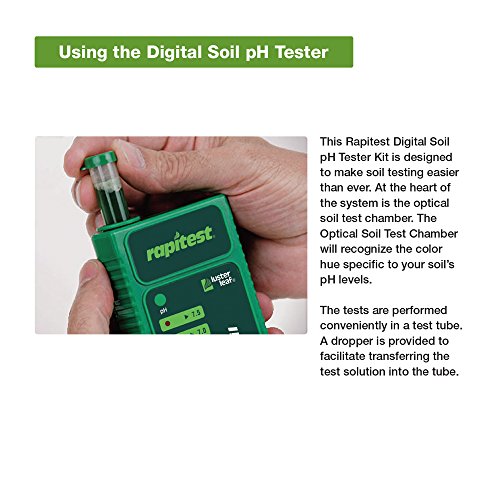

- Reads test colors utilizing advanced LED digital technology
- Just push test button to get results in a few seconds
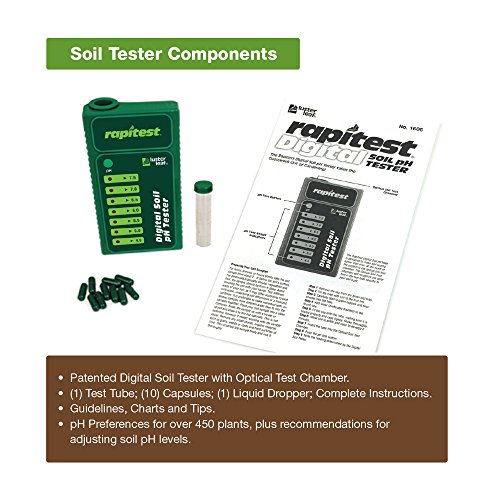
- Includes pH preferences for over 450 plants and how to adjust soil pH
- Extensive, yet simple instructions and guidelines included
- Performs 10 tests for soil pH
-
Information
-
Twitter
-
Pinterest
-
Youtube
-
Facebook
Anna Garcia
Pretty Darned Acvurate
So far, I've only used the pH test, but I'm very happy with the results. I never worried about pH levels until this past year, when my garden really didn't produce. Doing some research online, I found that pH levels play a critical role in a plant's ability to absorb nutrients. Shortly after that, just by chance, I ran across an old Ferry-Morse pH and Fertility meter at a garage sale. For a buck, what the heck. I tried it, but it stayed pretty much between 7.0 - 7.5. Was my soil that bad, or was this thing not working? I mixed some vinegar into the soil, and it did show movement to the acidic range, but I still wondered, was it working? Moving ahead 3 months, I ran across a TestWest pH meter on Amazon. It looked pretty cool, it seemed a lot easier to use (just poke it into the soil), and it could be used on indoor plants, which isn't specifically addressed with the Ferry-Morse. Once again, for under $15, what the heck. And also, to test everything further, I purchased this Luster Leaf Rapitest Digital Soil Test Kit . Like one of the other reviewers, I had used Luster Leaf's other soil test kit, but found it difficult to analyze the murky colors against the color charts, so I decided to go with this digital kit. Besides, it sounded pretty easy. Mix it up. Put the test tube into the meter, press a button to let the meter read the color and give you the results. What fun. For the test, I used the soil from one of my indoor plants, a 4-1/2 foot hibiscus. I followed Ferry-Morse's instructions, dug some soil out from about 3" down, watered it, let it set and then tested it. The Ferry-Morse read 5.8. The TestWest read 5.9. Pretty darn close. To validate the results, I used the same soil sample with the Luster Leaf Rapitest's pH test. Note: for the Luster Leaf's soil test, I followed Rapitest's instructions and set a bit of soil aside before watering it (they want to start with dry soil). After mixing the soil with the reagent and water, letting it set, placing it into the test chamber and pushing the TEST button, it lit up the 5.5 indicator--which means that the soil pH is between 5.5 and 5.9. I couldn't ask for a better validation (other than spending another $50+ and sending a soil sample to a full-fledged lab). All three tests instruments read within the same pH range. I already amended my garden soil this Fall (before I purchased this soil test kit) with a high sulfur fertilizer and an organic soil acidifier. I'll be testing my garden soil in the Spring with all four tests in this kit. I trust the results implicitly.
Jody Carney
For the money, it does the job
I see other reviews on here talking about "send your soil in to a lab" or other alternatives to this product. Fact is, if you were willing to spend the money to send your soil to a lab, you probably wouldn't be buying this. Probably like you, I bought this because it's cheap and it'll give you a basic idea of what's going on in your garden. Here's how it works: You get 4 vials, one for soil pH, and one each for Nitrogen (N), Phosphorus (P) and Potassium (K). Essentially, you place the directed amount of soil/water mixture into each vial, and add the contents of the corresponding color-coded capsule. The capsules look like pills, the type you can pull apart and the contents spill out. After you empty the capsule into the vial, you place the rubber cap on the vial, shake and let it sit for the specified amount of time. All the quantities and times are clearly listed in the manual. Each vial has a color chart that is near your soil sample window which allows you to compare the color to the chart. This is how you know where your soil stands as far as pH, N, P and K. I've seen some reviews on here saying it's "impossible" to empty the capsules into the vials because they're too small. True, they're small but if you twist them and carefully pull them apart over the vial it's really pretty easy. If you're elderly or have trouble holding your hands still (or you're just spastic), it might be a task for you but it's still doable. It's really not very difficult. I've tested my soil maybe 10 times using this product, and it's never let me down. It doesn't give you an exact number or anything, but any time I've shown low on something, I amended the soil and a few days later it tested fine and the plants looked healthier. It's not extremely precise, but it's reliable and it will definitely tell you if there is something dangerously askew in your garden. My suggestion to the guy that only uses the lab is that either he got a defective one, or he's not cleaning them properly after each use. You should clean them with water thoroughly after each use and don't mix them up. You don't want to use the pH vial for the K test, or any other variant. Keep them clean, follow the directions and don't mix and match. My only complaint is that the vials can be knocked over easily as they have an oddly poor center of gravity. Once the cap is on, who cares. But, when you're filling them or trying to empty the capsule into them, it's pretty easy to knock them over and that's just a big bag of bollox. Anyhow, to sum up, for the money, this product can really, really help. If you're looking for something more precise then spend some more money or send to a lab like the other guy said. If you just want to make sure everything is generally good in your garden, this will probably suit you just fine. Hope this helps
Melissa Lynn Gilliland
Don't believe the disbeliever!
Most negative reviews say that pH and N test results are not good, where PH is always neutral and Nitrogen is always depleted, some have actually said that they tried even adding vinegar and pH would still be 7 and such. It is a cheap kit so I bought one, I tested my soil and guess what, I got pH neutral and N depleted, actually N test chamber was very clear without any color like fresh water. So I done another test, only adding a few drops of lemon juice to the pH test chamber, and a solution of uria (48-0-0) to the N test chamber instead of soil water, and after some good shaking, the pH was yellow and the N was purpule, I have attached a picture and you can see for yourself. When this test kit tells you the pH is neutral it really is, and when it tells you have no nitrogen you really don't, and you better be spraying a whole lot of it till you get it to "adequate" level.
Leo Bellamy
Don't throw money away on fertilizer
I grew up on a farm and I've been gardening for over 50 years. When I was a child, we took soil samples to our county agent every few years and guessed during the years between samples. That was not often enough for NKP or PH. The County Agent's report covered 6 or 8 more things such as borax, aluminum, and calcium. Those things change very slowly and only need to be tested for only every 5 to 10 years. In the fifties and sixties, we just assumed the soil would need lime each year; it was acid. However, the amount we used was calculated by rule of thumb. Others used the taste test; tasting the soil to tell if it was sweet or sour; better than nothing but very distasteful when the fertilizer of choice is manure. If you do no other tests, do this one! PH controls whether or not a plant can take up nutrients. All the fertilizer in the world will not help, if the PH is wrong. I purchased the full test set as well as this one so that I could do more frequent PH tests and in more places such as around shrubs, bushes, and trees, especially fruiting trees and bushes. I have been using these products for at least 20 years. This purchase was just to renew my supply. I can usually go 2 or3 years with a full Luster Leaf set plus an extra PH test set. Buy and use it!. It will save you money on fertilizer and you can have the best garden in the neighborhood!
Debbra Burns
Fast results, Fun project!
Based on my location and my own perception of my soil, I was expecting High Alkaline PH and low Nitrogen based on my grass(Bermuda) growth/health. I had no idea what to expect on Phosphorous and Potash. Overall this test confirmed what I thought, and I’m glad I did it. As for ease of use, it’s not super easy but I didn’t find it as difficult as other users. I was able to dig up my yard, 4” deep. I put a sample in a paper bowl and broke it down as small as possible. For the PH it specifically states in the instructions it’s best to use distilled water. I would highly recommend this. I do PH on my tap water for my fish tank And I know my tap water is also highly alkaline so to keep water quality out of the test use distilled water. As for the other 3 tests you have to make a 5:1 mixture water to soil and shake it up real good, then let the particulates settle out. I let mine settle for 2 hours. It says 30 mins-24 hours in the instructions. As far as the complaints about the capsules, I will confirm they aren’t super easy to open. I used a non-serated steak knife to slit open the outer side and it opened right up and I was able to pour it pretty easy. All said and done my kitchen counter looks like a lab experiment was going on. Bottomline: fast results, not too hard, very happy I did it. I’ll make some soil amendments and check again with the other pills.
Ajay Kapoor
Great for recovering soil
I bought these to try to fix my garden soil after the town fixed a sinkhole from a collapsed drainage pipe. Although they backfilled the plot of land with clean top soil, I had my doubts as to its usefulness for gardening. This kit was exactly what I needed to ensure good soil for gardening. The four containers themselves are very useful to use for measurements. The charts provide a good comparison of color to know what is required of the soil. Upon following the directions closely (some of the tests require allowing a soil/water mixture to sit overnight), the colors after adding the tablets are bright and easy to distinguish values. After performing my tests, I had a great list of what fertilizers and amendments I needed to add to my soil to improve its quality. I would recommend this kit.
Dana Vironet
this is one of the best at-home tests on the market
As others have posted..this is one of the best at-home tests on the market. I'm a Master Gardner and our local university offers soil testing. So, sure I could take my soil there yearly...but it's $30 a pop. Being a frugal gardener:), I much prefer this for it's cost effectiveness of this test. Is it as accurate as a soil test done in a lab - no. But, please know there is a variability built into all tests so I can assure you a few .10s of a point difference in an in-home test vs one done in a lab - will not make or break your tomatoes. Just my opinion...and we all know that gardeners have plenty of them! Happy growing!
Walt Cosby
I compared results to actual lab results
This product is easy to use and pretty accurate. Just to give you some background on me and why I can support that claim- I am an Environmental scientist and hopefully soon to be Professional Soil Scientist (once I pass some exams). So this is why I say it’s pretty accurate. I tested my yard and flower beds. Because of my profession, I have access to a soil probe. I took multiple samples across the yard between 6-12” deep and submitted that as 1 composite sample and did the same for my flower beds. I submitted these samples to the Texas A&M Agrilife Extension (i’m In Houston, Tx) and I just got results back. (They are very affordable and will even consult with you about results) First, let me tell you what this test kit told me. It told me my Nitrogen (N) and Phosphorous (P) is depleted, I maxed out on the Potassium (K) and my pH was at maximum of at least 7.5. My actual soil results confirmed I have 0 ppm Nitrate-N, very little P at 5 ppm, K reported at 108 ppm but does not exceed the “high” or Critical Level and my pH is at 8.0. I would say that considering how cheap this kit is, it certainly gave me enough information on what was wrong with my yard. Now I just need to apply my hard earned knowledge in Soil Fertility to real life, instead of just theory. =) I hope this information helped someone feel More confident in using this kit.
Sara Mae Towle
I'm not really a poet...but
My garden bed wasn't the best. So I bought myself this test. Took some dirt from the ground. Swirled it all around To find that Nitrogen was what I lacking Which, of course, sent me packing To my home improvement store I bought some blood meal (It was on sale, what a deal!) Sprinkled it atop my soil Nothing for days Blood starts to boil Then suddenly, my plants start to grow Basil, tomato, zucchini, and carrot So I highly recommend You won't regret it
Wildel Garcia
Beyond easy to use
Beyond easy to use, very straight forward. There is one very small caveat, the test only tells if the levels of N, P, or K are high, medium, low or very Low. What is high, and what is very low, we cannot tell. For all practical purpose, High could mean your soil is "Hot" for your particular plant, and so could medium. Otherwise this test is near perfect if you want a general idea of your NPK levels. For my fast growing and heavy-flowering potted annual plants with a serious Bolting phase, High NPK soil is perfect. Lots of complaints on here about the capsules being difficult to open and pour into the vials. Here is my trick: 1) Cut a 8.5 X 11 copy paper in 4. 2) Fold one of the pieces of paper in 2 making sure the two halves are separated by anice crisp groove. 3) Hold each end of a capsule between your thumbs and index fingers, 4) Bring over the folded paper, and twist your left and right hands in opposite directions while gently pulling them apart. 5) funnel the powder into the vial along the nice crisp groove in your paper. Voila!