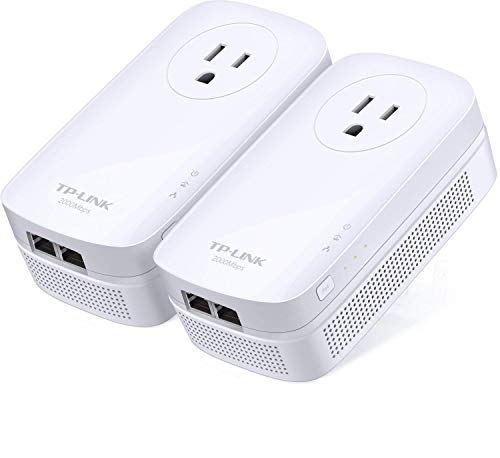

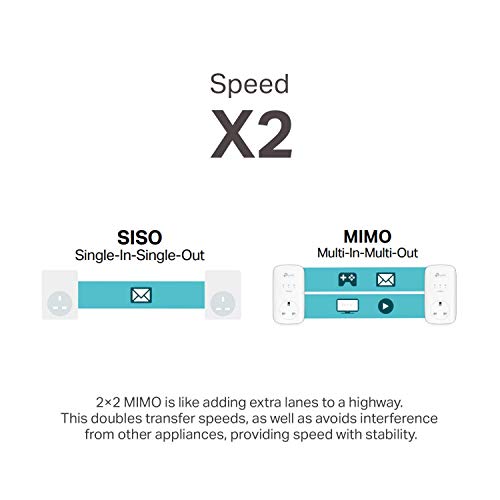

- Powerline adapter provides up to 2000Mbps Ethernet over power. Ideal to be Ethernet extender who can easily go over the walls
- As network adapters supporting HomePlug AV2, easy to add multiple adapters and works under 110-240V. The Best Powerline: "The Best Powerline Networking Kit" - The Wirecutter
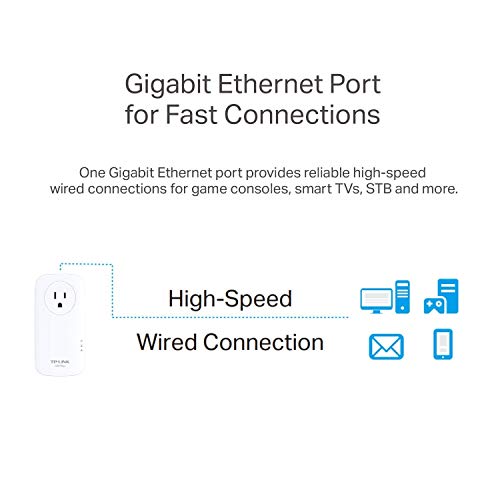
- Gigabit port, give you full speed of your internet. Transmission Speeds: Ethernet 10/100/1000 Mbps, Range 300 meters in house.
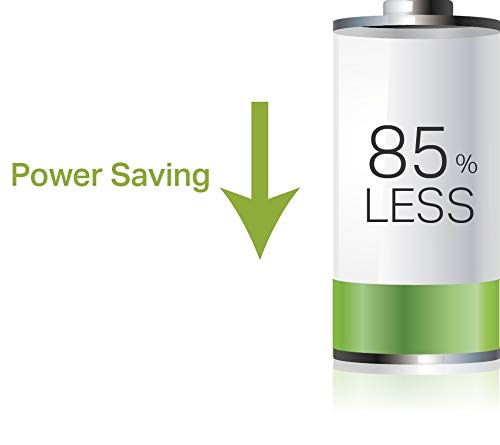
- Power saving automatically reduces power consumption by up to 85%
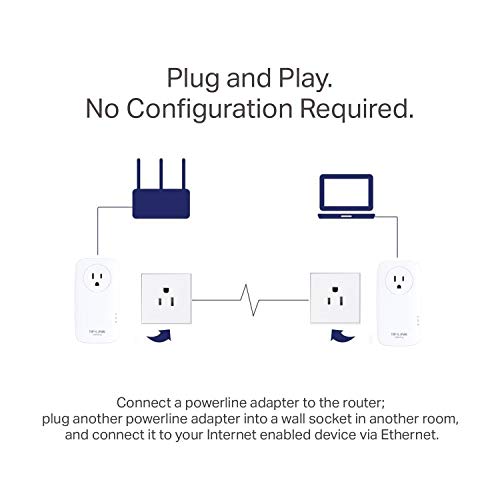
- Plug & Play, no new wires and no configuration required; Compatible with all AV2000, AV1200, AV1000, AV600, AV500 & AV200 powerline adapters.Modulation Technology:OFDM
- Data encryption by 128-bit AES to make the network safe and private
- Industry Leading Support: 2-year warranty and free 24/7 technical support.
-
Information
-
Twitter
-
Pinterest
-
Youtube
-
Facebook
Melly Mel
Notably faster than old powerline system (WD Livewire)
I bought this unit after seeing it recommended by Wirecutter. It replaced a years-old Western Digital Livewire unit that served me well for many years but, for some reason, had become erratic and sometimes would drop into single-digit Mbps internet speeds. For comparison, in case it helps others, my internet connection comes in at around 200 Mbps downstream with a direct wired connection to my router. My Livewire system would get around 20 Mbps, until it started stuttering. With this unit, I am getting speeds in the 50-70 Mbps range (obviously much lower than spec, but I’m sure it’s due to the wiring of my house - these outlets are not on the same circuit). EDIT: The TP-Link app reports a link speed in the 500-550 Mbps range -- the speeds I'm discussing above are internet download speeds and my real-world experience from upgrading to this Powerline kit. I wish more companies would make these without enormous wall warts (the Livewire has a regular cord), but I’m happy with the speed and ease of installation. Does the job.
Chantelle Reid
Great product with speeds less than rated but impressive
Although the results in my house are nowhere near the rated speeds this is still a very useful and impressive addition to my home network. I have an old, 3 level, 1500 sqft house with solid walls and my router in the basement. I have broadband with gigabit upload and download speeds and I get those speeds with a computer that has a wired connection to the router. I have a wifi dead spot in an office on the top floor. A wireless range extender helped but only resulted an unreliable 20 Mbps up and down. I tested the powerline setup in my basement, close to the router and with the adapters in adjacent wall plugs. Here I got something in the range of 300 Mbps up and down - not quite Gbps but more than sufficient nonetheless. When I move the one adapter to the top floor I get about 100Mbps up and down, very stable. Again, not quite Gbps but stable, 100Mbps speed is, for my needs, more than sufficient. In fact it is incredible and a huge improvement. The setup of this kit is brainless - essentially plug it in and push a button. Highly recommended. I may get a second pair to expand wired Ethernet through my home. The higher speed broadband connection has exposed all kinds of issues with my wireless setup and this product is an easy and effective way to move to wired connections and more fully utilize the broadband speeds I have.
Muhammad Naseer
Near wired speeds. Easy setup.
I had the older TP-LINK which worked well but starting cutting in and out so upgraded to the TP-LINK AV2000. Saw a marked improvement in my download speed. From my wired router I have 100mb down and 10mb up. With the older TP-LINK I was getting 42mb down and 10mb up. With these I'm seeing speeds > 90mb down and 10mb up. Powerline results will vary depending on how your house is wired. I have a newer built home which I think helps but the two Adapter kits are on different circuits so the signal is going back through the circuit panel and back to my home office. Overall very happy with the results. Only minor complaint is the adapters are huge. The pass thru helps but if you are plugging one end to a 4 outlet box it will take up more than one outlet.
Gina Passarella
Works great!
Our house is 8 years old. Bought this to improve data delivery rate to the TV whose wifi reception was suffering by being in an area distant from the modem/router where doing a long ethernet cable run, while being the ideal solution, was impossible without doing major damage to the house. Installation consisted of plugging one of these units into a wall outlet proximate to the modem and the other into an outlet proximate to the TV, pushing a button on each unit to synch, and attaching the supplied ethernet cables (comes with two 6 ft.) to modem output and the LAN input on the TV. Wifi at the TV pre-installation was in the 25-28 Mbps range in comparison to about 180 hardwired at the modem. After installation, LAN speed at the TV end was 100 Mbps. Obviously some signal bleed over the electrical circuit but still, wow, worth it! The plug-in units pretty much obscure the outlets, so spend a few extra bucks to get the AC pass-through version.
Kelley Darling Tessier
Virtually as fast as direct connection (86 Mbps download,19 Mbps upload, 15ms ping) vs 90 Mbps direc
These TP-Link Powerline Adapter AV2000 units are very easy to set up and are super fast. All I had to do was (1) plug one into wall near my router, (2) plug an ethernet cable from the router to the adapter, (3) plug the other unit into the wall near my computer (4) plug an ethernet cable from the adapter to my computer; job done. If you prefer you can also press the little button next to the lights on the side of one unit and then press the same button on the other unit (within 3 minutes) and this will pair the units (useful if you have more than 2 units and want to pair a specific pair). No drivers or additional setup. The speed of the connection through the wiring of my house using these adapters is {86 Mbps download,19 Mbps upload, 15ms ping}, measured using the OOKla Speed Test website (currently the most popular and trusted speed test website and app). For comparison the speed of my WiFi connection was only {5 Mbps download, 8 Mbps upload, 23ms ping} (yeah seems odd to have a slower download speed than upload but that was the results). Note, I previously tried a pair of TP-Link Model: TL-PA4010 (500 Mbps rated) adapters and with those the speed was about 25 Mbps download, so if you want truly fast download speeds the TP-Link AV2000 adapters are the ones to get. PS: a direct connection using a ethernet cable from the router to the computer resulted in about 90 Mbps download speeds so the TP-Link AV2000 adapters at 86 Mbps are virtually the same speed as a direct connection.
On Ly El
Works fine powered by a UPS
Couldn't find anyone talking about using these with UPS backup power. Most of the people discussing how to connect these emphasized connecting them directly to the wall and bypassing any power strips or extension cords for maximum speed. I read up on the technology used in the newest generation of Powerline Ethernet devices, and the HomePlug AV2 MIMO standard used in the adapters I purchased (TL-PA9020P) indicates that it can pass data over neutral and ground as well as hot wires. It wasn't clear how this would behave when the UPS disconnected the power from the wall in backup mode, so I figured I would test it myself. In my implementation, speed is not the primary goal, just trying to achieve a reliable consistent connection not subject to interference (currently using WIFI). I connected both of my adapters to a couple of UPSs and paired them (no problems yet). I ran a quick speed test, and saw about 30Mbps. Not super fast, but more than enough for what I need. I turned off the breakers to both UPSs, and the speed remained roughly the same. I then tested the same units connected directly to the wall in the same locations, and I saw approximately 60Mbps. So 1/2 speed with the surge protection and UPS in the on or off state. Now keep in mind this was tested in a condo with approximately 45 units sharing 3 phase 208 mains power with 2 phases per unit. I expect there is quite a bit of noise from other people using similar devices and miscellaneous devices causing a wide array of RF interference throughout the building. That said, I expect they will work as well or better in the commercial environment I plan to install them in later. For reference, the two UPSs I tried were a 550VA APC which provides only backup power and surge protection and a 1500VA Cyberpower that has the same features plus AVR. Both were stepped/simulated sine wave. The end result is this means that the network connection doesn't have to go down when the power goes out and my UPSs kick in. Since this network is primarily for point of sale equipment, the lower speed will not be an issue. Also saves me the headache of having to open up the exterior building walls to drop a new network cable at this location. Hope someone finds this helpful, as I couldn't find this info anywhere on the internet.
Lily Savage
Do Your Research First
Before you consider buying these you need to look into the advantages and disadvantages of Powerline Adapters. I live in a narrow home that is designed to be more spacious vertically with a lot of floors. It is not easy to drill and run cables so I needed another networking solution. Wi-Fi is fine but when I did speed test, I was not happy with the drop in speed or the inconsistent results. I knew before hand that depending on the electric line setup of your home and the distance you are using these from, you would see varying results. I also knew there was a possibility they would not work at all depending on specific features of your home's circuit breaker. Interference caused by certain appliances is also a factor. I was desperate so I took a leap of faith on these. I was very impressed with the results. Not only did these work but I can access nearly all of my bandwidth from any room in the house. Even with my router in the basement and the adapter in the top floor, I saw no more than a 10 percent decrease in speed (at most) during multiple tests. The upload tends to be affected more than the download but not by much. I will be buying another pair of these and I highly recommend them assuming you know that they can work in your home. A lot of the negative reviews here seem unfair. Powerline Adapters are not a universal networking solution and is is a limitation of the technology, not the product. Please verify these will work beforehand or be willing to spend the money to find out if they do.
Pam Scott Hill
Great home networking solution!
So far so good! I bought these because my home cable modem/wireless router is in the living room by the TV, while office is in a different part of the house. I have a hardwire desktop and a NAS I needed to connect to the home network, and these are working perfectly. I did speed tests on my connections and I'm getting what I should be pulling from my ISP (granted it's only 10 MBs service, but I get that through this setup in my office, or via my wireless or wired services directly connected to the router/modem. It beat having to run a bunch of cable through my house. I'm impressed.
Devin Seeker Christie
... distance away from your router I can whole heartedly recommend this adapter kit
If you have computers or other devices a decent distance away from your router I can whole heartedly recommend this adapter kit. I was considering a 100 foot plus Ethernet cable when a friend suggested I consider giving a powerline adapter a shot. I did a bit of research, and decided it was worth a shot. Set up is very easy. You simply plug an Ethernet cable into one of the adapters and then plug the other end into your router. You then plug the other adapter in near your devices. Once both are plugged in you push pair on one adapter and then pair on the other and you are good to go. I have one plugged in on the bottom floor of my townhouse and the other on the third floor running to my switch that has all my devices plugged into it. They work almost without issue. For example, I will catch a moment of latency once an hour or so watching Netflix. It's very brief and barely noticeable. These saved me a ton of work running an Ethernet cable down multiple staircases and over doorways.
Shane Abasola Batas
Awesome solution!
I could not be happier with this POWERLINE. Researched extensively and this model delivers. Set up home office in room opposite our internet connection...on a separate circuit. We have xfinity 175mb internet service. Top speed on 5ghz channel on Asus WiFi router is about 75mb. Top speed on 2.5ghz channel, that the whole family uses, is 40mb. I get 95mb-115mb on my powerline in my home office. Very nice solution to my problem. I added 2 extra outlets in my new office. One I installed just below the desk height to be dedicated to the power line. I did not want to be short on outlets. So this is not required at all, just something I chose to do. Glad this worked so well. Otherwise I would have explored WiFi repeaters or pulling a hard line through the attic. My home is 2100sqft. And distance from office to internet source is 60 ft.