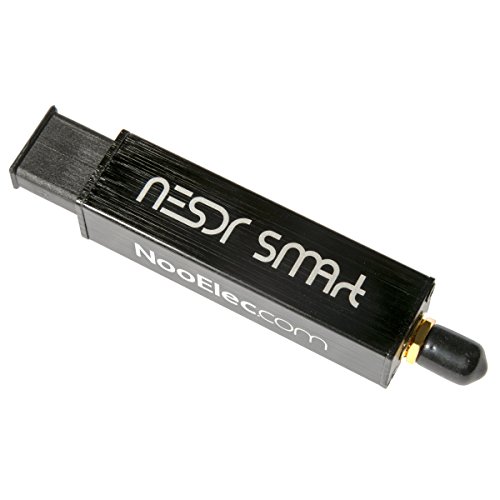


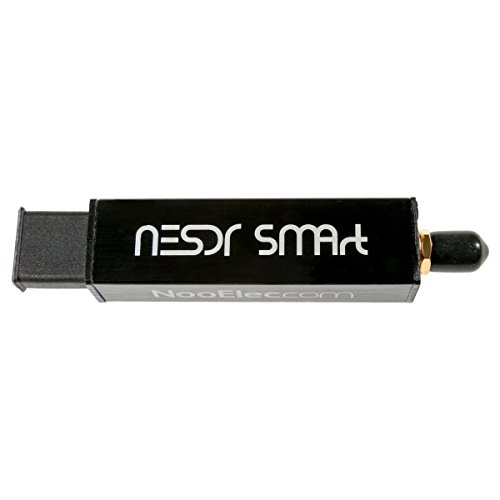


- Premium Software Defined Radio 'NESDR SMArt' in a beautiful brushed aluminum enclosure. Proudly built by NooElec in the USA and Canada! Full 2-year product warranty
- A wide variety of improvements on other designs, including ultra-low phase noise 0.5PPM TCXO, RF-suitable voltage regulator, custom heatsink, 2 silicone pads and SMA female connector
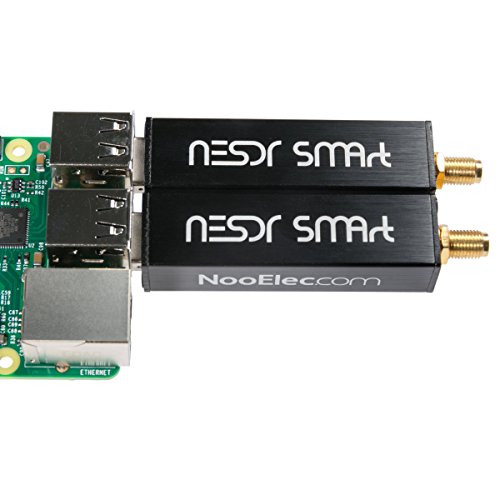
- Designed from the ground up to reduce USB port occlusion. Run multiple NESDR SMArt side-by-side with any USB-compliant device, including tightly-spaced embedded devices like the Raspberry Pi
- SDR frequency capability approximately 25MHz-1700MHz. Frequency range can be extended down to 100kHz or lower with the Ham It Up, also available on Amazon (B009LQT3G6)
- An 8pc SMA adapter set and carrying case is also available on Amazon (Product ID B073JT98RR)
-
Information
-
Twitter
-
Pinterest
-
Youtube
-
Facebook
Tahesher PinkishSmilez Anderson
Great little SDR, keep it cool for optimal performance
Really great SDR for the price. If you're familiar with this type of SDR, you'll know it's pretty much an accident that these things work perfectly for this application. I really like NooElec's enclosure. It's very sturdy and holds up great. The chip quality is fantastic as well, and I have not had any frequency drift or tuning issues. One really important tip that I highly recommend: Keep it cool. It runs pretty hot. Not hot enough to really decrease it's lifespan, but I measured it at around 110 degrees F when set at maximum gain. This temperature increase does add a lot of noise, so if you can keep it cool, you can save yourself a lot of trouble trying to find weaker signals. If you don't need it to be portable, say you're using it with a desktop, find something metal and use some CPU thermal compound to stick it to it. It does the job perfectly, and the temps lowered to around 90 degrees at peak. I stuck it to the steel case of a battery backup I have my computer hooked up to. I just put a drop of thermal compound between the enclosure and the metal of the battery backup's case. Then I taped it on with some strong masking tape so it wouldn't come off. Works like a charm.
Valinte Jesza
Perfect for my purposes.
Works great for my purposes. I am using it as a panadapter connected to an IF tap in my HF transceiver. Great bit of technology. The SMA connector is way better than the tiny MCX connectors on some of the other RTL-SDR dongles out there, particularly if you are experimenting with different setups and need to disconnect and reconnect the antenna a lot. The aluminum case is nice as well. The TCXO appears to be very stable. The radio does not appear to drift from startup.
Petrena Jones
Get's Pretty Warm, but It Shouldn't Be An Issue
It's very fun to scan through all the frequencies to see what's out there. It's a very good entry point into the world of SDRs! The only negative I see is that the dongle seems to get very warm after about 20 minutes of use, but doesn't seem to actually overheat or get much warmer once it's "up to temperature." This may be by design, but I wouldn't leave it plugged in overnight or anything.
Raptor Cat
A very nice RTL SDR with a high-quality enclosure and good quality internal components - a real value for a quality SDR.
It does what the listing says it does. The quality is very nice especially given the very moderate selling price. I especially appreciate the metal enclosure. It's quality is very solid and the USB and RF connectors are of good quality. The receiver works as well as any other RTL SDR I have used and offers reasonably stable frequency accuracy. I wouldn't expect this radio (or many other SDR's) to be highly accurate above VHF without the option for external reference standards. However, you can account for any frequency inaccuracies in software, so this isn't a real problem even when tracking satellites or performing basic radio astronomy. For the price, this is an excellent way to get your feet wet in SDRs. It is also flexible enough to add LNA's, up-converters, down-converters, filters and even improve the frequency stability through upgraded frequency/time standards. RTL SDRs are not just for getting your feet wet. With some DIY skills and commercially available parts, you can make an RTL SDR function well above its price-point. I like it.
Lou Olmos
Thumbs up for the new design
New design is very nice. The narrower body makes it much easier to use these in cramped quarters. Having two or more side-by-side where USB port spacing is tight shouldn't be an issue, although stacking them top-to-bottom could be an issue if the ports are close together. Aluminum case feels solid, fit and finish is excellent, no issues with either the USB or SMA connector. TCXO has a very tight tolerance; mine only needs 0.25ppm correction. Performance wise, these compare favorably to the popular RTL-SDR.com dongles. I see no discernible difference in the noise floor or any other performance category to distinguish one from another, aside from the slightly better TCXO that NooElec uses in these dongles. Both perform equally well, and are the only 'budget' RTL dongles that you should be spending any money on these days. I already own a few of the RTL-SDR.com dongles, and was previously not all that impressed with NooElec's offerings. I found them to be overpriced at the time for features that RTL-SDR.com was including at less than half the price. Now that they've gotten their prices in line with RTL-SDR.com, and have come out with this new design with a better TCXO, they've won me over. I plan on picking up a few more of these. See attached photos for a physical comparison alongside the RTL-SDR.com dongle.
Ma Lourdes M Felongco
NooElec Has Made Another Great Product
Other than the getting the appropriate drivers installed (hard as Chinese math), it's a very good product. The driver problem was my failure to read instructions properly on NooELC's web site. My bad. The stick works very well. Sensitivity level is outstanding and doesn't drift. I have always had great success with NooElec products and HIGHLY recommend the company and this Premium RTL-SDR stick to you.
EL Bitar Hanna Arze
So far, so good!
I had noticed that my piaware feeder hadn't been seen much traffic outside of 50nm of late. I swapped these in for the SDRs I had been using, and I'm seeing traffic well over 200nm again. I'll have to see how they do long term, but so far, these are working great! I swapped this in late on 9/23, so you can see from the Flightaware stats in the picture, it doubled my reception!
Renee Garcia
Good value, works well
This is everything it was advertised to be. Well built, 0 frequency drift, more sensitive than my older R820T2 set up. Almost, but not quite as good as my Airspy which cost much more. It works very well as the Voice Channel dongle in my DSD+ trunk set up. It does get warm, but just a bit warmer than the Airspy which is a much bigger enclosure. An update since I've had some experience with the dongle now. Frequency drift varies widely by frequency. On 935-939.000 Mhz trunking frequencies correction is in fact 0.0. The same seems to be true at 450-480.000 Mhz. At 152.000 Mhz following a NEXEDGE trunking system, 55.5 ppm correction is needed. That's not terrific news, but the good news is that the drift and correction needed are predictable. The heat issue isn't all that significant. My Airspy runs cooler, but it's about four times the size and thus has a lot more surface area for cooling. All of that being said, I still recommend it.
Tey S Rith
Solid little SDR, fits on a USB hub next to other SDRs for a multi reciever setup
So far so good on this little guy. I bought one to compare against my first SDR, the nooelec mini 2. I have seen solid performance out of this one running 1040mhz for aircraft transponders, 70cm band for FRS radio range testing back to my home station, and picking up CB frequencies to help me testing that gear. Also works a treat for FM radio on more laid back days. The performance so far is good. I love the small packaging in a slim aluminum case. Fits onto a USB hub with the ports laying flat, side by side, and with room to stack them tight like that without much issue. I think that is the strongest case for this particular unit is the form factor. Very pleased so far. This device is running on a "Sabrent 4-Port USB 2.0 Hub with Individual Power Switches" which is currently $7 not including 5v power supply. I needed to use individual power switches so I could power the SDR's up in the order I'm going to use them. ie Powering the mini 2, then opening my plane transponder program which slaves the available SDR to listen to 1040mhz. Then power this SDR and use SDRsharp to "bind" this unit to that program. This has to be done so you get the right SDR with the correct antenna matched with the correct program if you are like me and using 2 or more SDR units on a single PC.
Achref Khairi
Very affordable Software Defined Scanner Radio
First off I have been a ham radio operator since the 80s and hold an extra class (top) rating. I was looking for a very portable scanner that I could take along on my travels to listen to airline frequencies (also a private pilot) that wouldn't take up a lot of space in my full under seat bag nor look suspicious while in the airport, as a standard scanner might. The good news is that it does work, the bad news is that there are some limitations. The idea of slapping a small antenna on it and plugging into a cell phone or tablet with an OTG adapter is not feasible. The main issue is that the SDR radio draws more power than the OTG via the usb port can deliver. Solution, purchase a powered USB cable. This allows you to plug one end into a charging battery, which I always travel with, which powers the radio and doesn't drain the phone or tablet. https://www.amazon.com/Degree-Angled-Female-Enhancer-Adapter/dp/B071X8BCFH/ref=sr_1_3?keywords=powered+usb+cable+otg&qid=1552141974&s=gateway&sr=8-3 Then you will need an extension USB cable to the phone or tablet so you can place the unit in suitable position, and any adapters to your particular phone, USB to C, etc. Easily done and not expensive. Then there is the antenna! The beauty of this Radio is that it is extremely wide band covering below commercial FM to 1.700 Ghz or more. This covers most of the commercial bands including Aircraft, first respondeners, most walkie talkie and even cell phones. Note that many systems on those bands are encrypted and not easily monitored. The beautiful thing about this SDR radio is the spectrum display, or "waterfall" which will show you a chunk of the band and all the active frequencies. You are able to simply slide your virtual vernier to a hot spot and monitor the frequency. In addition there is a running visual display of all the activity on that part of the spectrum so you can see frequencies with intermittent activity. You also can easily select all the common radio modulation schemes, like AM, FM, FM narrow, amateur radio SSB USB, LSB and CW, etc. Of course, you will need an antenna and unfortunately antennas are tuned to the frequencies you want to listen to. Very critical if you are transmitting, less so for receiving. For example, international ham radio frequencies have a wave length of around 65 feet (20 meters) the length of a full wave antenna. 1/4 wave antennas also work at approximately 16 feet. Not practical to carry around plus you will need an additional adapter (Ham it up) to receive the lower frequencies. On the other hand a 1700 MX signal close to the top end of LTE cellphone data as a full wave length of 6". For receiving a wide band scanner antenna is probably your best bet like: https://www.amazon.com/AEcreative-Wide-Band-Scanner-BCD396XT-BCD436HP/dp/B07HWLSNQP/ref=sr_1_8?crid=3RCJLW4EP4MW&keywords=wideband+scanner+antenna&qid=1552143429&s=electronics&sprefix=wide-band+scanner+antenna+%2Celectronics%2C205&sr=1-8 When looking for an antenna you will need an SMA female connector. Lastly, you will need software for your phone, tablet or computer. Some of it is open source and free (donation) and others have a demo version and a small fee ($5-10) for the Android / IOS versions. Try before you buy! All in all a great product with serious applications.