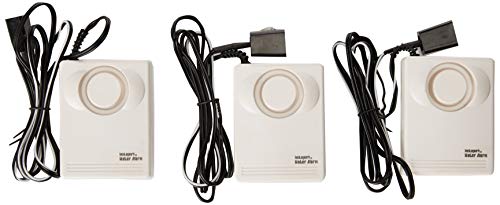
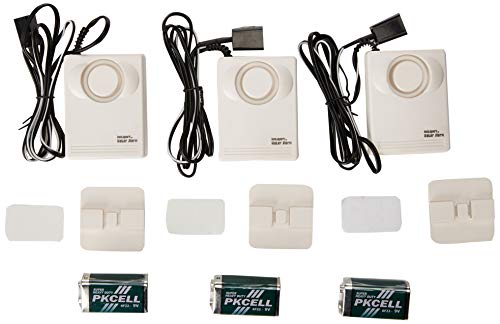
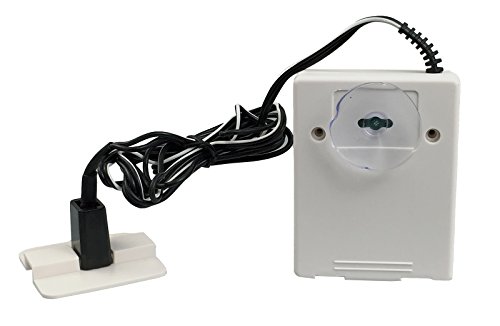

- 24/7 365 days automatic water leakage alarm is triggered when leakage or flooding is detected, a low-cost, simple, and effective device prevents property damage, monetary loss, health risks caused by water damage
- Powerful 130-dB alarm travels up to 100 yards, from end-zone to end-zone
- Advanced and sophisticated solid state circuitry ensures long-term sensitive and reliable operation
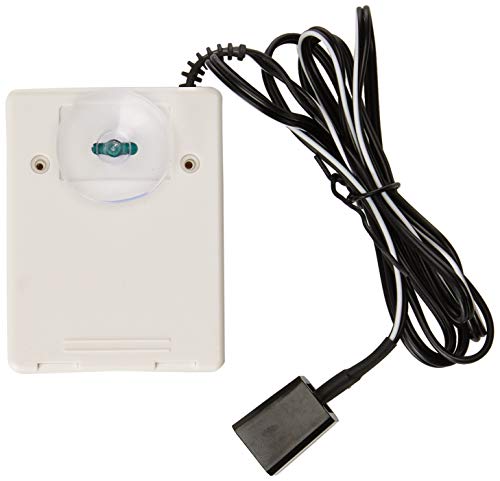
- Easy to remove, easy to clean double-sided adhesive foam tape pad included and built-in suction cup for easy attachment to an appliance
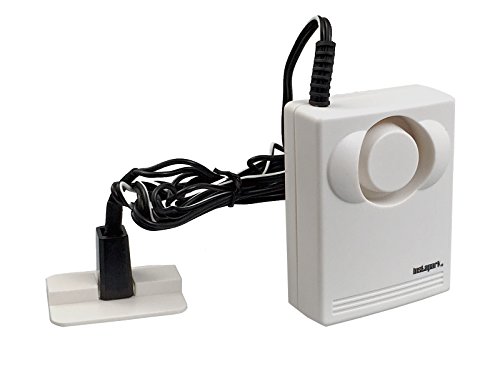
- 44-inch long wire extends far and beyond
-
Information
-
Twitter
-
Pinterest
-
Youtube
-
Facebook
Robin Guillory Franks
Been using for 2 months, has saved hours of cleanup
I work in a factory with lots of water treatment and pumps. If you have ~20 pumps pushing dirty, corrosive water around, the pumps clog, the pipes clog, and things need service constantly. Repairs used to go like this: (1) see water on ground (2) find overfilled tank, clogged pump/pipe (3) turn off water source (4) repair (5) clean up water on warehouse floor (2 gal to 500 gal on a very bad day) Now it's (1) hear alarm (2) turn off water source (3) repair (4) take a break There was one spot the water tended to splash a lot on the sensor (these sound like a dying bird if they dry out slowly). The sensor was wired to a cheap float switch (also from Amazon). The price has increased since I purchased these at ~$6/ea. Other sellers on Amazon offer a similar product. I only like the ones with the wires - you don't want your alarm getting wet!
Elfaris Zaki Sirgyous
Inexpensive, effective, loud and a 4-cent upgrade makes it even better!
While I haven't had any more water leaks to put these sensors to a real-use test, a teaspoon of water on the floor quickly set off the alarm, which then stopped immediately upon picking it up. This convinced me enough to feel they can be trusted. I actually bought them as a backup to a Wasserstein wi-fi enabled sensor that also works but I question how reliable it will be given the difficulty getting it to work initially with the smartphone app. That device also has no standard alarm of sufficient volume to get my attention upstairs, if using these downstairs as I intend. However, it does notify me via my cellphone, so that's great where these sensors will not reach me if I'm out of the house. But, when home, they are great and should easily get my attention. Heeding the suggestion of another reviewer, I improved sensitivity to a scant amount of water by simply folding a 1-inch square of a paper towel and tucking it into the bottom face of the sensor holder. As I wanted the sensor to stand flat upon the floor behind some cabinets where I couldn't easily see if it was properly positioned, I applied quite literally, a 4-cent fix: The sensors came with double-sided mounting foam to permit attaching the sensors or alarm box as desired. Cutting a piece of foam into 4 squares and affixing those squares at the four corners of the sensor holder's upper face, I then added a penny atop each square. This added enough weight to keep the sensor holder flat as I lowered it behind the cabinet. The wire was just long enough for the alarm box to simply lay discreetly at a back corner of the cabinet. At 3 for $20, these sensors are a "no-brainer" for anyone with water leak, flooding, overlflows, or other such issues.
Les Davis
Can you say LOUD?!!! But you'll need velcro to mount it.
These things are exactly what we needed. We placed two of them in the attic, in the metal drip pans for each water heater. Unlike some of the older, self-contained units, these can be used in a metal drip pan, since the contacts don't make contact with the metal. I placed them in the pans and attached the horn units to the side of the water heaters, with velcro (the suction cups that are included are useless). Then I closed the door to the attic, put on shooter's ear protection, licked my finger, and touched the contacts, setting off one of the alarms. My wife said that she could easily hear it downstairs, on the other side of the house. That's what we wanted. Update: Since the sensor and the horn are separated, these would be great to place around an RV, in the places where leaks may be common (near slides, in basement, etc.). These will be going in our motorhome, when we decide which one to get. The only thing I would change is, I would leave off the useless suction cup and double-stick foam pads and instead include a pair of stick-on velcro pads. These particular double-stick foam pads don't stick as well as you might expect. But I always keep velcro around, to it was not a problem for me. Just be pre-warned that you will probably want some stick-on velcro to mount the horns with.
Regina Bowler
A nice water detector with possibility for improvement
When you receive the detectors (3 in a carton) and connect the provided 9V battery, it will operate as expected sounding a loud alarm when a leak is detected. I am happy with the purchase and would certainly recommend it. However that said, the device can be mechanically improved. Permit me to explain. When you remove the detector from the first of three plastic bags, you need to open the back cover in order to insert the battery. Here is the first challenge since it is not clear how to open it (and the meager instructions do not address this). As you'll note from one of the photos, two "tabs" at one end of the unit when closed, fit into the slots. Thus to open the back, use a small flat-head screwdriver and push the tabs down so that they clear the slots. It's not easy the first time but thereafter it's not too bad and besides, you need to do this only when replacing the 9V battery (hopefully infrequently). Once the back cover is opened, you'll immediately note the small plastic bag containing two small screws. So it seems the manufacturer may be suggesting to use the two screws if A) you wish to have an additional closure mechanism (can't imagine why), or B) if the tabs break off, using the screws in place of the tabs. I certainly did not use the screws and in fact, used a small file to try and reduce the size of the tabs so that the cover would open easier. And by now you must have noticed the suction cup on the back cover used to attach the device to a surface. For me, the suction cup didn't work. Although the manufacturer provides a double-sided tape, this too is not a good solution since the tape will need to be ripped away whenever replacing the battery. A much better solution would be a piece of velcro on the back cover, or a "3M Company Re-Close Strip" (similar to the EZPASS attachment used on a car windshield), or gluing a small magnet to the back cover (thereby enabling attachment to a metal surface). With any of these options, the device can easily be removed and replaced without destroying the attachment itself. So now that the back cover is open, the 9V battery can be connected, leading to another small challenge (as many have previously noted). The battery compartment is very tight making it difficult to place the connected battery into the compartment. However here's what worked for me. First connect the battery to the associated snaps. Second, ensure that the battery cable will be situated at the bottom of the compartment (not the top) when inserting the battery. Third, using your fingers reduce the width of the battery snaps as much as possible so that it's about the same width as the battery itself. Fourth, insert the battery into the compartment with the snaps end first and then press down on the other end to push it into the compartment. After you've done so once or twice, it becomes relatively easy. (Of course, had the manufacturer increased the case width by only an 1/8 inch, this would not be an issue.) Having inserted the battery, the back cover needs to be closed, an easy operation, and the probe needs to be attached to the base (or platform), also an easy operation. At this point, I'd suggest you test the unit. To do so, simply moisten your index finger and for an instant slightly touch the probe. If should emits a loud shrill sound, indicating that the unit is functioning correctly. The device is now ready to be placed into operation, to the area where you wish to detect a water leak. Now should you be interested and have the time, here are a couple of improvements I've made. They are not essential to the operation but I believe it will make the device more reliable and sensitive. 1st improvement: Because the probe and base assembly is so light weight, it may easily move around a bit and thus no longer lie flat on the surface, essential for optimum operation. To get around the light weight of the base base, you can glue on some material on either side of the base, such as screw nuts or as I used, dead AAA batteries (see photo). Thus by making the base heavier, once placed on the surface to be monitored, it will lie flat and not have the tendency to move around as easily. 2nd improvement: This improvement, actually suggested by other users (thank you) is in the sensitivity of the detector. The plastic of the base to which the probe is attached is about 1/32 inch in thickness. Therefore the detector will detect water accumulation only when it reaches about 1/32 inch. By placing a tissue that's been rolled and crunched up into the bottom center channel of the base (see photo), the first indication of water will be wicked up by the tissue and thus activate the audible alarm much sooner than if the water had to accumulate to 1/32 inch in height. However just be careful that the tissue lies totally flat to the base. In summary, this is a very worthwhile and economical water leak detector. The mechanical issues described above should not detract you from purchasing the device. And once familiarized, these challenges become less of an issue the next time you deal with it. Finally it's important to note that the device relies heavily on the condition of the battery. It's prudent to check the battery condition on a regular basis, and possibly to replace it with a fresh one annually (or sooner if deemed necessary). Using masking tape or similar, I mark the date I last changed the battery on the case. Good luck.... hope this helps. Having recently received a 2nd order of units, this package cam along with a very reasonably sized and readable Instruction Manual (see photo). Evidently the manufacturer must be reading our comments...good! The most important part of this manual addresses the LOW BATTERY ALERT which reads as follows: "When the battery is low and needs to be replaced, you will hear an interval "beep" sound. Please replace battery with a new one." That said, I think it would still be wise to replace the battery annually.
Achref Khairi
Essential, yet easy to install
Everybody who has a hot water heater in their home should have at least one of these. When boilers go, they usually leak a bit at first before they explode - at which point the results can be catastrophic. These small devices can at least give you some measure of control over what is going on in the far recesses of your basement. Absolutely essential for that, as well as for sump pumps or sewer drains that are prone to clog. This model has a very impressive decibel level, but you really want that for something sitting in your basement. Also includes some nice touches, such as batteries, suction cups and double-sided adhesive pads. Easy to install.
Lisa Laws Peaks
Avert disaster!
I had a model that sat on the floor next to my sump pump. Luckily it warned us that the water was starting to overflow because the pump had failed. The water was coming from all the snow melting. It wasn’t a sudden hard rain. Just in time! Luckily my wife can hear good enough to notice the alarm was going off. It turned out the secondary pump ran out of battery backup. What I didn’t understand was the primary failed long ago. So even if you have a backup pump these are worth having. I have several sprinkled around the basement, next to the washer, next to the water heater. So I decided to get these. I can dangle them down the hole so that they alarm before the water reaches the top. I staggered 2 of them at slightly different heights in the well. I gave the third away as a Christmas present. Our neighbor had their basement window leak and flood the basement with a few inches before they caught it. Our other neighbors had multiple water backups over the years with expensive cleanup and even repairs. Catching it sooner minimizes damage. My parents had a wall develops a crack and leak in an unfrquently used storage room in the basement. So think about those locations too. These are so cheap, and you can arrange them in so many ways, just order them. Don’t overthink it. After you Get these and put them around your basement you can think about the fancy smart home emailing kind with phone app. ;) For a few dollars you can stave off a hell of a lot of water damage!
Pankaj Kumar
Works great!!
I've only been using them for a few weeks, but the peace of mind of having them has been priceless! They work well! I did the paper towel trick mentioned by another reviewer! I wish I would have ordered them sooner! I put one by my floor drain, one near my deep freeze (in case the door gets left open) and one under the kitchen sink. They are loud enough to hear on the main floor from the basement. The batteries were a tight fit, but not difficult to get in.I was tempted to buy the ones that have an app and notify you via text or email, but for my reasons for getting them it would generally only happen when someone is home. The cost of 3 for less than 1/2 of one was a huge advantage. I have already recommended them to a friend and should probably order more!!
Syed Masrequzzaman
Already paid for itself multiple times!!! + TIP
For about $6 per piece, this is amazingly high valued leak detector that works extremely well. WHAT I LIKE: ✔️ Includes 9v batteries! (because who carries spare 9v batteries at home?) ✔️ The water sensor can be placed in a tight space while the alarm can be place in different location due to 44-inch wire ✔️ Very loud alarm that you can't ignore even if you want to ✔️ Long battery life - more on this down below ✔️ Very accurate detection of water, even if it's just shallow drips of water! WHAT I DON'T LIKE: ⛔ Suction cup on the back of the alarm is useless. I would rather see magnet, wall mount hole, and/or a velcro options. ⛔ The water sensor clip is too light so it may easily tilt over but you can place something over to hold it in place. I originally purchased this last year because my front loading washer has leaks once in a while when the washing load is too heavy. I placed this in front of the washer so I would know if there's a leak during the washing cycle. Well, this thing already paid for itself because it warned me about the leak more than 5 times so far and I still haven't replaced the battery that it came with. Few months ago, I had a small leak under the kitchen sink so I placed this under the sink as well after fixing the leak and now I have a peace of mind that I will know as soon as there's another leak. BOTTOM LINE: 5 out of 5 stars. This is practically free insurance for your flood or water damage prevention. Just buy it, set it, and forget about it until the alarm is triggered. A must-have for every home owner! TIP: If you have a sump pump, the worst thing that can happen to you is finding out that your sump pump is not working. Place the water sensor inside the basin far above the sump pump's trigger point and place the alarm outside the basin so it doesn't get wet and you can hear the alarm better. If you hear the alarm, it means the water level has reached the point beyond where sump pump should have been activated, which likely means the sump pump is not working. Hopefully you have a spare sump pump! I don't have a sump pump in my house but I recommended this to my friends who have. Hope this helps!
Jessie Phillips
Save money from expensive water damage repairs, plumbing repairs, and insurance premiums!
Leaks caused by pipes under sinks, refrigerator's ice and water dispenser, water heaters, and windows. I can't say enough about any of those as I have incurred all of them. Early detection would have minimized water leaks and their damage, as both can get worse with time. Plus, who wants to get the home owners insurance involved for up to $500 in damage if it will only serve to just jack up your premium? The answer is early detection and prevention! Enter these little gems. The price cannot be beat and they perform beautifully! I wonder why they have to be so loud, but I will keep earplugs nearby to deal with the noise any time we have a leak again, now that these are deployed. I actually started with the leak bugs and they were so successful, I counted 6 more places that I should deploy water leak detection. That makes the leak bugs' cuteness a bit too pricey. I have moved those into the open areas where water leak detection is needed and people can see them. I will take these water detectors and put them in all the concealed spaces. Thanks for a great product! I am against any compensation via discounts, coupons, or any other cost break for giving reviews. This review is my true experience.
Leathaj Cooper Degraw
Cheap Insurance
Earsplittingly loud- I was wondering how the unit would be shut off after it was tripped, but it appears that all that is needed is to raise the probe out of the water. I tested by touching across the probes with a moistened fingertip, and it stopped as soon as I pulled my hand away. I have one placed by the washer(the water valve failed to shut off last week; it could have been worse but there was still a lot of cleanup to do, including pulling up most of the vinyl planking in an adjoining room) and since the alarm is easily accessible I muffled it by using a folded portion of paper towel held in place with electrical tape. I chose to tape the probe base down to be sure it stays close to the floor in order to trip as soon as possible. The suction cup worked fine to attach it to the side of the washer- I still need to get some adhesive clips in order to secure the loose wire. A second alarm is set up in the crawl space underneath the Kitchen plumbing, unmuffled. A third alarm is in the water heater closet, set up like the one by the washer. You will need a couple of inches clearance if you plan on setting the probe underneath anything. My only reservation about these is the difficulty in getting the battery to fit; there's no room to spare, but it's doable if the circuit board is temporarily lifted enough to tuck the battery clip and leads underneath. I've dealt with a couple of plumbing disasters, and these alarms give me peace of mind- I wish I'd thought of buying them sooner.