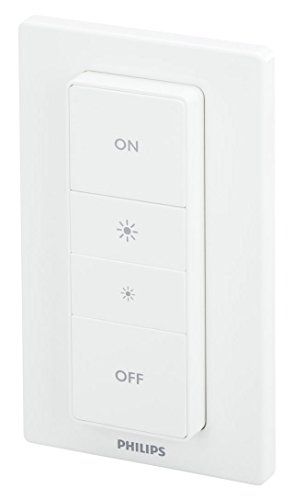


- TAKE CONTROL: The Philips Hue Smart Dimmer Switch allows you to control your Philips Hue smart lights from the comfort of your couch or bed. The battery-powered Wireless Hue Dimmer Switch with Remote smoothly adjusts the intensity and color of your Philips Hue smart bulbs, and switches them on and off
- SCHEDULE YOUR OWN CUSTOM LIGHTING SCENES: When using your Philips Hue Smart Dimmer Switch with Philips Hue Smart Bulbs, you can use the on-button to switch between 4 light recipes without the Philips Hue app, or use the Philips Hue app to configure your 4 favorite scenes hue ecosystem. This is the perfect way to personalize your smart home
- LIMITLESS POSSIBILITIES: Control up to 50 lights using the Philips Hue hub, or use the Dimmer switch without the Philips Hue Hub to control up to 10 smart lights. The Philips Hue Dimmer switch doesn't require an internet connection to work
- MAXIMUM FLEXIBILIITY: Mount the Philips Hue Smart Dimmer Switch anywhere with the included screws or adhesive tape, the removable remote for ease of use. No re-wiring required. Dimensions: Switch: 0.43 inch D x 1.38 inch W x 3.6 inch H, Wall plate: 0.55 inch D x 4.5 inch W x 2.76 inch H
- EASY INSTALLATION: Install your Philips Hue device in a minute. Simply follow the instructions in the Philips Hue app. Our default settings give you immediate control over your smart lights. Customize the smart lighting scene settings in the app to fit your needs
- SMART HOME DEVICE COMPATIBILITY: When you use the Philips Hue Dimmer switch with a Philips Hue hub, the dimmer switch can be used to control any Alexa smart home device or a HomeKit compatible appliance via the Apple Smart Home app
-
Information
-
Twitter
-
Pinterest
-
Youtube
-
Facebook
Serge Nekipelov
A Practical Way to Add Physical Controls to Your Hue System
I'm in a rental property with some questionably location light switches. My lease agreement is very strict about what we are and are not allowed to do to the property - electrical work is strictly off-limits. The Hue system allows me to easily control as many or as few lights as I'd like - though the phone app is just OK, and it's definitely a little cumbersome for guests. These familiar-looking switches are a great way to introduce people to IoT Lighting, because they "just work". I've had two of these switches in the property for a few months now and they've worked as expected every time. They are also extremely responsive. One quabble though - the markings are screen-printed onto the switches. I'd love if the next version had raised markings on the switches so it would be easier to tell which button is being pressed late at night - particularly for the On button.
Debbra Burns
Can't Change the Temperature of These Bulbs.
I love the philips hue system. Here's what you need to know. The Bulbs: Serves the job. They're brighter than any of the other A19/E26 bulbs that Hue sells. But they can't be color or temperature adjusted. Personally, I want more than a dim light when getting ready for bed. I want warm light. I want to cut out the blue light. And as a result I would strongly recommend users upgrade to the next light kit Hue sells. It's only $10-15 more, and it will give you warm to cool light on top of being dimmable. I only use this bulb over my shower because I like it's brightness and I don't tend to want to fall asleep in there. The Switches: These switches are great. They can control up to 10 bulbs at once with no bridge. No additional purchases required. They also contain a chunk of ferrous metal in the middle, it gives them a satisfying heft, and also enables them to stick to magnets. This means they easily click into their provided wall switch. It also means, that you can put magnets inside furniture and they will stick to that, too. Check out these pictures of my bedside table. I absolutely love that this is possible. As noted above, these bulbs aren't really that adjustable compared to other Hue bulbs. However, for those of you looking to buy this kit to add a dimmer switch to the rest of your Hue bulbs, THESE SWITCHES ROCK. They immediately upgraded my experience. All my other bulbs are able to produce gentle light at varying levels of brightness. But accessing them through a phone means 1) looking at a phone screen when you're trying to get ready for bed, and 2) making at least 8 taps and swipes to get to the scene I want to launch. With these switches, I can launch at least 15 different functions and scenes with just a press of a button. And that is awesome. It's convenient. It's pleasant. And it's awesome. (For example, if I hold down the dim button, it does a different function than when I press it. And when I press it, it does a different function that when I press it when all the lights are off. - Because why would I be dimming darkness? I wouldn't. So I converted the Dim Down button into another On button in that particular scenario.) Now, getting this many functions out of a dimmer switch requires a different app than the free Hue app. But it's officially sanctioned by Philips, and is easy to accomplish. You can completely control your room without getting out of bed. The Wall Plates: These wall plates are also awesome. They feature a built in 3M adhesive you can use to stick them to the wall, and the wall plate comes apart to reveal a hidden compartment where screws can be used to fasten the plate to the wall. Contrary to others reports, you CAN use these to replace your switche plates! I have done so. (See my fourth picture.) The wide screw holes allow it to screw into the drywall on either side of your light socket. Take note, the Hue ecosystem is designed to run with the power always connected. (Think the wall switch always being on), and then relying on your phone, or dimmer switches to electronically switch the light on or off. So, when I installed this switch in my bathroom, I removed the old switch, connected the wires inside so it would always be on, then position the Philips wall plate over the old hole, and screwed it into place. It has not budged. I have not used the provided adhesive, as I wanted a more removable and reusable option. For my bedroom, I left my old wall switches as they were, (just turned to the on position), and used 3M Command Strip Velcro adhesive strips to attach the plates above and to the side of the switches. (See my second picture). 3M velcro adhesive is also sold on amazon, can be removed with no marks to the walls, and allows me to temporarily take the plate down if ever I want to. Criticism & Buyer Beware: 1) Bulbs: These bulbs can't be temperature adjusted. For me, this is a huge issue. I only own one of these bulbs and I use it over my shower for this very reason. I only ever really want to shower with full light. In my rooms, my bathroom, my closet -anywhere else- I want more range of light from my bulbs. When it's bed time, I don't just want dim light, I want gentle light. The upside, is that no amount of philips hue upgrades will lead to more productivity for this bulb; buy this kit and you'll buy everything you're ever going to have. (No bridge or app required.) The downside, is that these bulbs don't have any upside, and, personally, when i want to get ready for bed, I find converting to warm light, as well as dimmed is a necessity. 2) Switches: I really wish these remotes weren't symmetrical. They do have a little bump on the back of the remote to help it click into the wall plate, but this isn't something I immediately think about. Aside from that, when I grab the switch in the middle of the night, there's nothing else to tell me which way I'm holding the switch, and I've hit the on-button many times when I meant to hit the off button. 3) App: This isn't really applicable to this particular set, as this bulb can only be turned on, off, and dimmed, but for those looking to invest in the philips ecosystem, the app is.. okay. This is easily fixed with officially sanctioned after market "Friends of Hue Apps" made by other providers, but these do cost money, not much, but something to be aware of. I strongly recommend making the purchase, however, as using an aftermarket app, my dimmer switch has 15 different functions from only 4 buttons. I can turn off the lights in my room and the entire house. (I think, theoretically, 24 different scenes would be possible.) Bottom line: This product is solid. I highly recommend the Philips Hue eosystem. The app may be clunky, but with excellent workarounds like the dimmer switch available, it dramatically upgrades a room with only one purchase.
Val Dodge
Smart light control for the not so smart guests
Repurposed these to control my smart lights and light scenes instead of the stock dimmer or on and off only. HomeKit from Apple allows me to configure the individual buttons to control more than one light/scene/or smart plugs rather than just use the on to turn on and dim my lights. My switch in my bedroom is used to control the lighting scenes in the whole house...ie...the off button would turn off all my lights in the house instead of just one light or room before I go to bed...the dim button was programmed to turn my bedroom lamps to only 25% brightness and turn on the kitchen lights as well when I wake up. All these can be done from my phone/iPad/computer but sometimes I just need physical buttons to control things on the fly and for people that don’t have access to unlock my phones/iPads.
Jill Davis
Remote with wall mount adds a convenient way to control Hue lights - great for guests not familiar with Hue
Works perfectly! I have a relatively simple Hue setup -- just four lights in lamps in my living room. None of these lamps are on switched outlets, so I can control the lights by a) using an app, b) using a voice-controlled device, or c) turning the lamps on and off. This gives another way to control the lights by using the smart dimmer remote. This is great if you have guests or visitors that might not be as familiar with Hue lights or how they work. This has two parts - a remote (which controls the lights) and a base. The remote can attach to the base by included magnets, or the remote can operate as a handheld remote. The base can be attached to your wall via sticky tape (also included). This makes it easy to attach the base to a wall and add a new "switch" anywhere you want - no wiring or cutting required. Just peel and stick. The remote has lets you cycle through four light settings and also adjust the brightness of the lights. Tapping the on button cycles through the four light settings. The first tap of the on button can either turn on the last-used setting or turn on a default setting of your choice. Highly recommended if you want to add another way to control your lights or if you are looking to make it easier for guests to control your Hue lights.
Dunja Gagulić
Great non-invasive solution to add switch to smart lights
I really did not feel like having to install new switches or mess with electric wiring or even having to turn off the power to add a switch to my smart light setup. I initially only had one room with a full array of Hue lights. My wife was complaining because almost the entire house is setup with smart lights and we operate them with voice commands via Alexa. I initially ordered just once of these Dimmer switches and it worked so great and looked so nice on the wall that I have since converted all of my smart lights to Hue bulbs and have a total of 4 switches to cover 4 different rooms. The setup is pretty seamless and the Hue app is pretty intuitive. Of course the bridge is required but I have had a bridge since the beginning and honestly, if you want access to the full functionality of Hue then just invest in the hub. It is totally worth it. And if you want to add a really simple switch setup to provide some manual switches for those not onboard with the smart home of the future then these are your best bet. I tried to figure out some way to add a switch to my Wink hub to control some TP-Link bulbs via IFTTT or Stringify but it turned into to much of a hassle. Honestly, save yourself some time (time is money) and just go with these Hue switches. They were easy enough to install that i converted to rooms that were not Hue, to Hue. The plain white dimming smart bulbs are pretty affordable.
Claudia Soares
You’ll want this! It’s convenient!
I avoid most “smart-home” items. However, I love my Hue lights- this dimmer makes them even better since it gives others an easy way to interact with them without needing the Hue app. Plus, I don’t need to talk to Siri through my iPhone (refuse to put any other speakers in the house - they’re just too creepy) and can simply press a button. There are a couple awkwardly placed light switches in my home, sticking one of these to the wall makes that minor annoyance a thing of the past. Really, Philips should give these away for free - one to each Hue owner. Once people try them, they’ll want a couple more. I bought one through Amazon and within a couple months had a total of three of them.
Fagbohun Kazeem Olawale
Perfect switch to go with you HUE lights
This switch is the best thing to get along with your HUE lights. Just wish that they would include it when you at least bought the HUE starter kit. Setup: Super simple. Take the switch/dimmer out of the box, remove the plastic tab sticking out of the battery tray, open the HUE app and in the settings tab go to Accessories and click "add". The app will give you two options, one asking if the switch is new and never used before and the second asking if the switch was used for another light before. Just select the first one and wait a couple of seconds while it looks for the switch. Once connected it will has you which room(s) you want it to control, select the one you want and you're done. The switch has four buttons, on, off, brighter and dimmer. Here's a tip: the "on" button also acts as a way to switch the preset/color of the lights. Within the accessory part of the app you can click on the switch you want to edit and choose what happens when you click the "on" button once, twice, third time, fourth and fifth time. First press will turn the light on to the settings for when the light was last on (you can change this though), you can make second-fifth press change the "scene" of the lights. Over all very happy with this and my wife LOVES it since she still doesn't like talking to Alexa.
Adele Semenaviciene
Great technology but mounting a wall plate has complications
Even though we were doing a full house rewiring and could install hardwired dimmers wherever we wanted, there are a few places where the Hue dimmer tech makes a lot of sense. For us, it was two bedrooms where we wanted the ceiling fixture and two plug-in lamp fixtures to turn on and dim in sync. The only complaint I have is that there isn't a clean solution for covering or replacing the standard switch wall plate that is made obsolete by the Hue dimmer functionality. I didn't want to remove the standard switch because I didn't want to leave a wiring project for the future if we retire the Hue system (nothing lasts forever, after all). But there is no off-the-shelf, unified solution for keeping the switch in place and attractively adding the Hue dimmer next to it. Our imperfect solution was to use a two-gang decora plate: the left side of the wall plate is connected in the normal way to the paddle switch that controls the ceiling fixture. A small piece of clear plastic tape holds that switch in the ON position. Then on the right side, we put a blank filler plate, removed the magnets from the Phillips mounting plate and glued them to the back of the blank plate. This allows the remote to stick to the right side of the wallplate adjacent to the always-on paddle switch. A guest entering the room finds the switch where they expect it to be. As long as they don't try fiddling with the paddle switch. Without a small lip or edge below the removable remote, however, the remote tends to magnetize against the blank plate slightly askew. I now need to craft a small lip or ledge to prop the remote perfectly upright. I should note the magnets do hold the dimmer snugly in place.
Cris Sangster
Great!
With me already owning 5 of these, it’s fair to say I like these devices. However, unlike some people, I haven’t really gone ‘all in’ with Hue products, currently just owning a Hue Bridge (2nd gen) a Hue Go, the aforementioned Dimmer Switches and eight basic ‘Warm White’ Hue bulbs. These bulbs are in an area frequently used by mother-in-law, and as such I need her to be able to control the lights without using the original switches – which as you may know – disconnects the smart bulbs from Hue & HomeKit. Not much point in smart bulbs if they’re disconnected right? So this is where these dimmer switches come in handy. They’re stylish enough to blend in to most places, and they’ve got just enough buttons to both please the techies, but also not too many for those that don’t really care. These switches hit that middle area perfectly for her, and now that the old light switches are disconnected, she knows to use these new ones, and she loves them (if it’s possible for an octogenarian to love something like this…). The packaging is pretty straightforward for Hue products, being a fairly thin cardboard outer with an inner plastic frame, encasing the device itself. Whilst the carton does come across as a bit on the flimsy side, the fact that the plastic suspends the device far enough from the outer packaging, all but guarantees that the device won’t come close to suffering any impact damage. The Dimmer itself comes in two parts, with a base plate that attaches to the wall, along with the switch itself, which almost comes across as a remote control (which it sort of is, essentially). The Dimmer sits inside the recess of the base plate and is held in place via magnets situated at the rear of the base plate. These magnets, in addition to holding the switch in place, can also be used to magnetically attach the base plate to anything else that is metal. I currently have one on the side of our refrigerator, which faces you, as you walk into the kitchen, which really holds very well, taking some effort to remove it from the side of the fridge, so there’s little chance of it ever falling off. However, if you’re not lucky enough to have a magnetic surface to attach it to, there are other options; The base plate also comes with a pair of 3M adhesive strips, so if you’re going to places these somewhere permanently, then this is just as secure, if not more so. The third option for attaching the base plate is via two holes inside the base plate itself, which can come apart. You would basically drill two screws into the wall, through these holes, in order to secure the plate. So, there are many options, and there’s really no reason why you need to attach it to a wall if you don’t want, as the button part is, as I’ve already stated, a remote control of sorts. The switch and base plate are rather unassuming, and perfectly ‘nice’ in terms of design, providing you with just enough style without sticking out too much. The dimmer part is powered by an included CR2450 coin battery that should last at least 12 months, and as long as 24 months, if used sparingly. Besides the battery life, the Dimmer does have a distinct lifespan, which is determined by how many times it is pressed. They estimate 50,000 presses before it starts to fail on you. Based on an average of the dimmer being pressed 10 times a day, that works out at 5,000 days or almost 14 years! I would say that should cover most people’s expectations. One thing to note is that there are different versions of the packaging around, whilst the product is essentially the same. This also happens to be the case with the switch itself, which comes in at least two varieties; There’s one version of the switch which has ‘ON’ and ‘OFF’ printed on the respective buttons, and another ‘international’ version which simply has a vertical line replacing ‘ON’ and a circle, replacing ‘OFF’. Aside from this, the switches act exactly the same. In terms of setting up the device, it must be made clear that while this will work with HomeKit, it can only do so via the 2nd Gen Philips Hue Bridge, which can be purchased separately. If you’re new to the Hue ecosystem, regardless of whether you’re going to integrate it into HomeKit, Philips offer a dizzying variety of starter packs, including a Bridge and bulbs, Bridge, bulbs and Dimmer, Dimmer and Bulb, and all manner of options in between, so there are plenty of options to get you started. Going back to setting the Dimmer up, you will initially have to activate it via the Hue app, which I won’t go into, as it’s really very easy, but it is worth mentioning that when you are setting it up in the Hue app, you’ll eventually be given the option to program the switch via the Home app, which I’d recommend if you’re planning on using it with anything other than Hue lights. This brings us to possibly the greatest thing about these (and other) switches; Not only can they be programmed to turn Hue lights on or off, and dim or brighten them, they can also be used to control just about anything, from the aforementioned Hue lights, but also other HomeKit enabled lighting (LiFX, Koogeek etc.). They can also control literally almost anything within the HomeKit world, so if you want to program it to turn on a Smart plug that turns on a fan, then it’s there for the taking. If you want to activate a specific scene, involving a series of actions, then that’s also possible. Not only that, but as there are four buttons, you have a multitude of choices. It can be taken even further however, with the use of conditionals. Conditionals aren’t available in the official Home app as of typing, but they are available in most 3rd party HomeKit apps. What conditionals allow you to do is essentially get a button press to activate an action or scene, based on another parameter, like the time of day, so you can have the ‘on’ button turn on your fan between the hours of 9am and 5pm, but control something totally different from 5pm – 11pm for example. I won’t go too deeply into this aspect, as there are a few articles on this in the ‘How To’ section of the site. It’s also a good idea to point out that whilst these options can give you a wild amount of choice, if you are going to use them strictly with Hue lighting, then there are other options available with these switches that are exclusive to what you can do with Hue lights, like multiple presses or long presses activating various parameters, for example. The overall verdict from myself, is that these really are my ‘go to’ switches when it comes to Hue or HomeKit (or both), and whilst these don’t replace in-wall switches as such, being battery operated, as opposed to being hardwired, they do offer a lot of flexibility, not only in terms of being portable, and programmable, but also in how and where you can place them.
Deigee Grandee
This switch has been a great addition to my Hue lights
This switch has been a great addition to my Hue lights. I used to exclusively use the Google Assistant to turn my lights off and on, but sometimes when you get home late, you just want them on! This switch solves that problem. The ON button on the switch has multiple useful functions. If you press the ON button once it will turn your lights on, of course! But if you keep pressing the ON button, it will cycle though different scenes. The default scenes are ones like "Read" and "Relax", but you can change the order and scenes in the Hue app. The ON button also contains a light to let you know if it's connected to your lights. The dimmer buttons are great for fine-tuning the brightness of your lights, but they're a bit slow. Sometimes you have to wait a second or two before the brightness will change. If you start mashing the dimmer buttons, the remote light will turn red to tell you to stop for a second while it catches up with you. The switch is easy to mount, and it's also detachable from it's plate if you want to bring it around. It blends in well with other standard light switches.