

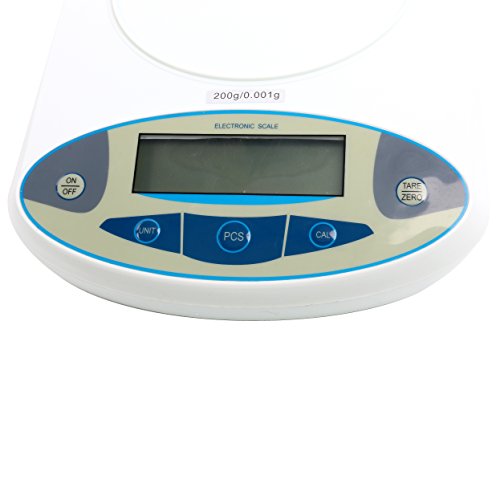
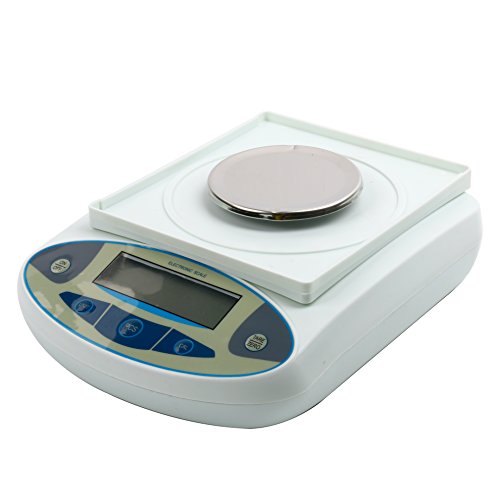
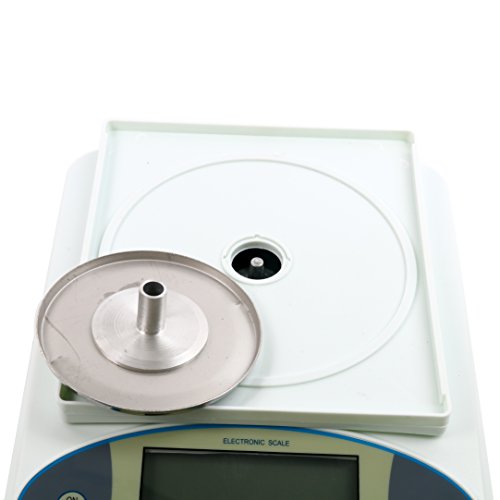
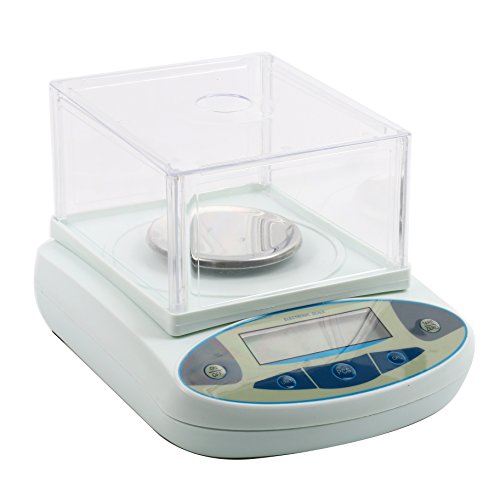
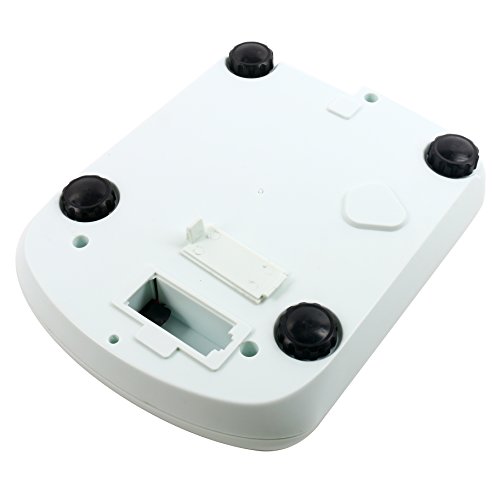

- Measurement: 200 g Rang; 0.001 g (1 mg) resolution; ±0.002 g Accuracy
- With Unit conversion: ounce, karat, gram, pound
- Both AC/ DC power supply
- With manual calibration, tare function, part count function
- LCD Display with backlight
-
Information
-
Twitter
-
Pinterest
-
Youtube
-
Facebook
Reina DE Sur
It does the job.
It works fine and reliably. Not a top lab balance, but worthy for the price.
Melissa Binder
Amazing price for great precision.
This scale is wonderful. I use it many times a day everyday and it constantly comes from upstairs to downstairs and vice versa depending on what projects are going on. It loses its calibration fairly easily if you nudge it or push it around frequently. I wouldn't expect this thing to have a perfect calibration down to the thousandth of a gram. I often find that even after calibrating with any 100 gram weight this will still be off by about .005 to .008. This doesn't affect my hobby uses but maybe a turn off to someone who requires that level of precision at all times. I believe your time and may be better suited to purchasing one of the more precise industrial options.
Marion Proudley
Works well for bread baking
I am a lazy baker and use a bread machine. Inconsistent results drove me to find a balance that could weigh accurately below 100 grams and wasn’t too expensive. I have used this balance over 7 months and it has worked very well. I am getting consistently good results from recipes that call for measures of ingredients below 10 grams and often are specified in tenths of grams. I use 4 oz polypropylene “Jell-O shot” cups to hold the ingredients on the balance when I weigh them out. Polypropylene can be heated in a microwave for short times to soften butter or honey, and the cups only weigh about 28 grams, so you can measure up to ~70 grams of an ingredient. The second picture shows a typical result of my baking efforts using weighing rather than measuring spoons or cups.
Deana Williams
A good purchase, a big and friendly device.
We have to understand some limitations to see this realistically. This is an electronic scale that relies on much the same technology as $20 scales. This is not a lab balance that costs $2000. One of the issues is always going to be drift - of the zero point and every measurement. If you needed to measure within 1 mg you'd need to resolve 0.1 mg. You'd have to spend more money. And it's going to be very difficult since the slightest change in the surroundings will affect it, things like temperature, magnetic fields, stability of the surface, etc. With this scale the same issues apply. If you work very carefully you can measure within a milligram or two by taking multiple readings, re-zeroing several times, sitting in the same way, etc. You have to learn how to compensate for the inescapable drifting. I use it to weigh medication, say 50 mg portions, where a milligram or two error is alright, and I love this scale. If you have to weigh say multiple 2 milligram portions, you're going to have to pull out your credit card, and work much harder. One big advantage of this over say a GEM-20 is that it does not auto-shutoff. It uses a wall-wart power supply. I keep mine powered 24x7. Another advantage is the smart auto zero. It's constantly re-zeroing. It's always ready. The thing isn't gorgeous, very Chinese utilitarian, fortunately not too greenish. The buttons are big, the display very legible. I use this in my home lab, and it's very functional. It's big and weighty enough to be a real tool. Just don't look at the side panels that are funky, shaky and laughable. Once they are in place you can pretend they aren't there, but keep 3 sides mounted as they help shield it from drafts. The 200 g range is useful, but also important because you don't have to baby the device, you can push things around on the plate without damage. It's good to get a cheap set of weights to get a feel for how the scale behaves and how inaccurate the "calibrated" weights can be. Reality check. Never try to weigh something close to zero, always put it in a beaker or something to pre-load the scale and work outside the auto-zero range. The tare function works well. But use it wisely. Say weigh the container several times. That's the tare. Write it down. Re-zero. Put the container on again and check. Tap the tare button, add the substance, write down the alleged net weight. Remove the container with substance, re-zero, weigh the total. Now subtract and see how close you are. If significantly off, start over. Otherwise average or fudge the difference, but if you did this carefully it's usually within a milligram, sometimes two. That's how you can get a pretty accurate weight. With practice you can do all the steps quickly. The scale settles rapidly, and that helps too. Needless to say, an auto-shutoff would make this very difficult. If you aren't doing several measurements a day, and stay within 20 g, you can go with a little GEM-20 and perfect similar techniques. It's going to be more of a pain, but the accuracy isn't going to be significantly worse. If you do repetitive weighing, save your sanity and spend the extra $60 or so. You'll come to improve your technique and you'll love this scale.
Victor Cassara
Five Stars
Really accurate
Dawn Miller
I've used it to measure chemicals for my home lab and I've had very good success with it
This scale work very well. I've used it to measure chemicals for my home lab and I've had very good success with it. My only complaint would be that the digital readout travels quite a bit but, in defense, it does settle down after a little while. I recommend the product.
Heather West
and I needed a good quality scale for balancing RC helicopter blades
My 0.01g scale wore out after a couple of years, and I needed a good quality scale for balancing RC helicopter blades. A 0.001g scale is extreme overkill for what I need, but the price was within my budget for a good scale, and I thought I might make use of the resolution, if only for the gee whiz factor. I was skeptical about the quality of an analytical balance at this price but decided to get it and if it wasn't reliable, I'd return it. I'll update my rating if the performance of the balance degrades, but as things stand now, I'm completely satisfied. It comes with a 100g calibration weight. I have another 100g calibration weight I used with the scale I'm replacing. Both weights were measured at 99.976g. I calibrated the unit and now the weights are measured at 100.001g and 100.002g. Given that the repeatability is 0.002g according to the spec, those measurements are fine. I repeated the measurements and they are very stable, within 0.001g typically. I did the same with some coins. Very precise, repeatable measurements. If that keeps up, I'll let the 5 star rating stand. If not, I'll adjust accordingly. FWIW, the clear plastic box and its plastic bottom are probably meant to prevent air currents from influencing measurements, but they have a very cheap, flimsy feel to them. That doesn't matter, for my needs, but if it matters to you, be aware the clear enclosure is low quality. The rest of the balance appears to be of decent quality for home/hobby use, but not what I'd call rugged.
Amos Akinwale Ayoola
Great very sensitive scale
Love the precision. Absolutely great price. Will buy again.
Sam Holder
Very handy
I like it because the wall wart allows it to be powered on all the time. Definitely let it warm up for maximum accuracy. I find for weight in the milligram range (5mg for example) it can be off by 2 or 3 mg, but this is the basic technology. Something more accurate is like $1500.
Michelle Donley
Ugly but, if it works, who cares? Really good value
This is huge and every bit as ugly as you expect it to be. The plastic top bit shakes around loosely and keeps collapsing. However, after trying two other gem scales on amazon, this is the only one that is accurate! I am using it for gemstones and this was extremely good value for money. It’s earned all five stars, I love this thing.