




- ITEM SPECIFICATIONS: This Brake Fluid Bleeder uses a standard workshop air supply and features a working pressure of 71-113 PSI with a maximum pressure of 113 PSI.
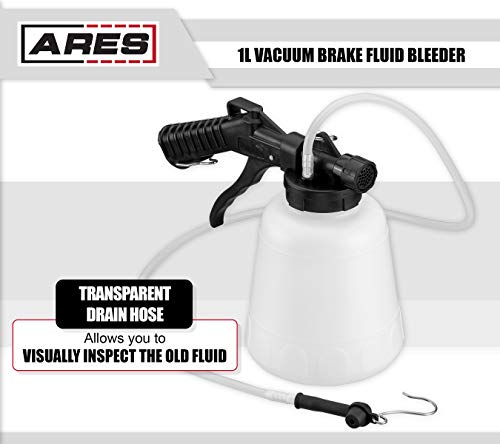
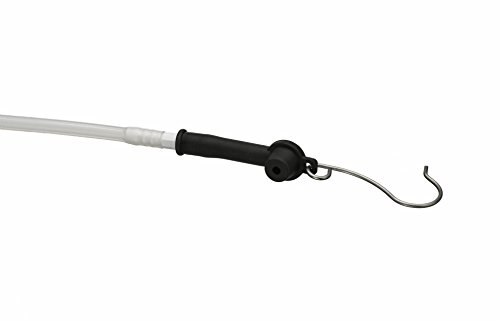
- CONVENIENCE: Our 1L Vacuum Brake Fluid Bleeder features a convenient hanging hook and locking trigger that allows for hands free operation.
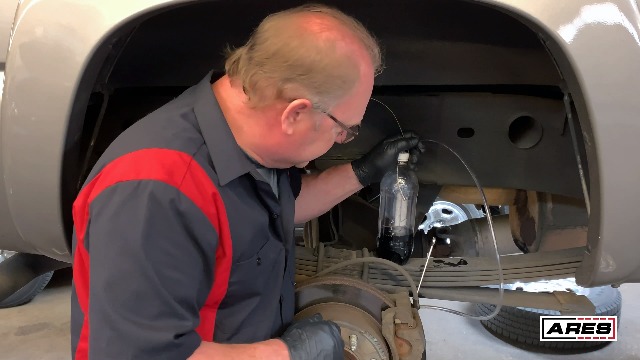
- TRANSPARENCY: The transparent drain hose allows you to visually inspect the old fluid during the draining process. You can easily flush your entire disc or drum brake system with this brake fluid bleeder!
- RELIABLE | EFFECTIVE | EFFICIENT: Users trust ARES to be quality tools. You are backed by our Performance Assurance. If you have any issues with your ARES 1L Vacuum Brake Fluid Bleeder, simply contact customer service for troubleshooting help, parts, replacement, or refund. Need a manual? Download it for free on our website!
- ASPCA BUSINESS AMBASSADOR: We are proud to be part of the ASPCA Business Ambassador Program. If you have a pet, you realize they are more than a pet, they are part of the family. With your support, we’re proud to help this great organization.
-
Information
-
Twitter
-
Pinterest
-
Youtube
-
Facebook
Freelanc King
Worked great!
I almost bought the Motive bleeder, but this was free one-day and I didn't want to wait a week for the other one, so I thought I'd give it a shot. I used this on my 09 BMW 335i and it worked perfectly. Here's a little tip, don't put brake fluid in it. Suck the old fluid out of the brake fluid reservoir with a clean syringe or turkey baster, fill the reservoir with clean brake fluid, put the bleeder cap on the reservoir, pump the bleeder up to 15 psi with air, and open the bleeder screw. Make sure you check the master cylinder often and don't let it go dry. Using it this way, the whole unit stays clean. No need to wash it out, and the hoses won't deteriorate from brake fluid. Check out the reviews of the Motive bleeder, people are doing the same thing with those. I highly recommend this pressure bleeder.
Parminder Brar
Buy it Now!!!!
Where has this been all my life and why did I not know about it??? I have bled hundreds of brakes in my lifetime, but never was it this easy. I have always used either the gravity method, the manual “pump the brakes” method, or more recently a handheld vacuum pump... enter the world of an air compressor powered vacuum bleeder! Simply connect your air compressor to the device, crack the bleed screw and pull the handle. You’ll instantly be treated by a smooth steady stream of fluid coming out. When your done, close the bleed screw while the device is still under vacuum and you don’t even have to worry about air sucking back in. Top off the reservoir and repeat again for the next brake. Maybe I’m easily amused, but this is single handedly the best automotive tool I’ve bought in the past decade!
Maria Agapiou Cignarella
Get the right adapter.
I bought this and used it after taking my 2002 Honda CR-V (146,000 mi,) in for airbag recall service and receiving a service recommendation for brake fluid change. To the best of my knowledge this service had never been performed and was long overdue (should be done every two years). The quote for service at the dealer was $162. So being retired, and having taken auto shop in high school 53 years ago, I decided to consider doing the job myself. I already owned the Honda 2002 CR-V service manual and have a fairly well stocked tool chest. So here's the advice. You'll need an adapter to connect the bleeder to the master cylinder and the bleeder doesn't come with one that fits. You'll need to shell out another $38.00 for the CTA 7030 adapter, plus a few more dollars for some thread sealer. You'll need to swap out the CTA male pneumatic/hydraulic fitting for the one that's in the adapter supplied with the bleeder. They are not the same type. The Ares tool uses something different than the fitting supplied with the CTA adapter (according to the CTA catalog, a Nitto quick disconnect coupler). Fortunately, the threads for the two two fittings are the same size and threaded identically. I used a little more than two pints of fluid for the change - so buy three pints (at around $4.50 per pint). I already owned some tubing and a collection vessel for the operation at the caliper. If you don't already have this, you'll need to buy some Tygon or surgical tubing for this part of the change. Ares has a YouTube video showing how to use the tool. It's pretty straightforward. Bottom line, you'll save a few bucks overall. And you'll be able to nurse your second generation CR-V, or Civic or Accord that shares the same master cylinder into old age. By the way, there is a question answered by someone who claims to be a Honda repair technician claiming (or strongly suggesting) the bleeder came with the appropriate adapter. 'Tain't so.
Jasmin Lingad
Love this tool.
This is a great tool. Quick and easy for 1 person to completely flush all the old dirty brake fluid out while at the same time refilling the system with fresh clean fluid. Suck all the old fluid out of the master cylinder reservoir with the ARES 70920 | Fluid Change Syringe or if you have an air compressor use the ARES 70923 | 1L Vacuum Brake Fluid Bleeder I bought all three. Fill the ARES 70921 and the master cylinder with new brake fluid. Pressurize the 70921 and attach it the master cylinder. All that's left to do is open the brake bleeder valves at each wheel and let the pressurized fluid to flow untell it runs clean. Close the valves. Put away all your equipment and install your factory master cylinder cap. Pump the brakes to insure a firm brake pedal and take the car for a test drive. All done in as little as 10 or 15 minutes.
Jessie Phillips
best thing since sliced bread - BUT . . . .
I am amazed. I bought something on Amazon and it actually does what it says it will do, is not a piece of crap, and it got to me on time - definitely not the usual result of an Amazon purchase. The device is absurdly easy to use, does not leak, the cap fits the master cylinder in my car, and best of all it just plain WORKS. Pump it up, put tubing on the bleeder, open the bleeder just a turn or so, and watch the old fluid come out. The device holds at least 3 quarts of fluid. When you are done, push the silver pressure relief valve, hold it for about 15 seconds, and you can remove the cap and reinstall your original master cylinder cap. The only drawback that I found with the item is that it will not work on the old style metal master cylinders with the double square metal covers that are held down with stiff wire bales. It requires that the car have a plastic master cylinder with a round threaded plastic cover. My 1987 Caddilac Allante does and I was able to bleed the master cylinder, ABS accumulator and ABS pump in under 30 minutes. Then I popped the hood on my 1978 Eldorado and discovered the situation with the metal master cylinder. No biggie, I built an adapter from an old cylinder top, but something to be aware of. I believe almost all cars form 1980 or so on will be fine for this tool.
Maggie Hart
Great Product! So Much Easier
This makes flushing brake fluid so much easier, eliminating the need for 2 people (pumping the brakes). The handle has a metal locking mechanism where you can work hands free. Solid construction, this should last me a life time!
Rahman Baba
Works like charm but there's catch
This device works based on Bernoulli's Principle. High speed moving air creates vacuum which pulls brake fluid. According to spec, working pressure is 71 psi but It works at even lower psi such as 55. Real problem with product description is that it's missing how much air it consumes to create vacuum. I have 6 gallon small air compressor which worked eventually but hard to keep up air flow. According to compressor spec, it's 2.5 CFM @ 90 PSI but couldn't keep 90 psi so I think this bleeder consumes something like 3 CFM. Even with lower PSI, front brake job was easy air it's closer to brake pump. But it's harder to pull for rear break. So, 10 min job for front but 30 min for rear as tubing is longer which needs to bleed more fluid and it also pull slowly.
Brad Wales
Great Tool
Summary: pros: -- one person affordable brake system flush finally -- it actually works, not most of the time, but so far every time. -- good for occasional use, unlike commercial expensive units which retain too much fluid and therefore lead to waste or worse, use of water contaminated brake fluid. -- connectors and adapters are high quality cons: -- it is slower than the very expensive commercial units -- In my opinion, this tool would not hold up in a commercial garage in daily use. The air pump part doesn't seem particularly durable. OTOH, you can buy several of these for the price of one commercial unit. -- For some reason, Ares is very unhelpful in determining which cap to use for reservoirs. -- I managed to read enough hints on the web to correctly guess what I needed to buy (in my case, 2005 F150 and 7.3L F350 (after 2000), both use the Ares 18002-50.7mm adapter. Probably works on many other vehicles, but you will just have to measure the reservoir and count the tabs, and hope you guess right). -- you get to print the manual from the website, directions are not included (at least, not with my tool). Finally a tool that is both reasonably priced and allows one person brake fluid flushes. I have use the "helper" method, and the "vacuum bleeder" methods-- helper, you need another person, OK for something simple like a caliper replace but consumes a lot of the helper's time for a system bleed. I have had poor luck with the vacuum bleeders, because the bleeder screws allow air to leak past the threads so I can't tell if the system is air free (yes, I've used all the usual methods in an attempt to seal the threads: teflon tape, teflon thread goop, heavy grease, silicone grease, stack of o-rings... best I can manage is 25% success. Not good enough, I use the vacuum bleeder now to pull fluid out of the reservoir now, works great for that). The Ares tool attaches to the brake reservoir, and once filled and pumped up it replaces fluid that flows out when the brake bleeder is opened. Finally, a way that actually reliably works for one person brake bleeding-- particularly useful for doing a brake system flush. But... there is a learning curve. Here are some hints: -- wear safety glasses-- if you disconnect this tool with pressure still in the container, brake fluid will spray out. Bad enough on skin, don't want brake fluid in your eyes. -- as the manual notes, check the level in the tool periodically, as you do not want to get air in the system if the Ares tank runs dry and the reservoir then empties-- why? for too many vehicles this means a difficult/complicated process of bleeding the ABS hydraulic components. Don't go there. -- I wrapped some pig blankets around the reservoir just in case there was spillage-- did not happen, but I don't want brake fluid spilling on anything, particularly painted surfaces. I did find that there is significant leakage from the disconnected reservoir adapter/tubing, the pig blankets worked well for that. -- when I first set this up, the air bleeder leaked (this is the button to press to let out air pressure prior to disconnecting tool from vehicle). It is a threaded gadget with a spring, just tighten the silver button part. No hint from the sparse manual, I guess you figure this out on your own. Disconcerting to hear that tell tale hissing when pumping up the Ares, I was thinking "defective" but this was not the case. -- Be sure the brake fluid reservoir is not at max level. Each time this tool is used, including when adding more fluid to the Ares tool tank, somewhat more brake fluid ends up in the vehicle reservoir; I started at max level and had to remove some brake fluid from the vehicle reservoir because the reservoir went over max level. -- in a similar vein... if you are doing a vehicle flush suck out the old reservoir fluid and add fresh fluid, just don't need to spend time flushing the reservoir fluid AND the lines for the first caliper. Yes, obvious, until you just connected and pumped up your new toy and realize... yes... forgot this step. -- you need a more or less flat surface near the brake reservoir to set the Ares tool. For my first use, one truck had a convenient battery, other one I used a piece of plywood on top of the engine. I did not want to get fluid on the air valve if the Ares pitched over on its side (might spray out some brake fluid when relieving pressure). -- the silicone tubing seems to be 5mm ID x 8mm OD, which also works well as bleeder hose -- I found that the bleeding rate was slow enough, that at the end of the process for flushing the brakes, I could allow the Ares to just flush out the balance of the fluid into the brake system and last bleeder, allowing some air into the reservoir to reduce the level somewhat below max-- enough time to get to the bleeder and close it before too much fluid was pumped from the reservoir. I was using about 15psi on the Ares gauge. -- If the Ares brake bleeder tool is only occasionally used, have isopropyl alcohol on had for flushing. Otherwise the old brake fluid sits there soaking up water for ages, potentially contaminating your next brake bleeding. (method: pump out all the DOT3 in tank by using the air pump on the unit and directing waste fluid into waste receptacle, add the isopropyl (I used 99% anhydrous, so that it evaporates out faster, but this adds to the cost vs. cheap local store bought 70% isopropyl), swish around to get to all the DOT3, then pump the fluid out into waste receptacle. Allow to air dry before capping reservoir. Store out of sunlight, the Ares tank is susceptible to UV degradation over long periods of time (as the "manual" implies). I like this tool.
Kim Losky
The Easy Way to Bleed Brakes
After failing bleeding brakes using a suction bleeder, I caved and bought this one. The product is great quality with very durable plastic and well built. It included an adapter that fit my BMW perfectly. The process was dead simple: Poor in brake fluid, screw on the reservoir cap, quick attach the hose, pressurize, and go through each caliber and bleed. If it weren't for having to remove tires, it could be done in under 30 minutes by a single person. Very much satisfied with the product. The quick attach feature spilled no fluid when detaching, the pressure release valve is a nice bonus, and while the pumping mechanism is slow, it only needs to be performed rarely as it holds pressure perfectly. I can't believe I've wasted so much time bleeding brakes any other way.
Merouane Mimou Maskri
Works great on a BMW M4 Brake Reservoir Cap
I wasn't sure if this unit would be compatible with the BMW series since some of the reviews stated that the manufacturer wasn't clear on which adapter to use. I purchased the brake bleeder anyway hoping this would work since I had to prep the M4 for a race in less than a week. Happy to report the unit and attachment fitting that comes standard with the ARES 70921 worked fine on the M4. As some reviewers reported it took more time to remove the tires at each location than it was to attach the fitting to the brake reservoir cap and pressurize the system. Also as reported, 15 psi is adequate to pressurize the brake lines and allow fluid to flow to each brake piston and bleed fitting. Also like the idea that the quick disconnect fitting attached to the cap is able to rotate so as not to kink the line if you have to reposition the unit in the engine compartment. The unit also has a pressure relief valve button to release pressure prior to removing the cap otherwise you could make a mess. (Other models do not have some of these features) I had no issues at all with this unit and would gladly purchase the ARES 70921 Brake Fluid Pressure Bleeder again. Well worth the $$ and it saved me time to service the brake system.