
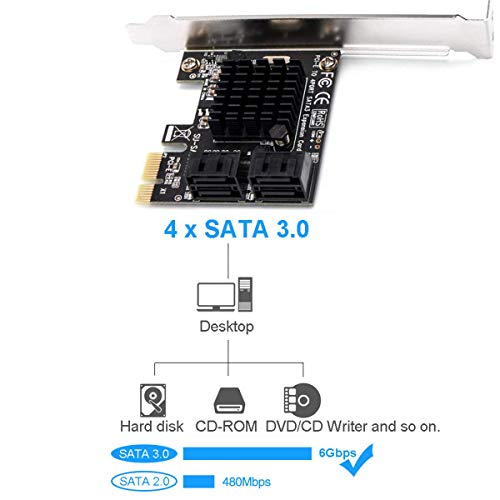

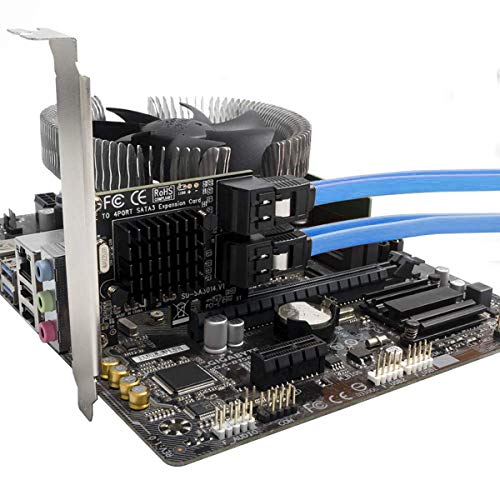

- ➤You could make the system to boot from this SATA controller but non RAID.If your motherboard has RAID function, you could make a RAID with this SATA Card.
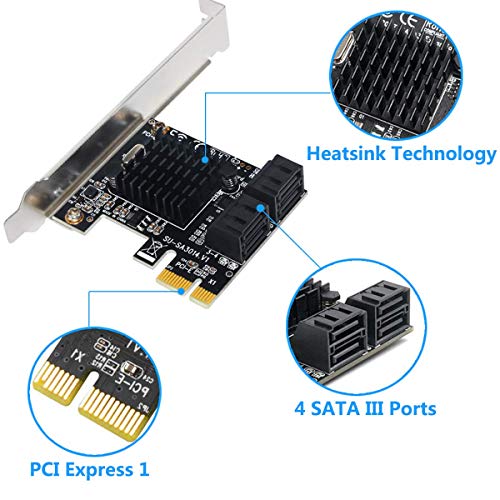
- ➤4 Ports Adapter Card --- You could add 4 6Gb/s SATA 3.0 devices to your computer with this PCIe SATA card.
- ➤Chipset --- With using The Marvell 88SE9215 chip,more stable and compatible.Port Multiplier FIS-based and Command-based switching supported.
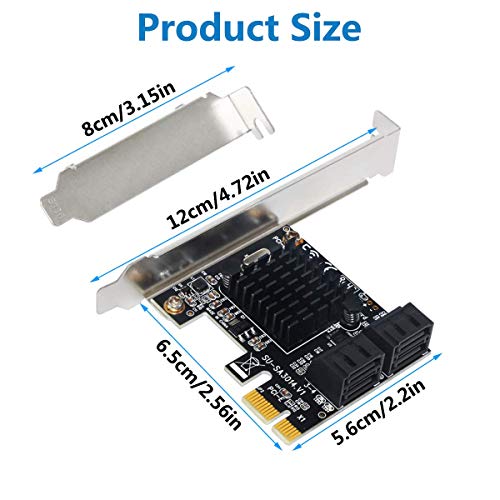
- ➤For All PCs --- With a low profile Bracket and 4 SATA Cable,compatible with 99% size chassis on the market.
- ➤System Support --- Connect 4 large capacity storage devices at the same time. Compatible with Windows XP / 7 / 8 / 10 / MAC / NAS / Linux OS / Driver: http://www.ziyituod.net/ProDetail.aspx?ProId=110
-
Information
-
Twitter
-
Pinterest
-
Youtube
-
Facebook
Pinky Quiban
Great device because it works and needs no extra drivers
I had an 8-port SATA 3.0 card. It came with drivers but didn't explain which version of the two sets of drives that came on the CD. Anyway, Windows 10 found some drivers for it and it worked for the most part. I still had an issue with the fact that all of the hard drives on this card showed up in Windows 10 as removable/portable drives, which was a pain. Each one could be ejected even though they were installed inside my PC. However, my motherboard as 10 sata ports on it and two sata controllers, which two ports on the second sata controller. Those two port also showed up as removable/portable drives, even though they are installed inside the PC. After a lot of searching on the internet for a solution, I finally found a registry mod that would allow those drives to be set to not show up as portable in Windows 10. That worked for the ports on the card, but the two ports on the motherboard didn't work. So, for those, I tried to update the BIOS in the computer. Unfortunately, after doing that, they computer would not longer boot up with the 8-port sata card installed. That lead to me getting two of these 4-port cards. My computer boots fine with these and I know have 8 extra sata drives installed in addition to the 10 sata drives on the motherboard (only 8 of these are hard drives, the other two are the boot SSD and a Blu-ray player). What I like about this one this that no driver is needed. I will install a third one today and stop using those two sata ports on the motherboard that result in the two drives showing up an portable, ejectable drives in Windows 10. For anyone having similar problems with Windows 10 Pro showing your sata drives as portable/ejectable drives, there is the solution I found on the internet: I had the same problem but only had one drive. I found this in another forum and decided to save it. If Kbird's solution does not work try navigating to HKEY_LOCAL_MACHINE\SYSTEM\ControlSet001\Services\storahci\Parameters\Device in the registry. Once you are on the Device Key, In the right hand plane, right click and create a new Multi-String Value Name the new value TreatAsInternalPort Double click the new value to edit it. In the Value Data section, start with 0 then 1 2 3 depending on how many ports you have. The trick here is they must be numbered vertically. The value data section will look like this: 0 1 2 3 4 5 6 7 8 9 10 11 The example will work for twelve ports. It is important that you add a separate line for each port. This what I 'm using on Windows 10 Pro version 1809. Also, this is a registry edit so DO NOT DO THIS if you are not comfortable doing registry edits as this kind of thing could potentially trash your computer. Backups should be made first. Obviously, someone with nearly 20 SATA devices is probably not going to be a computer rookie. :)
Yoseph Shiferaw
Great, easy setup with FreeNAS
I've been using this SATA adapter in my FreeNAS box with 4 drives attached. Absolutely no complaints. Drivers were handled automatically, which is to be expected as it has a Marvell 88SE9215. Would recommend for anyone on FreeBSD/FreeNAS looking for an easy way to add more ports.
Jacqui Cooper
Yay! More SATA ports!!
My X370 motherboard running Win10 has been maxxed out with drives but the temptation to scoop up some SSD's for certain tasks is just too hard to pass up with these prices. So rather than debating about which drive to pull, luckily this PCIe SATA card provided 4 extra ports. So it was pretty much a no brainer. Connected the unit, the OS picked it up without any issues, and I began to migrate some VM's on my dinky SSD to the 1tb SSD which is connected to this new PCIe card. Enclosed is the photo of the transfer rate between SSD's. Averaged 267 MB/s which I'm satisfied with. So literally the mount of time it took to write up this review was about the same amount it took to install the card and connect the drive. Definitely recommend giving it a go.
Anita Andriash
works great
speeds are good. small in a good way. plug and play for me with z270 i7 6gen. i did have to purchase long sata cords. little extra reach considering this is placed by your lower end of mobo. i used a air 540 case. medium sized cubes case. highly recommended for the best cooling in a case ever. i had a raid sas sata controller in before this. did not run in raid so no need. plus older controller did this initializing thing right when you start pc took like 30 seconds. my pc starts up in about 4 seconds. so that was annoying. with this you have no pre start up screens
Felixia Marie Santiago
Plug and Play
Was able to install this on my MSI B450 Gaming Pro Carbon AC AM4 ATX AMD Motherboard and Windows 10 picked it up right away. I only attached HDD's to this device but I was able to reach the max speed for the drive without issues or degradation. The SATA controller card has been working in my machine for about a month now without issues. Great product as it comes with x4 SATA cables and tools for you to fully get started. Highly recommended!
Keith Wages
Great extension with one caveat for SSD
Ordered this a little while ago because I was getting a couple new SSDs and had no room to install them on my onboard SATA slots. Now, there is a problem with SSD: the transfer speed is limited to 400mbs. That includes everything: write, read. And it is shared between the drives you connect. It will dramatically limit the whole idea behind having an SSD: achieving high speeds. Personally I just rewired the couple "older style" HDDs so they attach to this expansion card, and connected the SSDs to my onboard SATA. It works great! I'm achieving great speeds, didn't have to abandon my older backup drives. I'm completely satisfied with my purchase.
Andres Romero
Saved me form replacing entire setup
Great card, and works perfectly. It saved me form replacing my entire setup. I have an old Mini Itx custom build PC, which I use as a Home server, NAS, and media center. Perhaps I had a voltage spike, and I had to replace my PSU, but even then I found my motherboard cannot recognize my SSD drives anymore, seemed the surge damaged something else too. I spent good amount of time of trying different options, updating bios and ssd firmware... Nothing helped and I was debating between investing in new motherboard (and thus new CPU, Ram) or booting form slow USB 2.0 (yes, motherboard is that old).. As motherboard seemed working perfectly besides recognizing SATA devices, I decided to give a try to PCIe SATA card. And it worked!!! I was so relieved, as I got attached to my little box, I wasn't ready to just throw it, not saying about spending $$ on new media server setup. I didn't test whether RAID works (I use a software solution instead), but all 4 SATA ports work well together. And nice part it's SATA 3 (motherboard was Sata 2), cannot leverage it fully as other components kinda old for that, but subjectively it feels faster with shorter boot times. If you have a slim case with tight space (like mine) you mint need to get also flexible PCIe extender. ( the picture shouws the card w/o extender, still waiting for it to arrive. )
De Guzman Dyan
A solid product.
Owned for 40+ days now and it performs just as advertised. It gets roughly the 500 mbps transfer rate of the PCIe x1 port, but be aware, that is for all the drives plugged in at once. The odds of using multiple drives simultaneously are low since it's an add on card, but be aware that the transfer does cap at 500 mbps at once for all devices hooked in. It's not a limit of the hardware on the card, it's a limit of the connection to the motherboard. So don't expect to hook up 4 ssd drives and run them all at once at full speed. but for normal mechanical drives, it's more than enough overhead.
Crystal Love
Plug and play in Windows 10
I needed to add a new Seagate 8TB drive to my PC running Windows 10 on an AMD Ryzen 7. Shutdown, powered off, removed the cover. I have a case with card clips, instead of screws, so I flipped one off and pulled out the blanking plate. Plugged in two SATA cables then plugged in the card and snapped the latch down. I routed the cables to the drive, and the front panel which I hadn't connected before. Closed up and booted. Windows recognized the controller and handled it, then found the front panel interfaces and the hard drive. Everything just worked. I added the drive and copied 3TB of movies to it. The card is trivial to install and works perfectly.
Marvin Mesa Midem
Windows 10 x64 Plug n Play
I have a large Case Labs box and already had all the SATA inputs tied up on my Asus Hero VIII board. So I popped this card into an open x1 pcie slot with 3 HDD's connected and they showed up on bootup (2x8TB & 1x2TB HDD's). The sata III drive transfer speeds measure =/> than the motherboard sata ports so I'm happy. The card has 4 sata ports so I've got a spare until I buy that next HDD. Haven't had it long enough to gauge reliability, but for sure it functions as advertised right out of the box, no driver install no hassle.